
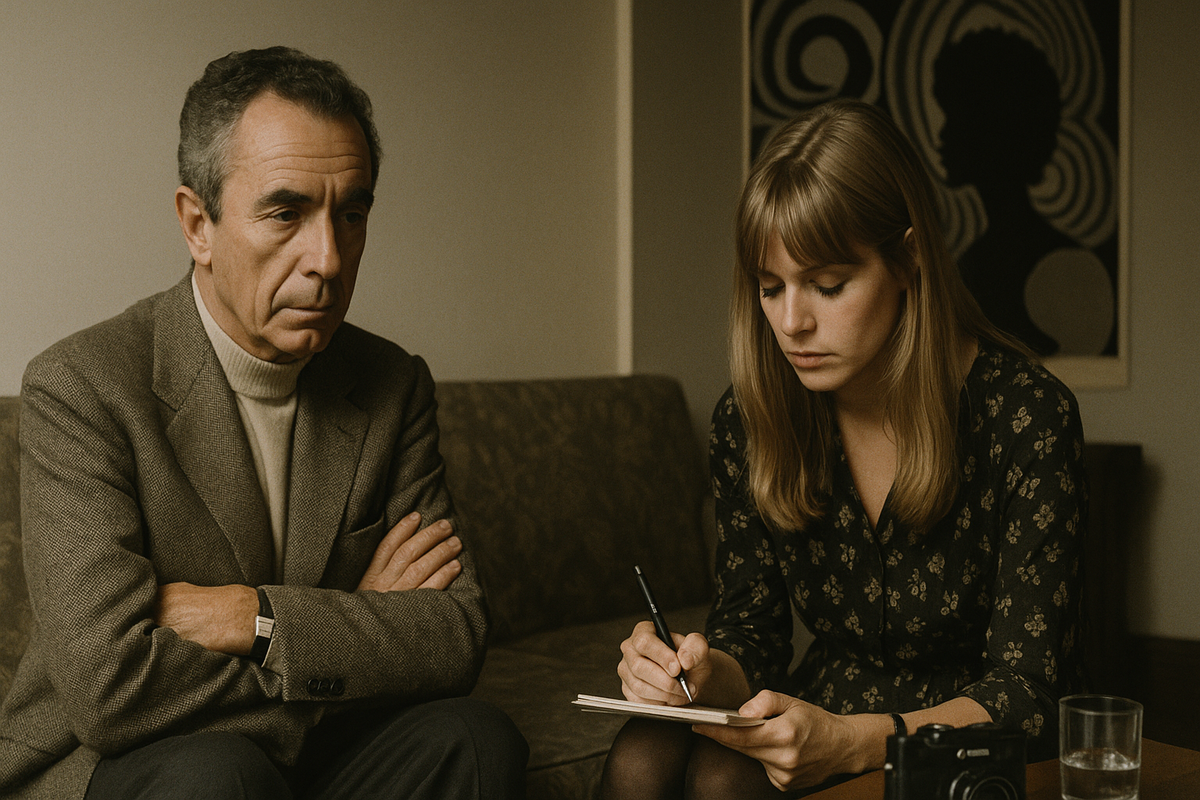
The Night Michelangelo Antonioni Explained Alienation to America—Through the Pages of Playboy
How the November 1967 issue became an unlikely monument to existential cinema, psychedelic culture, and the contradictions of the Sexual Revolution
November 1967. While the Haight-Ashbury district dissolved into bad acid trips and the Vietnam War shredded the social contract, America's most unlikely intellectual salon was being assembled between photographs of women in various states of undress. Hugh Hefner's Playboy Magazine—derided by feminists, condemned by clergy, devoured by millions—published what remains one of the most penetrating conversations about modern alienation ever given to an American audience: a full-length interview with Michelangelo Antonioni.
The Italian master of cinematic emptiness had just scandalized and mesmerized audiences with Blow-Up (1966), a film about a fashion photographer who may or may not have witnessed a murder in a London park. The movie's ambiguous ending, languid pacing, and infamous orgy scene made it a sensation. But Antonioni wasn't interested in scandal. He was interested in something far more unsettling: the possibility that modern life had made genuine human connection impossible.
Playboy gave him twenty pages to explain why.
Archive Details
Historical Figure: Michelangelo Antonioni (1912–2007)
Issue Date: November 1967
Archive Source: Playboy Magazine
Cultural Context: Summer of Love, Psychedelic Movement, Sexual Revolution
When the Cocktail Party Met the Art House
By 1967, Playboy had engineered something unprecedented in American publishing: a magazine that treated its readers as both sensualists and intellectuals. The formula worked because it refused to apologize for either impulse. You could read Norman Mailer's latest essay, study the Playboy Advisor's recommendations on stereo equipment, and encounter pictorials that pushed the boundaries of what mainstream America would tolerate—all in the same sitting.
The November 1967 issue crystallized this editorial alchemy. The cover photograph—a woman in a backless white gown embracing a shadowed partner—suggested eroticism through composition rather than exposure. It was elegant, European, knowing. Inside, the table of contents promised "Sex and Psychedelics," "The History of Stag Films," and the crown jewel: an exclusive conversation with the director whose films made La Dolce Vita look like a romantic comedy.
For American readers still processing the cultural shockwave of Blow-Up, the timing was perfect. Antonioni's earlier masterworks—L'Avventura (1960), La Notte (1961), L'Eclisse (1962)—had been art-house rarities, studied by critics and ignored by general audiences. But Blow-Up had gone mainstream, largely because it featured a writhing sequence with two naked models and David Hemmings. Audiences came for the scandal. What they got was an education in existential dread.
The Playboy interview gave Antonioni the platform to clarify what he'd been doing all along.
The Architecture of Emptiness
Antonioni spoke with the precision of a surgeon and the weariness of a prophet. His subject was simple: modern life had created material abundance and spiritual bankruptcy. His films were diagnostic tools, not entertainments.
On the collapse of intimacy: He described contemporary relationships as structures held together by inertia rather than passion. Marriages persisted not because of love but because of the terror of loneliness. His characters moved through luxurious apartments and fashionable parties like ghosts, physically present but emotionally absent.
On the psychedelic moment: When asked about LSD and the youth movement's embrace of consciousness expansion, Antonioni was neither dismissive nor celebratory. He understood drugs as a symptom, not a solution—evidence that a generation sensed something fundamentally wrong but lacked the vocabulary to name it. His films provided that vocabulary.
On cinematic language: He explained his aesthetic—the long takes, the silences, the refusal of narrative closure—as an attempt to capture existence itself rather than dramatized versions of it. Plot was a simplification. Life unfolded in ambiguities, missed connections, and questions without answers. Cinema, he argued, should do the same.
On technology and alienation: The modern world promised liberation through progress. What it delivered was isolation in comfortable rooms. His characters had everything except what mattered: the ability to touch and be touched by another human being.
This was not the kind of content typically associated with a magazine featuring the Playmate of the Month. That was precisely the point.
Why Playboy Mattered More Than You Think
It's easy to reduce Playboy to its most obvious component and move on. That's a mistake. Throughout the 1960s, Playboy conducted some of the most important long-form interviews in American journalism. Miles Davis, Malcolm X, Orson Welles, Jean-Paul Sartre—they all sat for Playboy because the magazine offered something rare: space, sophistication, and a massive audience.
The Antonioni interview represents Playboy at its most ambitious. No other mainstream American publication would have given twenty pages to a European filmmaker discussing the spiritual crisis of modernity. Time and Life wanted stories. Esquire wanted wit. Playboy wanted conversation—the kind that happened at 2 a.m. when the party had thinned out and the remaining guests were finally saying what they actually thought.
The magazine's genius was understanding that its readers contained multitudes. They wanted beautiful women and serious ideas. They wanted pleasure and meaning. Playboy refused to make them choose.
What Antonioni Saw (And What We're Still Living)
Looking back at the November 1967 interview, what's startling is how precisely Antonioni diagnosed problems we're still struggling to articulate. His characters, drifting through relationships mediated by surfaces and transactions, look remarkably like us—scrolling through feeds, swiping through options, feeling vaguely empty in rooms full of connection.
He understood that alienation wasn't a bug of modern life but a feature. Capitalism produced wealth but required the destruction of the organic communities and relationships that once gave life meaning. Technology promised communication but delivered isolation. Freedom meant the anxiety of endless choice in a world where nothing felt quite real.
His films didn't offer solutions because he didn't believe solutions existed. Cinema's role, he insisted, was to witness—to hold up a mirror to the emptiness without flinching.
Key Themes from the Interview
The Fragility of Modern Love
Antonioni observed that marriages and relationships often persisted not out of true intimacy, but out of fear of loneliness—a diagnosis that feels painfully contemporary.
The Role of Cinema
He insisted that film must go beyond plot to capture the rhythms of real existence, even if it meant embracing ambiguity and silence.
Alienation as the Modern Condition
His characters reflected a truth he believed was universal: modernity had created wealth but stolen intimacy.
The Youth Movement
He recognized that the counterculture's embrace of drugs, freedom, and rebellion was both a response to and a symptom of the crisis of meaning in modern society.
Where Playboy Stands Now
The magazine's cultural position has shifted dramatically since 1967. What once seemed transgressive now appears quaint. But the interviews remain. They're artifacts of a moment when American popular culture was genuinely grappling with difficult ideas, when a men's magazine could function as a legitimate intellectual forum without apology.
The Antonioni interview, in particular, endures because it captured something essential about the 1960s: the sense that all the old certainties were collapsing, that relationships were being renegotiated, that art was searching for new forms adequate to the strangeness of modern experience.
Antonioni didn't have answers. But he asked the right questions. And Playboy, improbably, gave him the space to ask them.
The Collector's Case
Historical Significance
The Antonioni interview captures a pivotal filmmaker at the height of his international fame, speaking with unusual candor about his artistic philosophy.
Cultural Timestamp
The issue embodies 1967—the Summer of Love, the psychedelic explosion, the sexual revolution, cinema's philosophical turn. It's a primary document of the decade's contradictions.
Editorial Excellence
The cover design, the interview's depth, and the surrounding content represent Playboy at its most sophisticated.
Scarcity and Demand
Vintage Playboy issues featuring landmark interviews—particularly with major artistic figures—command serious attention from collectors of both cinema history and 20th-century periodicals.
To own this issue is to hold a time capsule. Not the sanitized, nostalgic version of the 1960s, but the real thing: messy, searching, brilliant, confused, and utterly alive.
Explore the Archive
For collectors and cultural historians, original issues of Playboy represent more than nostalgia—they're primary sources for understanding postwar American culture in all its complexity.
Browse Playboy Magazine CollectionEvery issue is an authenticated artifact, a window into the debates, aesthetics, and anxieties that shaped a generation.
The November 1967 Playboy Magazine remains what it was in 1967: a paradox wrapped in glossy pages. It offered sex and philosophy, provocation and seriousness, surface and depth. In its contradictions, it was perfectly American. In its willingness to let Antonioni speak at length about alienation and emptiness, it was perfectly suited to its moment.
Hold this issue today and you're holding 1967 itself—the year when everything seemed possible and nothing felt quite real.