
The Day the Dream Died: Inside Esquire's Autopsy of Altamont
When Ralph J. Gleason wrote the counterculture's obituary in August 1970
Four months after Woodstock crowned the 1960s as the Age of Aquarius, a California speedway became its graveyard.
When Esquire Magazine hit newsstands in August 1970, it delivered something unprecedented: not a concert review, but a cultural death certificate. Ralph J. Gleason's searing essay on the Altamont Free Concert wasn't journalism—it was a coroner's report on the counterculture itself.
The Rolling Stones had promised a free show to cap their American tour. What they delivered instead was chaos, violence, and the fatal stabbing of 18-year-old Meredith Hunter by Hells Angels hired as security. Gleason's article, anchored by unflinching photography, became the first major publication to ask the question no one wanted to answer: What happens when utopia collapses in real time?
This wasn't Rolling Stone magazine processing its own mythology. This was Esquire—sophisticated, literary, unsparing—turning its gaze on rock culture and declaring the party over.
Historical Context
Publication: Esquire Magazine
Issue Date: August 1970
Featured Writer: Ralph J. Gleason
Editor: Harold Hayes
Subject: The Altamont Free Concert, December 1969
Woodstock's Shadow
August 1969 had been a triumph. Over 400,000 people gathered in upstate New York for three days of music that seemed to vindicate every hope the counterculture had held. Against the grinding backdrop of Vietnam, racial tension, and political fracture, Woodstock offered proof: a generation could build something better.
Altamont was supposed to echo that achievement. Instead, it exposed every fault line Woodstock had papered over.
Hastily organized. Undersupplied. The Hells Angels—paid in beer—patrolling the crowd with pool cues. When Meredith Hunter, a young Black man, allegedly drew a gun during the Stones' set, the Angels descended. The stabbing was captured on film. The footage would later anchor the documentary Gimme Shelter, but it was Gleason's words in Esquire that gave the tragedy its meaning.
This wasn't a tragic accident. It was a reckoning.
Esquire's Moment
By 1970, Esquire had transcended its origins as a men's lifestyle magazine. Under editor Harold Hayes, it had become a laboratory for New Journalism—literary, bold, unafraid to wrestle with uncomfortable truths. Tom Wolfe. Norman Mailer. Gay Talese. The magazine didn't just report culture; it interpreted it with a novelist's eye and a philosopher's rigor.
Gleason's Altamont piece fit perfectly into this tradition. He didn't simply recount what happened at the speedway. He diagnosed what it meant—the fragility of idealism, the violence lurking beneath the peace-and-love veneer, the uncomfortable racial subtext of a Black teenager dying at the supposed apex of hippie brotherhood.
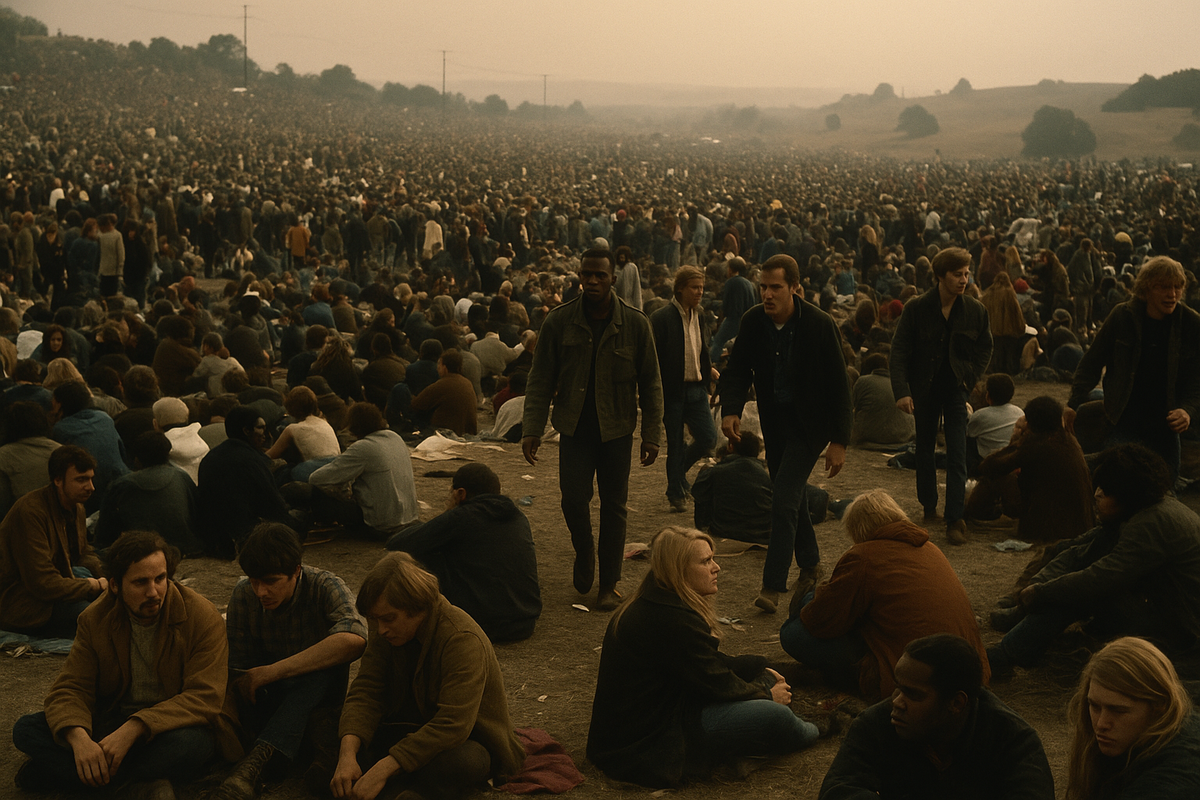
The visuals amplified the horror. Aerial shots revealed the overwhelming crush of humanity. Sequences captured the buildup to violence, the explosion, the aftermath. Close-ups showed faces drained of joy—anxiety, shock, fear replacing the blissed-out smiles of Woodstock's photo spreads.
Where other publications might have softened the blow, Esquire leaned in. The magazine understood that style and truth weren't opposites—they were partners in bearing witness.
What Gleason Saw
The essay dissected several uncomfortable realities:
The Collapse of Utopia
Poor planning and wishful thinking don't build sustainable communities. They build powder kegs.
Race in the Counterculture
That Meredith Hunter—a young Black man—became Altamont's casualty while surrounded by thousands of white flower children raised questions the movement had avoided.
The Rolling Stones as Mirror
The band electrified crowds but also soundtracked their unraveling. They wanted to be dangerous. Altamont showed what danger actually looked like.
The End of an Era
No manifesto or protest could have drawn the line more clearly. The 1960s ended at Altamont. The 1970s—jaded, cynical, uncertain—began there.
Why This Issue Matters
The August 1970 Esquire isn't just a magazine. It's a primary source—one of the first major publications to process Altamont while the blood was still fresh. Unlike later retrospectives shaped by decades of analysis, this issue captures the raw shock of the moment.
The Esquire Difference
What separated Esquire from its competitors was its refusal to choose between sophistication and substance. It could profile jazz legends and dissect masculinity. It could celebrate style while eviscerating pretension. It published literature alongside cultural commentary, trusting its readers to handle complexity.
The Altamont issue exemplified this identity. Gleason's essay was both elegy and indictment, written with the urgency of someone watching ideals crumble in real time. Paired with Esquire's bold design sensibility—stark layouts, commanding photography, innovative typography—the result was journalism as art.
These magazines endure because they were never disposable. They were statements.
For the Collector
Historical Immediacy
This is how people first understood Altamont, before it became legend.
Iconic Documentation
The photographs remain among the most reproduced images of the era—studied in film schools, cited in documentaries, embedded in the visual memory of the late 1960s.
Rock History Cornerstone
Issues tied to the Rolling Stones, particularly those documenting watershed moments, command sustained collector interest.
Cultural Artifact
Owning this issue means possessing the moment when the counterculture confronted its own mortality. It's the obituary, printed and bound.
The typography, the photo spreads, the advertisements—everything captures 1970 as it actually looked and felt. Digital scans can't replicate the tactile experience of holding history as it was first delivered.
If you're building a collection of vintage Esquire issues, August 1970 isn't optional. It connects you directly to the Rolling Stones, to Altamont, to the final chapter of America's most convulsive decade.
This is a primary source, a cultural witness, a museum piece you can hold.
Coda
The August 1970 issue of Esquire Magazine stands as one of the most significant cultural documents of its era. Ralph J. Gleason gave words to what many already sensed: the dream was over. Woodstock's idealism had lasted a single season before drowning in blood and chaos at a California speedway.
Through fearless writing and haunting imagery, Esquire helped a generation process what had happened—and what it meant for everything that followed.
When you hold this issue, you're holding the moment the counterculture looked in the mirror and saw its own death. The 1960s didn't fade. They ended violently, all at once, under the California sun.
And Esquire was there to write the eulogy.
Explore the Archive
Browse our complete collection of original Esquire magazines and own a piece of cultural history.
Browse Esquire Magazine Collection