
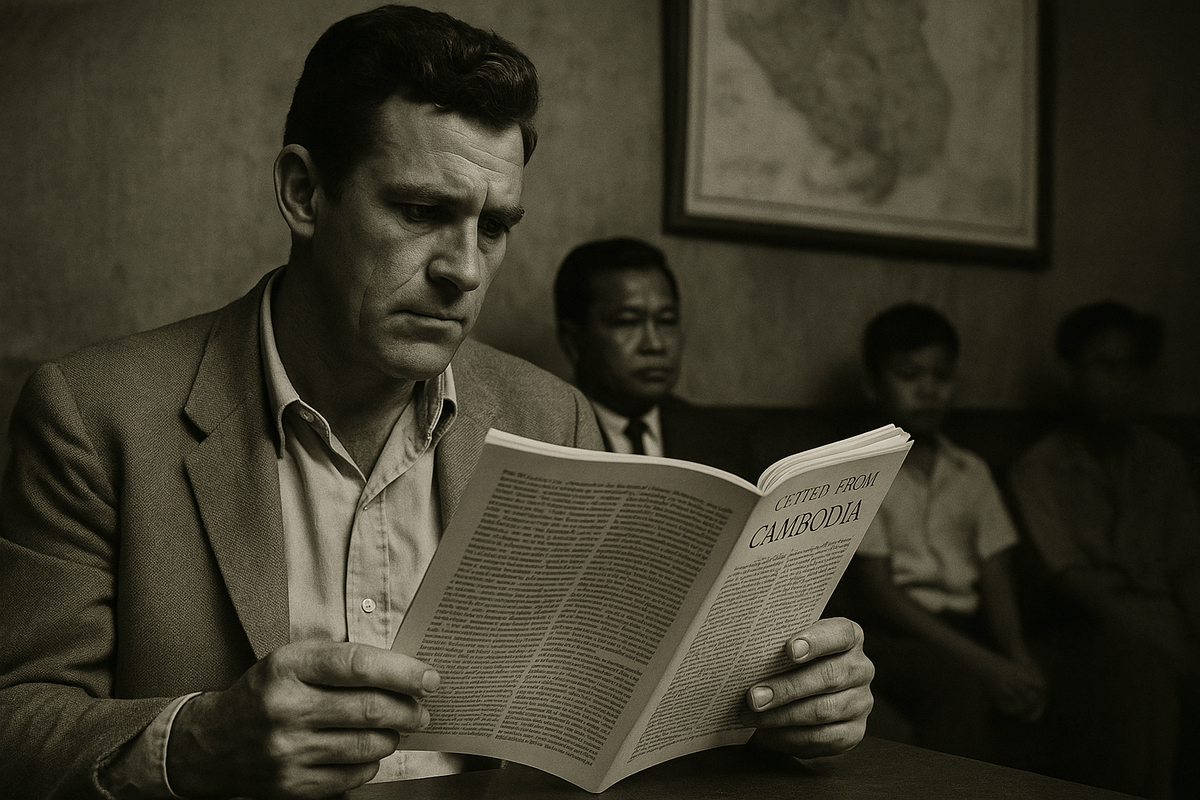
The Last Dispatch from a Doomed Kingdom
How The New Yorker's September 1966 Cambodia essay captured a nation's final act of survival—before the fall
On September 17, 1966, American subscribers opened their mailboxes to find something extraordinary tucked between advertisements and bills: a magazine that would transport them 8,000 miles east to witness a nation's final act of diplomatic survival. Inside that week's New Yorker sat "Letter from Cambodia"—a dispatch from Phnom Penh so prescient, so richly observed, that it now reads like a eulogy written before the funeral.
Three years later, Prince Norodom Sihanouk would be overthrown. Five years later, American bombs would carpet the Cambodian countryside. Nine years later, the Khmer Rouge would turn Cambodia into a killing field. But in September 1966, none of this was inevitable. Cambodia still clung to neutrality. Phnom Penh's French colonial boulevards still hummed with café society. And Sihanouk—part monarch, part showman, part survivor—still believed he could walk the tightrope between Washington, Moscow, Beijing, and Hanoi without falling.
The New Yorker captured that vanishing moment with surgical precision.
Archive Snapshot
Historical Figure: Prince Norodom Sihanouk, Cambodia's Head of State
Issue Date: September 17, 1966
Featured Article: "Letter from Cambodia"
Cover Artist: Saul Steinberg
Archive Source: Original New Yorker Magazine Collection
The Prince Who Juggled Superpowers
Prince Norodom Sihanouk was not a conventional Cold War leader. Where others pledged allegiance to one bloc or another, Sihanouk invented what he called "neutralism"—a high-wire foreign policy that treated ideology as negotiable and survival as sacred.
"Letter from Cambodia" dissected this strategy with the kind of intimate detail that distinguished The New Yorker from every wire service and newsweekly. While American television saturated living rooms with Vietnam combat footage, this essay offered something rarer: a portrait of the war's quieter front, where diplomacy, personality, and cultural memory collided in the shadow of encroaching violence.
The piece painted Sihanouk as equal parts theatrical and shrewd—a leader who understood that Cambodia's independence required performance as much as policy. He hosted film festivals and jazz concerts while secretly allowing North Vietnamese forces to use Cambodian border sanctuaries. He railed against American imperialism in public speeches, then privately courted U.S. aid. He played Mao against Johnson, Hanoi against Saigon, always calculating which gesture would buy Cambodia another month, another year, another breath.
By mid-1966, that calculation was becoming impossible. North Vietnamese troops treated eastern Cambodia as an extension of the Ho Chi Minh Trail. American military planners viewed Cambodian neutrality as complicity. The vise was tightening, and Sihanouk knew it.
Phnom Penh: Colonial Twilight in a War Zone
What made "Letter from Cambodia" remarkable was its refusal to reduce geopolitics to abstractions. The essay grounded Cambodia's crisis in physical space—in the pastel-colored villas, the Vietnamese-run cafés, the French restaurants where expatriates and diplomats still debated Sartre over wine.
Phnom Penh in 1966 existed in temporal suspension. The French had departed a decade earlier, but their architectural and cultural imprint remained everywhere: in the language of government, the layout of boulevards, the menus of restaurants. The city projected an odd serenity, a kind of willful obliviousness to the artillery fire audible from the Vietnamese border.
The New Yorker recognized this contradiction and used it as narrative tension. Phnom Penh was not just a capital under siege—it was a stage set, a beautiful illusion sustained by diplomatic theater and collective denial. The essay captured how fragile that illusion had become, how quickly calm could shatter into chaos when great powers decided a small nation's fate.
When Journalism Became Literature
The September 17, 1966 issue exemplified what made The New Yorker essential Cold War reading. This was not stenography. This was literary journalism—deeply reported, elegantly structured, willing to linger on cultural texture rather than rush toward conclusions.
While newspapers delivered Cambodia in bullet points and casualty counts, The New Yorker gave readers Cambodia as lived experience. The essay did not simply report Sihanouk's policies; it observed his contradictions, his vanities, his desperate cleverness. It did not just describe Phnom Penh; it conjured the city's atmosphere, the way colonial memory and Cold War dread coexisted on the same boulevards.
This approach demanded patience from readers—and trusted their intelligence. The New Yorker treated foreign policy not as a spectator sport but as a subject worthy of sustained attention, historical context, and moral complexity. That editorial philosophy is precisely why these issues endure when yesterday's newspapers disintegrate into irrelevance.
Steinberg's Postcard Collage: Fragile Connections
The issue's cover, drawn by Saul Steinberg, offered its own commentary. His whimsical collage of postcards and letters appeared playful at first glance—vintage stamps, overlapping envelopes, fragments of correspondence from distant places.
But the symbolism cut deeper. In 1966, as war fragmented Southeast Asia and Cold War allegiances hardened into binaries, Steinberg's image suggested something more fragile: the tenuousness of communication, the way distant conflicts reached American consciousness through scattered reports and filtered dispatches. The postcard collage was not decoration. It was editorial argument rendered in ink and paper.
Steinberg understood what The New Yorker's writers understood: that global events arrived in America not as coherent narratives but as fragments requiring assembly, interpretation, care.
Key Themes: The Deep Dive
Neutralism as Survival
Sihanouk's balancing act between superpowers—treating ideology as negotiable and independence as sacred in a world that demanded binary allegiance.
Colonial Memory
Phnom Penh's French architectural and cultural legacy creating an atmosphere of temporal suspension—a beautiful illusion amid gathering storms.
Literary Journalism
The New Yorker's approach to foreign correspondence—deeply reported, elegantly structured, treating readers as capable of sustained intellectual engagement.
Prophetic Witness
The essay's documentation of a vanishing political order—reportage that became prophecy, capturing Cambodia before the fall.
Why This Issue Matters to Collectors
Historical Urgency
Published at the precise moment when Cambodia's neutrality became unsustainable, the issue documents a vanishing political order. Within three years, everything described in "Letter from Cambodia" would collapse. The essay is both reportage and prophecy.
Literary Craftsmanship
This is The New Yorker at peak form—international journalism executed with novelistic attention to character, setting, and moral ambiguity. The essay rewards rereading in ways that conventional news reports cannot.
Steinberg's Artistry
The cover alone justifies acquisition. Steinberg's postcard collage ranks among his most thematically resonant works, a visual metaphor for Cold War-era communication and disconnection.
Cultural Artifact
Beyond its content, this issue embodies mid-1960s American intellectual culture—the assumption that citizens could and should grapple with foreign policy complexity, that magazines could serve as instruments of public education rather than mere entertainment.
The Archive That Remembers What We Forgot
Cold War-era magazines like this September 1966 New Yorker serve a function beyond nostalgia. They preserve the texture of historical moments before hindsight flattened them into inevitability.
We know now that Cambodia's neutrality failed, that Sihanouk's tightrope snapped, that the nation descended into nightmare. But in September 1966, Americans reading "Letter from Cambodia" encountered a Cambodia that still existed, still maneuvered, still hoped. The essay captured contingency—the sense that history had not yet decided, that different choices might yield different outcomes.
That perspective, that granular attention to a specific moment's texture and possibility, is what makes vintage journalism archival rather than disposable.
A Magazine That Saw What Was Coming
The September 17, 1966 New Yorker did not predict the Khmer Rouge. It could not foresee the devastation that would consume Cambodia within a decade. But "Letter from Cambodia" understood something fundamental: that small nations caught between superpowers rarely escape unscathed, that neutrality is a luxury great powers permit only until it becomes inconvenient.
Sihanouk's Cambodia was always doomed. The only question was when.
For one week in September 1966, The New Yorker gave American readers a chance to see that nation before it vanished—to understand not just what happened, but what was lost. That act of witness, that insistence on complexity and humanity in the face of geopolitical abstraction, is why this issue remains essential reading nearly six decades later.
Some journalism ages into irrelevance. This issue aged into requiem.
Access the Collection
Thousands of original New Yorker issues spanning the 1920s through the late 20th century are available for collectors, researchers, and enthusiasts of literary journalism. From Cold War dispatches to cultural criticism, from iconic covers to groundbreaking fiction, these magazines document American intellectual life at its most ambitious.
Browse The New Yorker Magazine Collection