
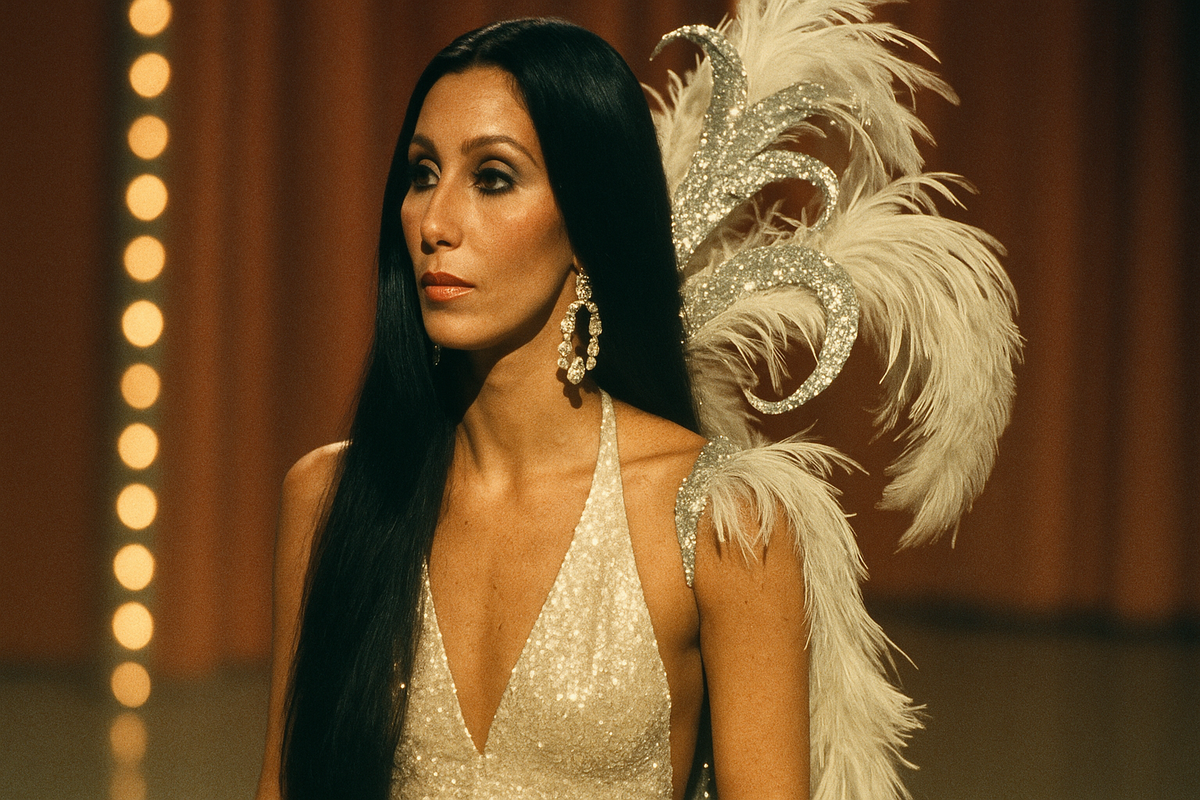
Cher, Stardom, and the Redefinition of Fame in 1970s America
When Time Magazine put a single name on its cover, it captured more than a celebrity—it documented a cultural revolution.
The woman on the cover didn't need a last name.
When Time Magazine hit newsstands on March 17, 1975, the single-word cover line—"Cher"—said everything. No context. No qualification. Just a name that had become shorthand for something larger: a cultural shift happening in real time, broadcast into American living rooms every week, wrapped in sequins and defiance.
This wasn't a profile of a singer or a TV personality. It was Time documenting the arrival of a new species of celebrity—one who could divorce her creative partner, commandeer prime-time television, and turn costume changes into cultural statements. For readers across America, the issue marked something else: proof that a woman could control her own reinvention, publicly and unapologetically, in an era when the rules were still being written.
Archive Details
Featured Subject: Cher (Cherilyn Sarkisian)
Issue Date: March 17, 1975
Publication: Time Magazine
Cultural Context: Post-Watergate America, height of 1970s variety television, feminist movement
The America That Made Cher Possible
The timing wasn't accidental. By March 1975, America was still nursing its Watergate hangover. Nixon had resigned eight months earlier, and the nation's faith in institutions—government, media, authority itself—had cratered. Into that vacuum stepped a different kind of public figure: unfiltered, human-scaled, and refreshingly transparent about the messiness of their lives.
Cher embodied that shift. While politicians dissembled, she was filing for divorce on the front pages. While the establishment clung to respectability, she showed up on CBS in Bob Mackie creations that blurred the line between fashion and provocation. The feminist movement was challenging every assumption about what women could be, and Cher—independent, glamorous, contradictory—became an unlikely ambassador for that new visibility.
Television had become the dominant cultural force. Variety shows commanded audiences in the tens of millions. The medium had outgrown its role as radio's flashy younger sibling and had become the place where American identity was negotiated. Cher's variety series wasn't just entertainment—it was a weekly seminar in self-invention, where the wardrobe was as important as the vocal performance.
The music industry was in flux, too. Folk-pop had given way to disco, rock was fragmenting into subgenres, and genre boundaries were collapsing. Cher's career trajectory mirrored that chaos: from Sonny & Cher's wholesome duets to solo stardom that required her to find her own voice, literally and figuratively.
Against this backdrop, Cher's rise felt inevitable and impossible at the same time.
When Pop Culture Became News
By 1975, Time had stopped pretending that politics and policy were the only subjects worth serious attention. The magazine was chronicling culture with the same rigor it brought to foreign affairs. The Cher cover story was proof.
The cover itself was a study in contrasts: Cher's face, framed by that signature jet-black hair, set against a stark background. No props. No gimmicks. The simplicity amplified her presence, signaling that she had graduated from being Sonny's partner to being her own phenomenon.
Inside, the photography told the story Time's prose couldn't. Cher in sequined headdresses. Cher in feathered gowns. Cher in costumes that seemed engineered to provoke conversation. These weren't just fashion shots—they were evidence of spectacle as strategy, proof that Cher understood something fundamental about television: the medium rewarded audacity.
The editorial tone walked a careful line. Time was sharp enough to note Cher's business acumen—her contracts, her ratings dominance, her cultural currency—while also treating her as a subject worthy of psychological inquiry. The article explored her resilience, her navigation of divorce and public scrutiny, her refusal to conform to the traditional molds of female stardom.
This was the magazine treating pop culture as a beat that mattered.
The Narrative Time Told
From Outsider to Icon
The article traced Cher's trajectory from her California childhood—outsider, misfit, improbable candidate for Hollywood success—to her position as one of the most bankable names in television and music.
The Sonny Dynamic
Time didn't shy away from the Sonny & Cher partnership. But Cher's separation was framed as liberation, a necessary shedding of partnership in favor of solo flight.
Television Spectacle
Her CBS variety series was described as part music, part comedy, part runway show. Cher's costumes had become events unto themselves, sometimes eclipsing the performances.
Feminist Undercurrent
Cher's choices—divorce, professional independence, single motherhood—aligned with the decade's conversations about women's autonomy. She was living the questions the movement was asking.
Time also acknowledged the cost. The article detailed the grind of stardom: punishing schedules, failed relationships, tabloid scrutiny. Yet it emphasized Cher's capacity to endure, to absorb the chaos and keep moving. Resilience wasn't incidental to her story—it was the story.
Why This Issue Mattered
The March 17, 1975 issue represented a shift in how Time understood its mission. By putting Cher on the cover, the magazine signaled that celebrities weren't just entertainers—they were cultural barometers, reflecting the national mood and aspirations.
This was new territory. Women in entertainment had always been "stars," but they hadn't been analyzed as forces shaping the culture itself. Cher, with her contradictions and her command of the spotlight, became a case study in what post-Watergate America wanted: authenticity, even if it was performed; independence, even if it was marketed; glamour that didn't apologize for itself.
The issue marked a moment when pop culture stopped being trivial and started being essential.
Why It Endures
Time's coverage of Cher in 1975 still resonates because it treated her as unfinished business—evolving, daring, impossible to pin down. That's exactly why Cher has remained relevant for five decades, and why this issue retains its value.
Unlike disposable tabloid coverage, Time offered serious journalism mixed with vivid imagery, creating a permanent record of how a generation understood its icons. The article didn't try to solve Cher or reduce her to a simple narrative. It let her contradictions stand.
That approach has aged remarkably well.
The Collector's Perspective
Pop Culture Significance
Cher was at the apex of her influence, navigating a moment of professional and personal reinvention. The issue captures that inflection point—the divorce finalized, the solo career ascending, the public fascinated.
Iconic Photography
The cover portrait remains iconic, and the interior spreads—those costume shots, those Mackie creations—are among the most memorable Cher images of the decade.
Crossover Appeal
The issue resonates beyond magazine collectors. Music historians, fashion enthusiasts, and students of 1970s culture all find value here. Cher's fanbase ensures continued demand.
Cultural Artifact
Owning this issue means holding a primary source from an era when television and music were reshaping identity, gender, and the nature of fame itself. It's not memorabilia. It's evidence.
Building a Collection
If you're assembling an archive of vintage magazines, the March 17, 1975 Cher issue of Time Magazine isn't optional—it's foundational. It captures not just a performer but the entire climate of mid-1970s America.
Browse Time Magazine CollectionThe March 17, 1975 issue remains one of the most significant pop culture covers Time published in the 1970s. It documented not just the rise of a performer but a broader redefinition of celebrity, gender, and entertainment in America.
Holding this issue now is like accessing a moment when sequins, feminism, and prime-time television collided—and one woman stood at the center, rewriting the rules in real time.
For anyone who values primary sources, vintage Time magazines like this aren't collectibles. They're artifacts of the cultural revolutions that shaped the world we inherited.