
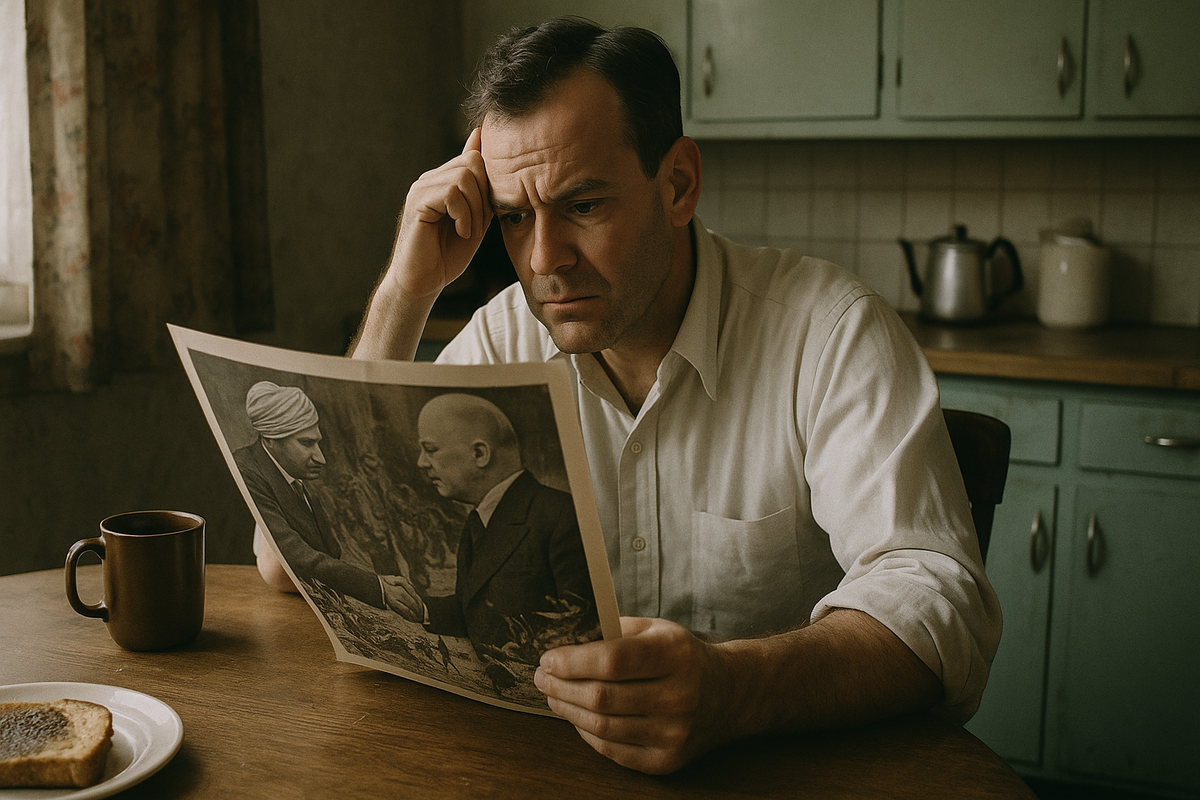
The Magazine America Read on the Eve of War
Stewart Alsop's March 1950 alarm and the Saturday Evening Post issue that captured a nation at the crossroads
On March 11, 1950, millions of Americans sat down with their Saturday Evening Post and discovered they were losing a continent.
Stewart Alsop's article—"We Are Losing Asia Fast"—appeared three months before the first shots of the Korean War. For families reading in their living rooms, this wasn't geopolitical theory. It was a forecast of their sons' futures. The issue they held represented the exact moment American anxiety transformed into action, when magazine journalism became the drumbeat for a generation of foreign policy.
Today, this issue stands as one of the most historically significant Post publications of the Cold War era—a document that captured not just what Americans thought, but what they feared.
Archive Details
Featured Article: "We Are Losing Asia Fast" by Stewart Alsop
Publication: The Saturday Evening Post, March 11, 1950
Cover Artist: Amos Sewell
Historical Context: Published three months before the Korean War
The World on Fire
The Second World War had ended five years earlier, but 1950 offered no peace dividend. China had fallen to Mao Zedong's Communist forces in October 1949—a psychological blow Americans called "the loss of China," as if a nation of 500 million had been misplaced. Now Alsop was reporting from the frontlines of what came next.
His dispatch painted collapse in real time. Shanghai, the cosmopolitan jewel of Western commerce in Asia, was now under Communist control. The French were hemorrhaging authority in Indochina. Burma teetered on the edge of anarchy. Prime Minister Jawaharlal Nehru's India, skeptical of Western motives, was charting an independent course that looked dangerously neutral.
Alsop's thesis was blunt: Soviet influence was spreading from Europe to the Pacific, and America had one narrow window to respond before the entire continent shifted out of reach.
This was the Domino Theory before it had a name.
Journalism as Policy Engine
Stewart Alsop wasn't just observing history—he was shaping it. His reporting from Asia carried weight in Washington. When he warned that communism was cleverly aligning itself with anti-colonial nationalism, he was explaining why Moscow was winning while the West looked like yesterday's empire.
The article's power lay in its specificity. Alsop didn't traffic in abstractions. He described meetings with Nehru, analyzed the weakness of Burma's infrastructure, and included photographs of Soviet diplomat Andrei Vishinsky shaking hands with Indian officials—visual proof that the Cold War was being fought in embassy halls as much as on battlefields.
For Post readers, this wasn't foreign correspondence from a distant world. It was a warning about their world, delivered with the authority of someone who'd been there and seen the machinery of communist expansion up close.
The Saturday Evening Post: America's Living Room
By 1950, The Saturday Evening Post had become the cultural arbiter of middle America. Published since 1821, it reached millions of households with a formula that balanced literary fiction, humor, and hard-hitting reportage. You could read C.S. Forester's latest Hornblower adventure, flip past a Norman Rockwell cover, and land on an analysis that would shape Congressional hearings.
The March 11 issue exemplified this range. Alongside Alsop's geopolitical alarm, readers found short stories titled "Lonely Honeymoon" and "Hurricane Wedding," C.S. Forester's novelette "The Capture of Hornblower," and essays on American culture and domestic life.
This wasn't schizophrenia—it was the magazine's genius. The Post understood that Americans wanted both escape and engagement, that the same household consuming fiction about romantic getaways also needed to understand why their tax dollars were flowing to Asia.
The blend made complex foreign policy feel accessible. Millions who might never read Foreign Affairs or State Department cables read Stewart Alsop in the Post.
The Cover: Innocence Armed
Amos Sewell's cover for this issue depicts neighborhood boys in full cowboy theater—toy pistols drawn, staging gunfights on American streets. The scene radiates innocent play: children lost in Wild West fantasy, acting out the mythology of frontier justice.
But placed against Alsop's article, the image acquires a second meaning. Here was America's self-image in miniature—a nation that saw itself as perpetually ready, rugged, prepared to defend what it valued. Even children's games rehearsed readiness.
Sewell's covers, like those of his more famous colleague Norman Rockwell, didn't just decorate the Post—they defined American aspiration. This particular cover, with its mix of childhood innocence and mock combat, captured the duality of 1950: nostalgia for simpler times colliding with awareness that dangerous years lay ahead.
What Alsop Actually Said
The core arguments of "We Are Losing Asia Fast" would prove prophetic:
Alsop made clear that Mao's victory wasn't temporary chaos—it was the loss of Asia's demographic and strategic heartland.
The city that had embodied cosmopolitan Western culture in Asia was now a Communist showcase. For readers, this wasn't abstract—Shanghai meant something.
Years before American combat troops arrived in Vietnam, Alsop predicted French colonialism couldn't hold. Vietnam, Laos, and Cambodia were vulnerable, and their loss would cascade across Southeast Asia.
Alsop understood what many American policymakers missed: Soviet ideology was succeeding because it aligned with anti-colonial movements. The West looked like the old oppressor; Moscow looked like the liberator.
With minimal infrastructure and political instability, Burma represented low-hanging fruit for communist expansion.
India's prime minister, as Alsop reported, saw both Western imperialism and Soviet communism as foreign impositions. His non-alignment frustrated American strategists but made perfect sense in New Delhi.
Moscow wasn't rushing—it was exploiting every opening, backing nationalist movements, and waiting for the West to exhaust itself.
Alsop's language carried genuine urgency: act decisively now or lose Asia entirely.
These weren't guesses. This was reporting that anticipated the next two decades of American foreign policy—from Korea to Vietnam to the broader Cold War competition across Asia.
The Voice of 1950
What makes this issue endure is its capture of a specific American mood: anxious but not panicked, alert but not yet committed, still believing that clear-eyed analysis and decisive action could change outcomes.
Stewart Alsop wrote with the confidence that words mattered, that reporting could shape policy, that an informed public would demand appropriate action. The Saturday Evening Post published him knowing their readers wanted both to understand their world and to be entertained by it.
That combination—serious journalism wrapped in accessible culture—made the Post essential reading. And on March 11, 1950, it made this particular issue a document of American purpose at a crossroads.
Why This Issue Matters Now
Historical Inflection Point
Published three months before North Korea invaded the South, this issue captures America at the edge of the cliff, not yet in freefall. It documents the thinking that would lead to decades of military engagement in Asia.
Primary Source Authority
For historians studying how Cold War policy was communicated to the public, this issue is essential. It shows how mass-market journalism translated complex geopolitics into middle-American alarm.
Cultural Artifact
The combination of Alsop's warning and Sewell's innocent cover art illustrates how Cold War anxiety penetrated every level of American life—from children's play to dinner table conversation.
Collector Scarcity
Issues from 1950 featuring major geopolitical commentary by figures like Stewart Alsop are increasingly difficult to find in good condition. As the generation that lived through this era passes, these primary documents grow more valuable.
Artistic Merit
Amos Sewell covers carry significant worth among illustration collectors, particularly those depicting quintessentially American scenes from the mid-century period.
Educational Value
For anyone studying Cold War America, media history, or the cultural mechanics of foreign policy, this issue offers irreplaceable insight into how millions of Americans learned they were entering a new kind of war.
Own a Piece of Cold War History
Original issues of the March 11, 1950 Saturday Evening Post are available to collectors, historians, and enthusiasts who want to hold this moment in their hands. These aren't reprints or digital scans—they're the actual magazines that sat on American coffee tables as the nation prepared for Korea.
Browse The Saturday Evening Post Magazine CollectionWhether you're building a Cold War archive, studying mid-century journalism, or simply want to experience how American families encountered history in real time, these magazines offer something no textbook can match: the authentic voice of the era, preserved in ink and paper.