
The First Martyr: How Ebony Magazine Reclaimed the Black Revolution in 1961
When Lerone Bennett Jr. resurrected Crispus Attucks in the pages of Ebony, he fired the first shot in a cultural revolution
When Crispus Attucks fell in Boston on March 5, 1770, a musket ball from a British soldier made him the first casualty of the American Revolution. When Lerone Bennett Jr. resurrected his story 191 years later in the pages of Ebony Magazine, he fired the first shot in a different kind of revolution—one that would reclaim the founding of America itself.
The November 1961 issue of Ebony arrived in mailboxes and on newsstands at a singular moment in American history. Freedom Riders were being beaten in Alabama. Sit-ins had spread from Greensboro to dozens of Southern cities. And in the offices of Ebony, Bennett was doing something radical: proving that Black Americans hadn't just arrived at the fight for freedom—they had always been there.
His article, "The Negro in the American Revolution," was not merely historical correction. It was cultural warfare.
Archive Details
Publication: Ebony Magazine
Issue: November 1961
Featured Article: "The Negro in the American Revolution" by Lerone Bennett Jr.
Historical Figures: Crispus Attucks, Peter Salem, Salem Poor, Phillis Wheatley, James Armistead, Prince Hall
Cultural Context: Height of the Civil Rights Movement
History as Arsenal
Nineteen sixty-one was the hinge year of the Civil Rights Movement. Martin Luther King Jr. was ascending to national leadership. The Freedom Rides were underway. And mainstream America was asking Black citizens to justify their demand for equality.
Bennett's answer was blood and gunpowder.
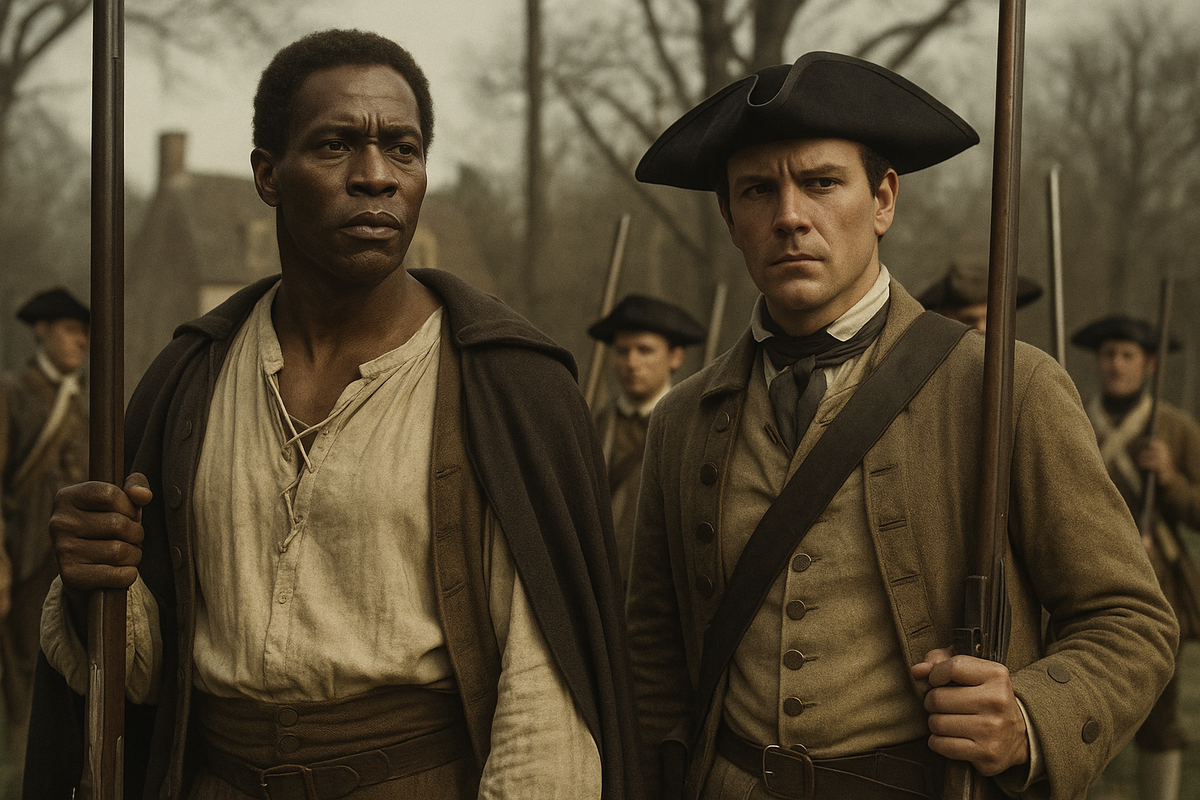
While white textbooks portrayed 1776 as an exclusively white struggle, Bennett documented what had been systematically erased: Black patriots fought at Lexington and Concord. They defended Bunker Hill. They crossed the Delaware with Washington, manned artillery at Yorktown, and spied on British commanders. They didn't just witness the Revolution—they bled for it.
For Ebony's readers, this wasn't academic. If Black blood soaked the snow at Trenton, then the Revolution belonged to them too. If their ancestors died for American liberty in 1776, then demanding it in 1961 wasn't radical—it was inheritance.
The Archive That Fought Back
Ebony was never just a magazine. Founded by John H. Johnson in 1945, it functioned as a parallel archive of Black achievement, documenting what white publications ignored: politics, arts, faith, triumph, and struggle rendered with unapologetic dignity.
The November 1961 issue transformed historical scholarship into visual testimony. Readers encountered Crispus Attucks—of African and Native descent—frozen in the moment of his death, the Revolution's first martyr. They saw Peter Salem and Salem Poor at Bunker Hill, where Poor fought so valiantly that 14 Continental officers petitioned Congress to commend him. They met Phillis Wheatley, kidnapped as a child and enslaved, who became the first published African American poet and so impressed George Washington with her verse that he invited her to his headquarters.
They learned of James Armistead, the enslaved double agent who infiltrated British camps and relayed intelligence to Lafayette—intelligence that proved instrumental at Yorktown. They discovered Prince Hall, Revolutionary War veteran and founder of African Lodge No. 459, the cornerstone of Black Freemasonry and Black civic organizing for generations.
And they read of Haitian troops who fought at Savannah, connecting the American Revolution to a wider Black Atlantic struggle that would eventually topple slavery in the Caribbean.
Each portrait, each engraving, each biographical sketch delivered the same message: You were not footnotes. You were indispensable.
Crispus Attucks (1770)
The first martyr of the Revolution, killed in the Boston Massacre. His death symbolized the irony of a liberty struggle born in blood that was not exclusively white.
Peter Salem & Salem Poor
Distinguished themselves at Bunker Hill (1775). Poor's bravery was so extraordinary that 14 Continental officers petitioned Congress to commend him.
Phillis Wheatley
First published African American poet. Her tribute to George Washington so impressed him that he invited her to his headquarters.
James Armistead (1781)
Enslaved double agent who infiltrated British camps and relayed intelligence to Lafayette. His work was instrumental in the victory at Yorktown.
The Paradox at the Core
Bennett didn't sanitize the Revolution. He sharpened its contradictions.
Thousands of enslaved men joined the Continental Army or fled to British lines, gambling everything on promises of freedom. Some won. Most didn't. Thomas Jefferson wrote that all men are created equal while owning human beings. George Washington commanded an army fighting for liberty while enslaving hundreds at Mount Vernon. The Revolution sparked abolitionist thought in the North—and hardened slavery's grip in the South.
By spotlighting this hypocrisy, Bennett didn't diminish the Revolution. He made it unbearably real. America's founding wasn't a clean narrative of good versus evil. It was courage and betrayal wound together—a promise made and deferred.
This was Ebony's editorial genius. The magazine didn't ask for inclusion in someone else's story. It proved ownership of the whole American narrative.
Why This Issue Endures
For collectors and historians, the November 1961 Ebony represents a pivot point in American historiography—the moment Black scholars like Bennett began systematically dismantling the mythology of a whites-only Revolution.
But its value extends beyond rarity. This issue is a dual artifact: it documents both 1776 and 1961, the fight for independence and the fight for equality, in a single object. Teachers use it to connect students with suppressed histories. Families preserve it as heritage. Collectors recognize it as the intersection of scholarship, activism, and cultural pride.
In an era of digital ephemera, these printed magazines remain permanent witnesses. They remind us that history was once consumed slowly, passed hand to hand, saved in living rooms and libraries. That physicality—the weight of the paper, the grain of the photographs, the authority of the byline—cannot be replicated on a screen.
Collector Significance
Historical Pivot Point
Documents the moment Black scholars like Lerone Bennett Jr. began reshaping mainstream American narratives about the founding era.
Civil Rights Context
Published at the height of the movement, showing how historical research became a tool for contemporary empowerment.
Cultural Artifact
Vintage Ebony issues tied to historical milestones are highly sought after by collectors, educators, and families preserving heritage.
Educational Resource
Used today to connect students with suppressed narratives of Black patriots in America's founding story.
A Revolution, Twice Told
The November 1961 issue of Ebony Magazine remains one of the most important cultural publications of the Civil Rights era. Lerone Bennett Jr.—who would go on to become one of the twentieth century's most influential African American historians—didn't just fill gaps in the historical record. He reclaimed the Revolution itself.
To hold this issue today is to hold two inseparable truths: that Black Americans fought and died for a nation that would not grant them full citizenship for nearly two more centuries, and that their descendants in 1961 understood the power of that sacrifice well enough to weaponize it.
Thanks to Ebony's vision, those stories are not footnotes. They are foundational texts. And they are still here, waiting to be read.
The Collection That Remembers
From the 1940s through the 1980s, Ebony chronicled what no other publication would: the full spectrum of Black American life rendered without apology or diminishment. Whether you're a collector building an archive, a scholar seeking primary sources, or someone honoring your family's legacy, these magazines offer something rare.
Browse Ebony Magazine Collection