
When Ladies' Home Journal Declared War on an Invisible Killer
How a 1955 magazine article transformed cystic fibrosis from medical obscurity into a national crisis—and made mothers the architects of change
November 1955. Across America, five million women opened their mailboxes to find the latest issue of Ladies' Home Journal—its cover a portrait of mid-century glamour styled by Mead-Maddick. Inside, between the recipes and fiction, waited a reckoning.
Ronald M. Deutsch's article, "Cystic Fibrosis… Enemy of Our Children," did not ask for attention. It demanded it. And in doing so, it turned a disease most Americans had never heard of into a national emergency—one that would reshape how mothers understood their role not just as caregivers, but as advocates.
For the families of the baby boom, this was a fracture in the myth of medical invincibility.
Archive Details
Publication: Ladies' Home Journal
Issue Date: November 1955
Featured Article: "Cystic Fibrosis… Enemy of Our Children" by Ronald M. Deutsch
Cover Styling: Mead-Maddick
Circulation: Over 5 million households
Historical Context: Published the same year the Cystic Fibrosis Foundation was established
The Illusion of Progress
The 1950s promised certainty. Jonas Salk's polio vaccine had arrived that spring. Antibiotics had declawed pneumonia and scarlet fever. Science, it seemed, was winning.
But cystic fibrosis refused the script.
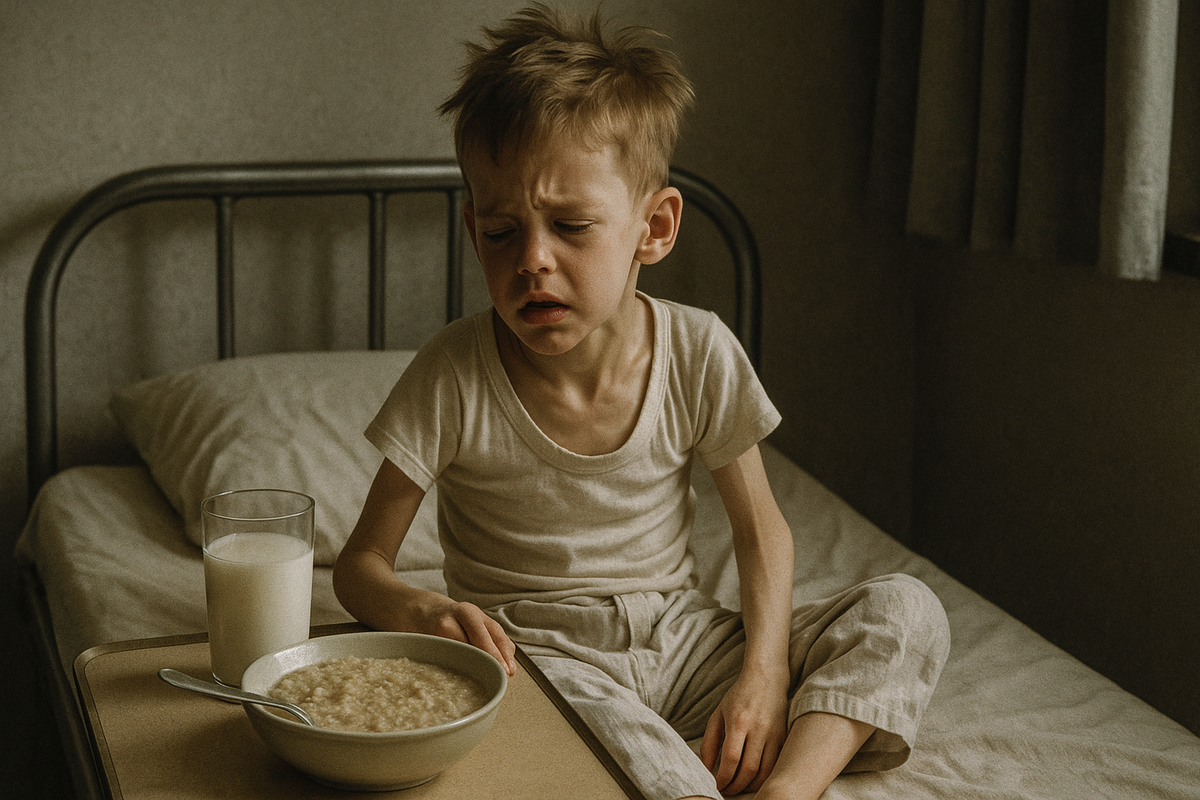
First identified in 1938, CF remained a medical enigma seventeen years later. Doctors understood the mechanics—thick mucus strangling pancreatic ducts, suffocating lungs—but had no answer. Children ate ravenously and starved. They coughed until they couldn't breathe. Most died before adolescence.
And yet, the disease had no public face. No celebrity champions. No ribbon campaigns. It was killing children in silence.
Ladies' Home Journal changed that.
With a readership larger than most newspapers, the magazine didn't simply inform its audience—it mobilized them. By 1955, suburban mothers were the unacknowledged architects of household health decisions: nutrition, hygiene, medical appointments, emergency judgment calls. If you wanted to ignite a movement, you spoke to them first.
And Deutsch spoke plainly.
The Anatomy of Advocacy
The article delivered precision without coldness, data without detachment.
The Disease Itself: Cystic fibrosis began in the pancreas, where mucus thick as paste blocked digestive enzymes from reaching the intestines. Children consumed thousands of calories and gained nothing—distended bellies, skeletal limbs, constant hunger. The same mucus invaded their lungs, transforming every cold into bronchitis, every cough into a potential crisis.
The Scale: Hospitals in New York, Los Angeles, Boston—and as far as London, Zurich, and Melbourne—were logging hundreds of cases. Doctors warned the true number was likely far higher. One in every 1,000 American children might carry the disease. It was not rare. It was unrecognized.
The Human Cost: Here, the article found its power. One mother had spent $5,000 over two years chasing a diagnosis—enough to force the sale of her home. Others had buried multiple children, each loss compounding the last, before a doctor finally named what was killing them.
The Foundation: The Cystic Fibrosis Foundation had been established that very year, 1955. Deutsch made the case explicit: research required funding. Funding required awareness. And awareness started here, in these pages, in these kitchens.
What Ladies' Home Journal achieved was an act of translation—converting clinical language into something mothers could carry into PTA meetings, church socials, and pediatricians' offices. The disease was no longer abstract. It was next door.
The Duality of the Pages
The cover photograph projected the aspirational ideal of 1950s femininity: poised, polished, confident. Turn the pages, and you met the reality—mothers exhausted by sleepless nights, families bankrupted by medical bills, children who would not see adulthood.
This was not contradiction. This was truth.
Women's magazines of the era have often been dismissed as trivial, their concerns reduced to casseroles and hemlines. But Ladies' Home Journal understood what historians would later confirm: the private sphere was never apolitical. Motherhood was labor. Caregiving was strategy. And when the medical establishment failed to act, it was mothers who organized, fundraised, and fought.
The magazine's layout—bold pull quotes, plain-language summaries, photographs of mothers with their children—honored that duality. It did not ask women to choose between elegance and urgency. It demanded they embody both.
What This Issue Captured
CF was described as silent until catastrophic—a disease that announced itself only after irreversible damage had been done.
In 1955, there was no standard test. Hospitals contradicted each other. Families spent years and fortunes pursuing answers that should have come immediately.
Medical costs didn't just strain budgets—they obliterated them. Mothers testified to selling homes, exhausting savings, making impossible choices between treatment and survival.
Chronic lung infections, recurring pneumonia, the slow suffocation of airways—CF turned breathing into a daily battle.
Thick mucus prevented nutrient absorption, leaving children perpetually malnourished no matter how much they ate.
Reports from Zurich, London, and Melbourne confirmed this was not a regional anomaly. CF crossed borders, cultures, and healthcare systems.
Unlike diseases that struck later in life, CF cut short the years that should have been safest—the years of play, of school, of becoming.
Deutsch spotlighted the newly formed Cystic Fibrosis Foundation and made the appeal direct: without funding, there would be no progress. Without progress, children would keep dying.
Grim as the facts were, the article refused despair. It insisted that knowledge—paired with resources and will—could bend the arc toward treatment.
Each element served a single thesis: cystic fibrosis could no longer be ignored.
The Legacy in Print
Women's magazines were never just entertainment. They were instruction manuals, support networks, and battlegrounds for public health. Ladies' Home Journal recognized its responsibility and used its platform to force a reckoning.
Every issue is a time capsule. Every article, a recovered voice. For collectors, these magazines are not relics—they are evidence of who women were when the cameras turned away.
Why Collectors Seek This Issue
Historical Synchronicity
Published the exact year the Cystic Fibrosis Foundation was founded, it captures a disease at the threshold of public consciousness.
Media Milestone
This was among the first mainstream efforts to bring CF into American living rooms—a turning point in how the press engaged with pediatric illness.
Cultural Document
It reveals how postwar optimism coexisted with the stark realities of childhood mortality, how domestic life intersected with medical advocacy, and how women's magazines functioned as instruments of social change.
Design Integrity
The glossy cover photography, the mid-century typography, the editorial layouts—all intact, all original. It is not a reproduction. It is the artifact.
Owning this issue means holding a primary source—a document that mattered then and testifies now to the power of the press, the persistence of mothers, and the long, unfinished fight against a disease that once had no name.
The November 1955 issue of Ladies' Home Journal, with Ronald M. Deutsch's "Cystic Fibrosis… Enemy of Our Children," stands as a landmark in American journalism. It gave a name to suffering. It placed mothers at the center of medical advocacy. And it proved that a magazine could be more than a product—it could be a catalyst.
Explore the Archive
Browse our full collection of original Ladies' Home Journal magazines—each issue an unmediated view into women's lives, fashion, literature, and cultural history.
Browse Ladies' Home Journal Magazine Collection