
The Magazine That Asked the Unthinkable
When Ladies' Home Journal questioned women's education in 1957 and lit the fuse for a revolution
In May 1957, millions of American women opened their mailboxes to find a cultural hand grenade disguised as a women's magazine.
There, on the pages of Ladies' Home Journal—sandwiched between recipes for tuna casserole and advertisements for automatic washing machines—sat an article so provocative it forced an entire generation to confront an uncomfortable question: "Is College Education Wasted on Women?"
The piece wasn't written by a controversial feminist firebrand. It was penned by psychologist Nevitt Sanford, Ph.D., drawing on years of research at Vassar College, one of America's elite women's institutions. And it didn't arrive in some radical underground publication—it landed in the hands of Middle America, where it belonged.
Because this wasn't just an academic debate. It was a mirror held up to the lives of millions of women who had traded intellectual ambition for wedding rings, who had shelved their degrees to raise children, who had been told that marriage was the only achievement that mattered.
Six years before Betty Friedan would publish The Feminine Mystique and ignite the women's liberation movement, Ladies' Home Journal was already lighting the fuse.
The Comfortable Trap of Postwar America
To understand why this article detonated with such force, you must first understand the world it entered.
The 1950s weren't just about prosperity and suburban expansion—they were about containment. After World War II, when women had kept factories running and offices functioning, they were swiftly ushered back into the home. The cultural message was clear and relentless: a woman's place was beside her husband, raising children, anchoring the nuclear family that would serve as America's defense against the communist threat.
Popular culture reinforced this at every turn. Television shows celebrated the happy housewife. Advertisements sold domestic bliss. Cold War ideology positioned stable family structures as patriotic duty.
Yet beneath this placid surface, contradictions festered. Women had won the vote in 1920, but professional advancement remained a distant dream. College enrollment among women was rising throughout the decade, creating an obvious paradox: What was the point of higher education if marriage and motherhood were the only acceptable destinations?
By 1957, the question had become impossible to ignore.
Archive Details
Publication: Ladies' Home Journal
Issue Date: May 1957
Featured Article: "Is College Education Wasted on Women?"
Author: Nevitt Sanford, Ph.D.
Research Source: Vassar College longitudinal study
Cultural Context: Pre-feminist movement, postwar domesticity era
What the Vassar Study Revealed
Sanford's article drew on longitudinal research comparing women students across multiple decades at Vassar. The findings were damning—not because women lacked intellectual capacity, but because the system had taught them not to use it.
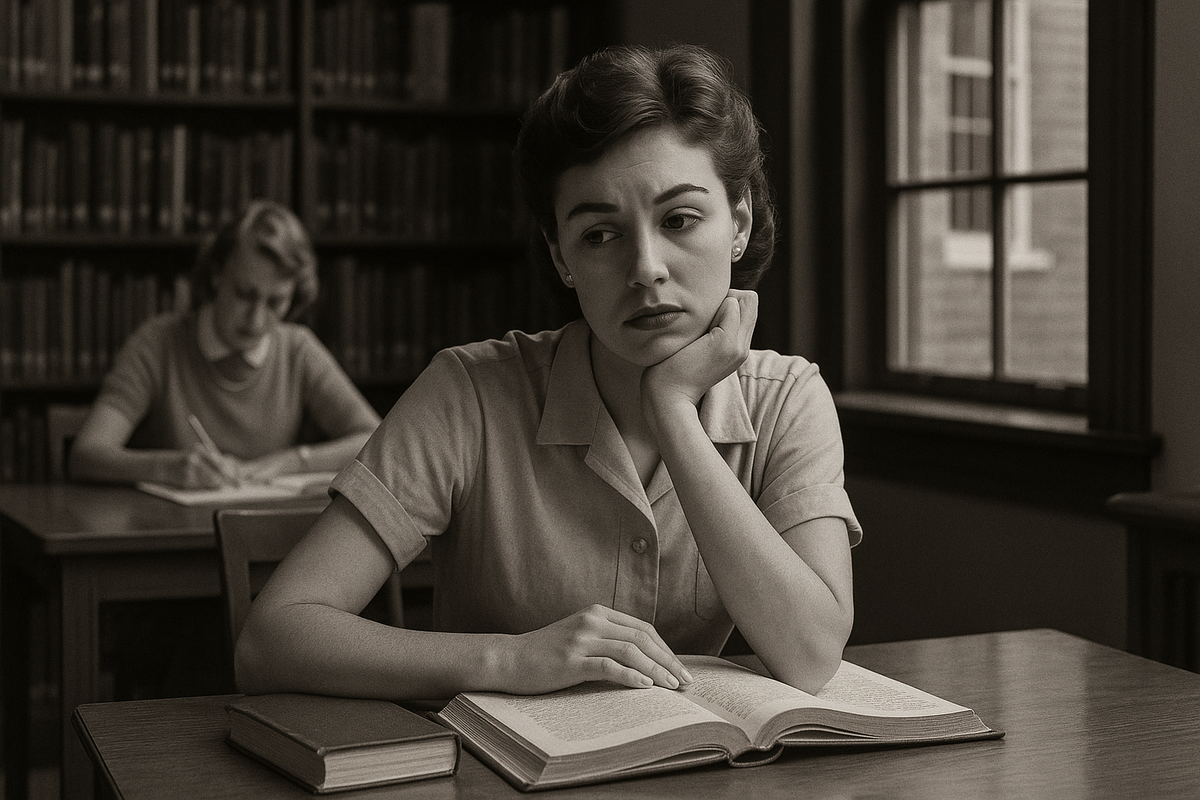
The study revealed that many female students weren't engaging deeply with their academic opportunities. Instead, college had become something else entirely: a finishing school for future wives. Young women attended to secure social standing, to improve their marriage prospects, to prepare for family life rather than professional careers.
The campus culture Sanford described was suffocating. Dating dominated everything. Women were encouraged to be pleasant, agreeable, noncontroversial—never too opinionated, never too smart. Academic ambition carried social penalties. Girls who appeared "too brainy" risked alienating potential husbands.
The article included reader comments—presented in handwritten fonts throughout the piece—that captured the brutal honesty of the moment. One reader noted: "Most females between 18 and 25 are out to get a chap." Another quoted a Yale senior: "The only qualification for a wife is that she must never, but never, bore him."
These weren't anonymous voices from focus groups. They were the actual beliefs circulating in dorms, at dinner parties, in kitchens across America.
Sanford's conclusion walked a careful line. College wasn't wasted on women, he argued—but its potential was being squandered. The system equated female success with marriage rather than scholarship, and in doing so, America was losing something precious: the intellectual and cultural contributions of half its population.
Why Ladies' Home Journal Published It
The decision to run this piece wasn't accidental. It was strategic.
Ladies' Home Journal had built its reputation as more than a homemaker's companion. Yes, it offered recipes, fashion advice, and decorating tips. But it also positioned itself as a cultural forum—a place where American women's roles could be examined, contested, and reimagined.
The visual design of the article underscored its seriousness. Unlike the magazine's typical layouts featuring glamorous illustrations and soft colors, "Is College Education Wasted on Women?" appeared in stark red typography with minimal decoration. It looked urgent. Confrontational. Impossible to ignore.
This was deliberate. The magazine's editors understood they were touching a live wire. By publishing Sanford's research, they weren't just reporting on a controversy—they were creating one, forcing their readers to reckon with questions most had been taught never to ask.
And it worked. The article became one of the most discussed features of the year, sparking debate in living rooms, college campuses, and newspaper editorial pages across the country.
The Themes That Wouldn't Die
The 1957 article captured several tensions that would define the next decade of American feminism:
The central conflict—should college prepare women for careers or simply polish them for family life?—exposed the fundamental ambivalence about women's intellectual development.
Reader comments revealed what everyone knew but few admitted: women attended college primarily "to get a husband." Academic achievement was secondary, sometimes even detrimental, to that goal.
Ambitious women faced constant social pushback. Being "too serious" or "too intellectual" marked you as unfeminine, undesirable, unmarriageable.
Sanford warned that confining educated women to purely domestic roles represented a devastating loss of "culture and humanitarianism" for American society.
Though framed in the cautious language of mid-century social science, the article previewed themes that would explode into public consciousness with the 1960s feminist movement.
This wasn't yet revolution. But it was something equally important: documentation of the precise moment when the contradictions became unbearable.
The Echo Across Decades
Six years after this article appeared, Betty Friedan published The Feminine Mystique, giving voice to what she called "the problem that has no name"—the quiet desperation of educated women confined to domestic roles. Friedan's book is often credited with launching second-wave feminism, but the groundwork had been laid years earlier in pieces like Sanford's.
The 1957 Ladies' Home Journal article matters because it caught the moment before the explosion—when the questions were being asked, when the contradictions were becoming visible, when women were beginning to admit that the postwar promise of suburban contentment felt more like a cage than a dream.
Reading it now, knowing what came next, you can feel the pressure building on every page.
Why Collectors Prize This Issue
Historical Weight
It documents a turning point—the moment when the national conversation about women's education, careers, and family roles began to crack open. This isn't retroactive significance; contemporary readers understood they were witnessing something important.
Cultural Authenticity
The handwritten-style reader comments preserve the actual arguments women were having in 1957. These aren't sanitized or edited for modern sensibilities. They're raw, sometimes uncomfortable, always revealing.
Rarity with Relevance
Unlike purely decorative vintage magazines valued only for their covers, this issue contains substantive content that still matters. Scholars, feminists, and cultural historians seek it out not for nostalgia but for research.
The Breadth of the Archive
Alongside the Sanford article, the issue contains the full spectrum of mid-century women's media: fashion spreads, fiction, homemaking advice, health columns. It's a complete snapshot of what American women were being told, sold, and asked to become.
For serious collectors, this isn't memorabilia. It's primary source material—the kind museums and university libraries acquire for permanent collections.
Preserving the Debates That Shaped Us
Original issues of Ladies' Home Journal from this era offer something digital archives cannot: the physical experience of holding the artifact that millions of women held, of turning the same pages, of encountering the arguments in their original context—surrounded by advertisements for appliances, fashion advice, and the cultural expectations they were beginning to question.
These magazines aren't quaint relics. They're documents of transformation, preserving the moment when American women started asking whether the lives they'd been promised were the lives they wanted.
Browse Ladies' Home Journal Magazine CollectionEach issue represents more than vintage publishing—it's a record of the debates, dreams, and cultural struggles that built the world we inhabit now.