
When America Stared Into the Mirror
Life Magazine's 1939 exposé on fascism at home—17,000 Americans, Nazi salutes, and George Washington conscripted as propaganda
Open the March 6, 1939 issue of Life Magazine, and you won't find fascism lurking in grainy newsreels from Berlin or Rome. You'll find it staring back from Madison Square Garden. From a modest home office in Chehalis, Washington. From a senator's desk in North Carolina.
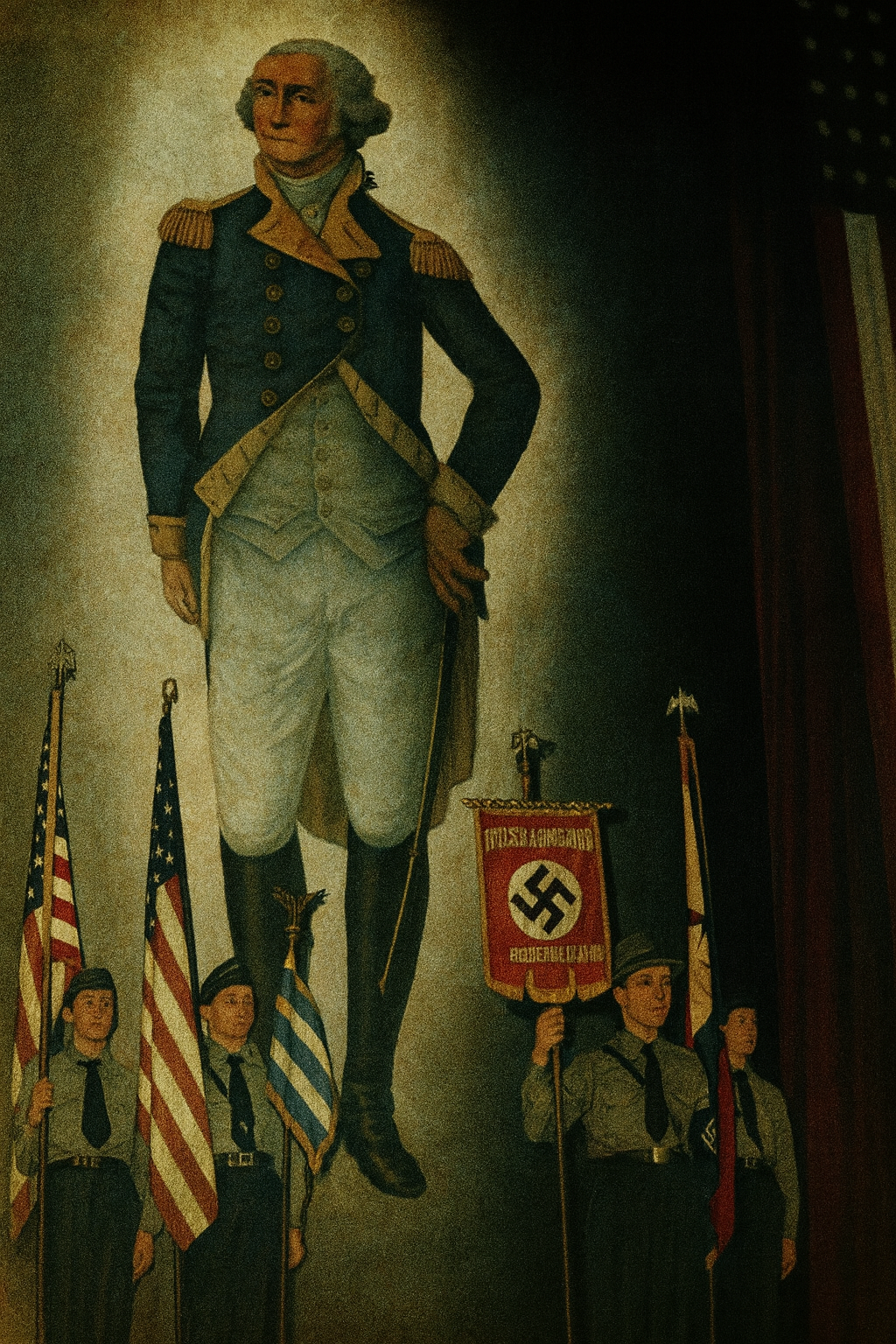
While Europe braced for war, Life turned its lens inward—and what it captured was chilling: 17,000 Americans cheering beneath a 40-foot portrait of George Washington, flanked by swastikas and storm troopers in full regalia. This wasn't foreign propaganda. This was homegrown extremism wrapped in the flag, and Life refused to look away.
The "Fascism in America" photo-essay remains one of the most unflinching acts of journalism in the magazine's history—a visual indictment that forced readers to confront an uncomfortable truth. The threat wasn't just "over there." It was in their neighborhoods, using their symbols, speaking their language.
Archive Document
Publication: Life Magazine
Issue Date: March 6, 1939
Feature: "Fascism in America" (Pages 57-65)
Historical Context: Published six months before Nazi Germany invaded Poland, documenting domestic fascist movements at their peak visibility
The Rally That Shook New York
February 20, 1939. Madison Square Garden. The German-American Bund called it a "Pro-American Rally." Life called it what it was.
Seventeen thousand people filled the arena. Uniformed storm troopers lined the aisles. Nazi salutes punctuated speeches denouncing Franklin D. Roosevelt and "Jewish Communism." And presiding over it all: George Washington, America's founding father, conscripted into service as a 40-foot Nazi mascot.
Life's photographers captured the grotesque collision. The magazine's caption pulled no punches: "George Washington is adopted as a Nazi hero in this 40-ft. backdrop at the Bund rally."
This wasn't ancient history being reinterpreted. This was real-time appropriation—the Founders weaponized, patriotism poisoned, democracy mocked by men who claimed to defend it. For readers leafing through the issue in living rooms across America, the images carried a visceral shock: This happened here. Last month.
The Bund wasn't operating in shadows. They rented the nation's most famous arena. They marched in uniform. They recruited openly, blending Nazi ideology with American nativism so seamlessly that thousands showed up to cheer.
Life documented every disturbing detail.
Photography as Evidence
Life Magazine built its reputation on a simple innovation: let the image do the work. Words could be dismissed as editorial bias. Photographs were harder to argue with.
The "Fascism in America" spread deployed this power with surgical precision. No lengthy think pieces. No hand-wringing editorials buried on page 12. Just stark, undeniable images spread across nine pages.
Page 57: George Washington towering over Nazi banners.
Page 61: Mugshot-style portraits under the headline "Some of the Voices of Hate"—William Dudley Pelley of the Silver Shirts, Father Charles E. Coughlin, Gerald Winrod, James True.
Page 62: Orville W. Roundtree, photographed in his modest Chehalis, Washington home, running a Silver Shirt office like a small business.
Page 63: A Seattle lecture hall—307 attendees, including women and children, listening to Silver Shirt propaganda.
The captions were clinical, almost forensic. "These Are Men to Watch." No rhetorical flourish. No plea for outrage. The photographs did that work.
What made the coverage revolutionary wasn't just its scope—it was its refusal to treat fascism as fringe theater. Life named names. Senator Robert Rice Reynolds of North Carolina. Major General George Van Horn Moseley, a decorated Army officer. Speakers like Frank W. Clark and Russell Dunn, who trivialized Jewish persecution while amplifying conspiracy theories about Roosevelt and the New Deal.
These weren't street corner cranks. They were men with platforms, titles, influence. And Life forced readers to see them clearly.
The Geography of Hate
Fascism in America wasn't a New York problem. It was a national network.
Life sent photographers beyond Madison Square Garden to document the sprawl. Silver Shirts in the Pacific Northwest. "Patriotic" organizations in the South. Propagandists like Robert Edward Edmonson and Chief New Moon distributing pamphlets from coast to coast.
The magazine highlighted the tactics: loudspeakers blaring anti-Roosevelt screeds, reinterpretation of New Deal symbols (the Blue Eagle recast as "Communist"), mass mailings, lectures in rented halls. Fascism was organizing with the professionalism of any political campaign—voter drives, membership rolls, local chapters.
And the message was always the same: We are the true patriots. They—Jews, Communists, Roosevelt, internationalists—are the threat.
By showing readers the mechanics, Life stripped away the mystique. This wasn't some incomprehensible European ideology. It was marketing. Recruitment. Propaganda refined for American audiences.
The most unsettling revelation: it was working.
The Men in the Margins
Father Charles E. Coughlin didn't need a rally. He had something more powerful: a radio microphone and millions of listeners.
The "Radio Priest" used his weekly broadcasts to blend Catholic social teaching with venomous anti-Semitism, railing against "international bankers" and defending fascist regimes in Europe. By 1939, his audience rivaled the president's fireside chats.
Life placed Coughlin's portrait alongside open Nazi sympathizers—a calculated editorial choice. The magazine wasn't interested in degrees of respectability. It documented the spectrum: from Bund storm troopers to elected officials, from mail-order propagandists to men with ecclesiastical authority.
William Dudley Pelley's Silver Shirts mimicked Mussolini's Blackshirts, complete with uniforms and paramilitary structure. Gerald Winrod, the "Jayhawk Nazi," published The Defender magazine, blending Christian fundamentalism with fascist conspiracy theories. James True sold "kike killers"—weighted clubs marketed explicitly for violence against Jews.
These weren't hypothetical threats. These were men selling hate as commodity, and Life cataloged them like a wanted poster.
Key Themes Documented
Why This Issue Mattered Then—and Now
Six months after Life published "Fascism in America," Nazi Germany invaded Poland. The world went to war.
But in March 1939, the outcome wasn't certain. Isolationism dominated American politics. Lindbergh spoke to packed crowds about staying out of Europe's conflicts. Polls showed Americans deeply reluctant to intervene.
Into this uncertainty, Life delivered a warning: the ideologies tearing Europe apart had already crossed the Atlantic. They were recruiting. Organizing. Normalizing.
The magazine didn't editorialize with apocalyptic predictions. It simply showed Americans what was happening in their own country—and trusted them to recognize the danger.
That restraint made the piece more powerful. No hysteria. No exaggeration. Just photographs, names, dates, and the unmistakable visual evidence of fascism wearing an American face.
The Permanence of Print
Digital archives preserve information. Original magazines preserve context.
When you hold a March 1939 Life, you feel the paper stock they used, see the advertisements they ran (cars, cigarettes, household goods—life proceeding normally), notice the smell of decades-old ink. You understand that this arrived in mailboxes and on newsstands as news, not history. Urgent. Present tense.
That physicality matters. These pages were folded, underlined, saved in attics, argued over. They're evidence of a national conversation that unfolded in real time, before anyone knew how the story ended.
For historians, collectors, and anyone seeking to understand the fragility of democracy, these magazines offer something digital scans never can: the weight of the moment.
The Collector's Perspective
Historical Placement
Published on the knife's edge—Europe bracing for war, America still debating its role, and domestic fascism at its peak visibility. This is the "before" document, capturing the moment just prior to the decision.
Photographic Power
The George Washington/swastika juxtaposition remains one of the most arresting images Life ever printed. You don't forget it.
Archival Completeness
Unlike newspaper coverage that focused on single events, Life assembled a comprehensive visual dossier—regional organizing, prominent figures, propaganda tactics, the full ecosystem of American fascism in one package.
Generational Artifact
These pages were studied at kitchen tables in 1939 by families trying to make sense of a fracturing world. Holding an original copy means holding what they held, seeing what shocked them, understanding what they feared.
Market Demand
World War II-era Life issues command consistent collector interest, but pre-war issues documenting the lead-up—especially those covering domestic fascism—occupy a distinct category. This is witness testimony from before the narrative was written.
Cultural Context
The cover features Tallulah Bankhead in a theatrical role, pure glamour. Turn to page 57, and you're staring at storm troopers. That contrast—entertainment and extremism bound in the same issue—captures the cognitive dissonance of 1939 America perfectly.
Explore the Archive
The March 6, 1939 issue represents one chapter in Life's decades-long chronicle of American culture, politics, and conflict. From the 1930s through the 1970s, the magazine captured history as it happened—wars, social movements, technological shifts, cultural revolutions—with the immediacy only photojournalism could provide.
Browse Life Magazine CollectionThe Echo Across Time
The March 6, 1939 issue endures not because it predicted the future, but because it refused to look away from the present.
Life could have covered the Madison Square Garden rally as spectacle—fringe theater, good for shock value, ultimately dismissible. Instead, the magazine treated it as a warning sign. Fascism wasn't a foreign ideology Americans could observe from a distance. It was here. Organized. Growing.
And it was using the language of patriotism to do it.
That clear-eyed documentation—names, faces, tactics, evidence—gave Americans the information they needed to recognize the threat. No hyperbole. No panic. Just the facts, rendered in black and white, impossible to ignore.
Today, the issue stands as both artifact and argument: vigilance isn't optional. Democracy requires citizens who can distinguish genuine patriotism from its authoritarian counterfeit. And sometimes, the most powerful act of journalism is simply showing people what's happening—and trusting them to see it clearly.
Life did that work in 1939. The pages still speak.