
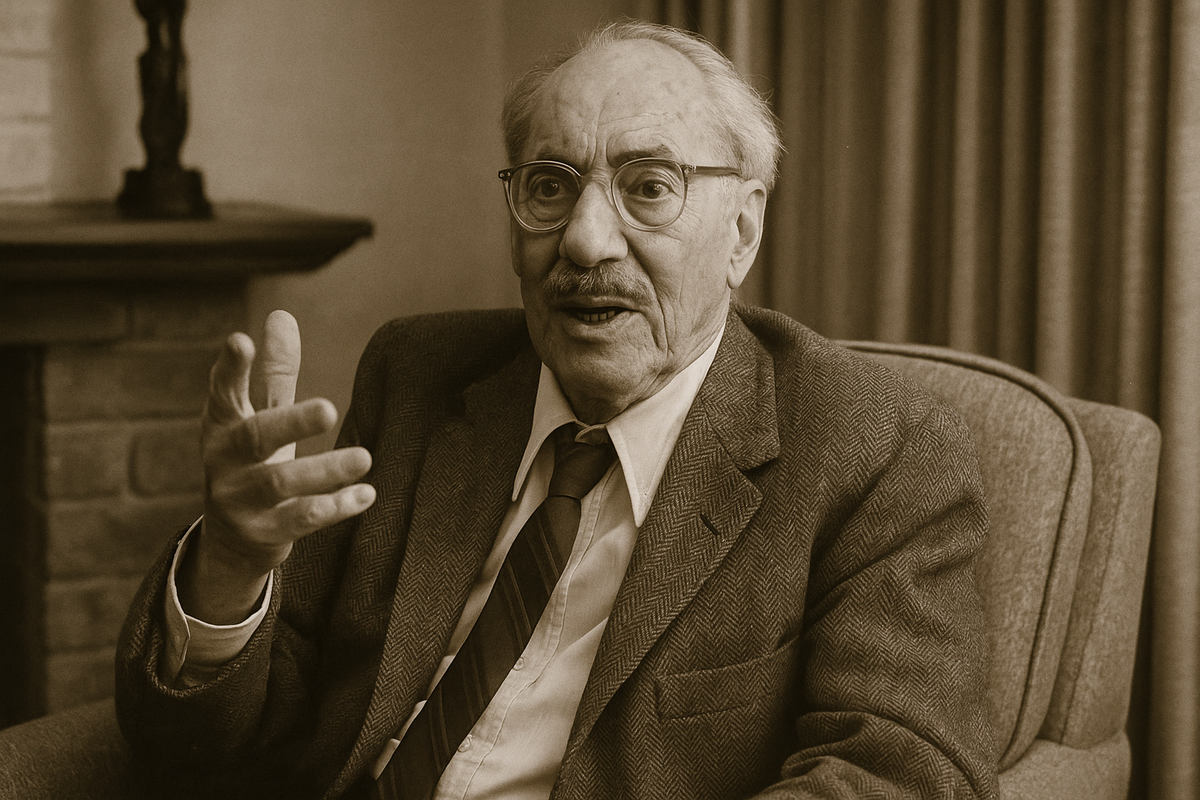
The Last Voice of Vaudeville
When Groucho Marx Spoke His Mind in Playboy, March 1974
At 83 years old, Groucho Marx sat down for what would become one of his final major interviews. Three years before his death, the man who had mockingly saluted dictators in Duck Soup and turned every conversation into verbal swordplay opened up to Playboy with the same weapon he'd wielded for six decades: unsparing honesty wrapped in punchlines.
The March 1974 issue didn't just feature Groucho Marx. It captured him—at the edge of mortality, still swinging at hypocrisy, still dissecting American culture with the precision of a comedian who had watched it transform from the vaudeville stage to the sexual revolution. For readers navigating Watergate, Vietnam's bitter end, and the wreckage of 1960s idealism, Groucho's voice offered something unexpected: proof that America's battles over freedom, sex, and authority had been fought before, and that laughter remained the sharpest blade.
This wasn't nostalgia. This was a master class in survival.
Archive Details
Historical Figure: Groucho Marx (Julius Henry Marx, 1890–1977)
Issue Date: Playboy Magazine, March 1974
Archive Source: Original 20th Century Magazine Collection
Cultural Context: Published during Watergate crisis, three years before Marx's death
The Cultural Crossroads of 1974
Playboy in 1974 occupied a unique position in American media. While dismissed by critics as mere titillation, the magazine had built an empire on a radical premise: that intelligent men could enjoy serious literature, cutting-edge journalism, and provocative photography in the same breath. The March issue demonstrated this fusion at its peak.
The cover announced itself with bold yellow and deliberate provocation—a model in stockings and heels, confident and unapologetic. Inside, the Groucho Marx interview proved the magazine's real ambition: to document the century's defining voices before they vanished.
By 1974, those voices were fading. The Marx Brothers had revolutionized comedy in the 1930s and 40s, turning A Night at the Opera and Duck Soup into manifestos of anarchic humor during the Great Depression. They mocked dictators when fascism was rising. They lampooned the rich when Americans were starving. Groucho's motormouth character—armed with greasepaint mustache and lethal one-liners—became the avatar of comedic rebellion.
Now, half a century later, Groucho was reflecting on what that rebellion had cost and won.
The Interview That Bridged Two Centuries
Playboy's interview format gave subjects room to breathe—no soundbites, no manufactured controversy, just conversation stretched across multiple pages. With Groucho, this approach unlocked something rare: the interior life of a man who had spent his career hiding behind characters.
On Poverty and Ambition
Groucho spoke plainly about growing up in New York tenements, dreaming of wealth while performing for nickels. His recollections resonated in the economically uncertain 1970s, when inflation was gutting the middle class and the American Dream felt increasingly remote.
On Comedy as Weapon
He articulated what the Marx Brothers had always understood: humor wasn't escape—it was assault. Their films targeted pomposity, greed, and authoritarianism with surgical precision. Groucho's comedy had always been class warfare conducted through wordplay.
On Marriage and Sexuality
He deployed his trademark sarcasm: "I don't like dirty pictures. I'm glad nobody took their clothes off in our movies. Can you imagine Harpo without his hat, looking undressed and naked with a cigar in his mouth?" The joke was self-aware—Groucho knew he was being interviewed by a magazine built on "dirty pictures," and he turned that irony into comedy.
On Legacy and Mortality
Groucho allowed something unusual to surface: vulnerability. He recognized his status as an elder statesman, celebrated but increasingly distant from the culture he'd helped shape. The interview captured a man aware that his era was ending.
Beneath the wisecracks about relationships, he spoke candidly about the absurdities of marriage, offering observations that landed differently in an era redefining sexual freedom and gender roles. On American society itself, Groucho remained unsparing. He skewered hypocrisy, questioned sacred cows, and reminded readers that institutional critique didn't begin with the counterculture—his generation had been doing it since the 1920s, just with better timing and greasepaint.
Why This Issue Endures
The March 1974 Playboy survives as more than a magazine. It's a historical artifact at the intersection of multiple American narratives.
Comedy History Preserved: Published three years before Groucho's death in 1977, this interview captured one of the 20th century's defining comedic minds while he could still articulate his vision. The Marx Brothers' films remain culturally significant, but this interview reveals the philosophy beneath the chaos—how poverty, timing, and rage at injustice forged a comedy that still resonates.
The Sexual Revolution Documented: Playboy itself was a bellwether of changing American attitudes toward sexuality, gender, and personal freedom. Groucho's presence in its pages created a dialogue between generations—between the repressed 1930s and the liberated 1970s, between vaudeville's coded innuendo and the era's explicit confrontation with desire.
Print Media at Its Zenith: Before cable fragmented audiences and the internet atomized culture, magazines like Playboy served as national town squares. The March 1974 issue represents that power at its peak—the ability to shape conversation, preserve voices, and document transformation as it happened.
The 1970s Crossroads: The issue captures America mid-transition. Watergate would force Nixon's resignation that August. Vietnam would fall in 1975. The sexual revolution was colliding with economic stagnation, creating the cultural dissonance that defined the decade. Groucho's interview became a touchstone—a reminder that cultural upheaval was cyclical, that earlier generations had navigated their own revolutions.
What Groucho Left Behind
The March 1974 Playboy interview reveals something essential about Groucho Marx and, by extension, about comedy itself: the best humor doesn't age because it's rooted in permanent truths about power, pretension, and human absurdity. Groucho's targets—pompous authority figures, institutional hypocrisy, the gap between what people claim and what they do—remain evergreen.
His reflection on mortality adds weight to every joke. Reading the interview now, decades after his death, we hear a man taking stock. The wisecracks land differently when delivered by someone who knows his time is finite, who's watching his contemporaries disappear, who understands that vaudeville and silent film and even the studio system that made him famous have become historical footnotes.
But Groucho refused sentimentality. Even at 83, facing the end, he deployed humor as defense and offense—mocking his own legacy, puncturing any attempt to treat him as a saint of comedy. That refusal to soften, to become safe and digestible, is what keeps his voice vital.
The Collector's Perspective
Rarity of Voice
Groucho's major interviews grew scarce in his final years. This Playboy conversation stands as one of the last extended platforms he occupied, making it irreplaceable for anyone studying his work or the evolution of American comedy.
Format Excellence
The interview spans multiple pages with Playboy's signature editorial polish—sharp questions, minimal interruption, maximum insight. The magazine's design, from the bold cover to the interior layout, exemplifies 1970s visual culture at its most confident.
Cultural Layering
The issue doesn't just contain the Groucho interview—it exists as a complete snapshot of its moment, with fiction, journalism, and photography that collectively capture 1974's anxieties and aspirations.
Condition and Availability
Original issues from this era, particularly those featuring landmark interviews, command serious collector interest. Condition matters—tight binding, vivid color, minimal wear—but even well-read copies carry historical weight.
Accessing History Directly
Thousands of original Playboy magazines spanning the 1950s through 1970s document these cultural transformations in real time—not through retrospective analysis, but through the voices, photographs, and journalism of the moment itself.
Browse Playboy Magazine CollectionFinal Frame
The March 1974 Playboy interview with Groucho Marx stands as one of American magazine journalism's significant achievements—a conversation that balanced humor with depth, celebrity with substance, and entertainment with cultural documentation. Groucho's voice, preserved across those pages, continues speaking to anyone willing to listen: about resilience, about using laughter as both shield and sword, about refusing to let age or circumstance dull the blade.
For collectors, historians, and anyone who understands that comedy is a serious art, this issue isn't just reading material. It's evidence that great conversations transcend their moment, that the best interviews become permanent records, and that some voices—like Groucho's—deserve to echo across generations.