
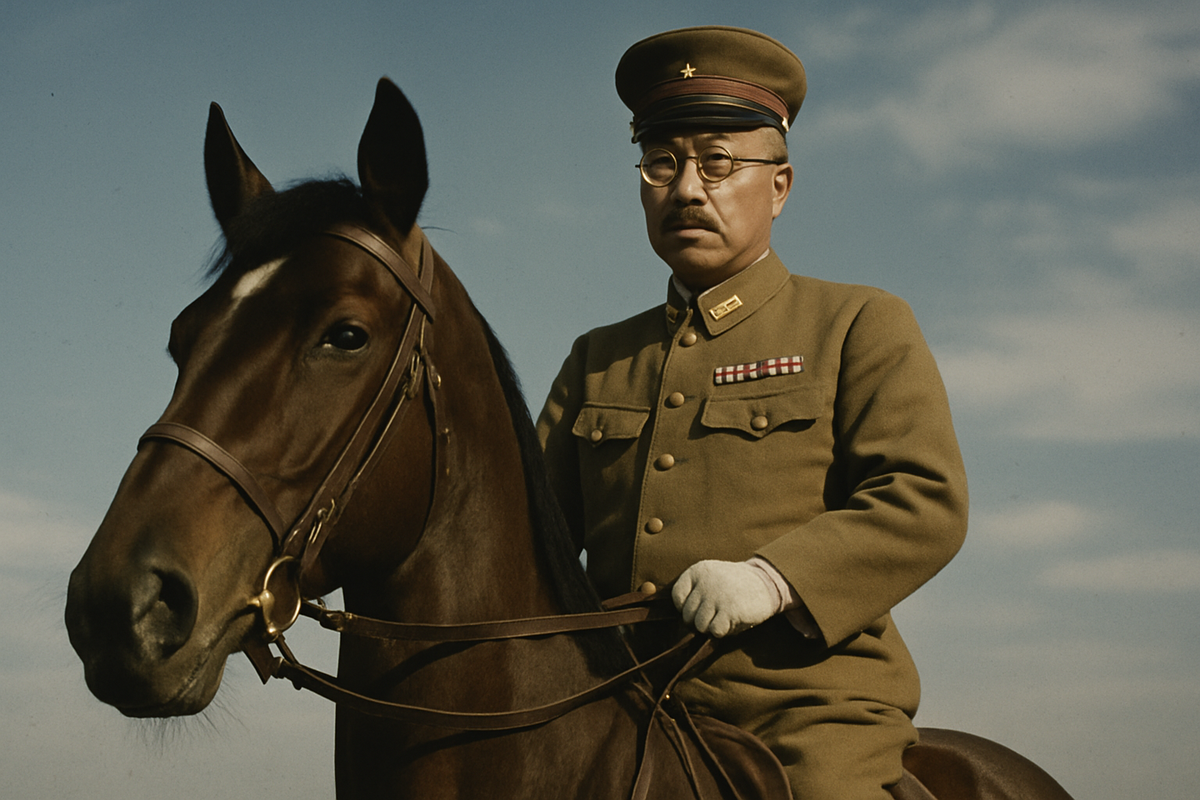
Hideki Tojo, Wartime Japan, and the Razor on Horseback
How The New Yorker's April 17, 1943 profile dissected Japan's wartime Prime Minister—and gave Americans a weapon sharper than propaganda
On April 17, 1943, American readers opened their copies of The New Yorker and found themselves face-to-face with the enemy.
Not on a battlefield. Not in propaganda. But in prose—sharp, probing, and unsettlingly intimate. The magazine's "Profiles" section carried a long-form portrait titled "Razor on Horseback," dissecting the character of Premier Hideki Tojo, the military bureaucrat who had become the embodiment of Japanese wartime aggression. For a nation deep in the Pacific campaign, this was more than journalism. It was reconnaissance of the mind.
Who was the man directing Japan's war machine? What made him dangerous? And perhaps most unsettling: What made him ordinary?
Historical Archive
Historical Figure: Premier Hideki Tojo, Japan's wartime Prime Minister
Issue Date: April 17, 1943
Archive Source: The New Yorker Magazine
Profile Title: "Razor on Horseback"
Cover Artist: Wallace Morgan
The War That Demanded Understanding
By April 1943, the Second World War had entered its bloodiest phase. Stalingrad had fallen. Allied forces were pressing through North Africa. In the Pacific, American victories at Midway and Guadalcanal had cracked open Japan's defensive perimeter, but the path to Tokyo stretched long and uncertain.
Back home, Americans weren't just following battles—they were studying enemies. Who were the men behind the Axis powers? What drove their decisions? In Germany, Hitler's manic charisma made him a known quantity, however monstrous. But Japan's leadership remained opaque, filtered through layers of propaganda and cultural distance.
The New Yorker answered that hunger with its Tojo profile. Nicknamed "The Razor" for his ruthless efficiency, Tojo was both administrator and ideologue, a man who rose not through brilliance but through relentless discipline. The magazine didn't just report his biography—it interpreted his significance, offering readers a psychological map of the enemy.
The New Yorker's Wartime Authority
By 1943, The New Yorker had established itself as something rare: a magazine that treated current events as both history and literature. Its "Profiles" section wasn't interested in hagiography or simple reporting. These were character studies—layered, ironic, and unsparing.
The Tojo profile embodied this approach. It rendered Japan's Prime Minister in vivid, deflating detail: bald, bespectacled, physically unremarkable. A man who walked the same route every morning, wore gray uniforms, ate plain food. Yet this ordinariness concealed something more sinister—the machinery of militarism operating through a single, implacable functionary.
Unlike Hitler, Tojo inspired no cult of personality. He was no orator, no visionary. He was a bureaucrat elevated by a system that valued obedience over imagination. And The New Yorker understood that this made him, in some ways, more dangerous: not a madman, but a cog who had become the wheel.
The profile mixed analysis with satire, a signature move. It acknowledged Tojo's power while puncturing his propaganda image—the "kindly paternal figure" promoted by Japanese media. What emerged was a portrait of authoritarian banality: discipline weaponized, ordinariness made lethal.
Inside the April 17, 1943 Issue
The cover, illustrated by Wallace Morgan, captures The New Yorker's wartime sensibility perfectly. Two uniformed naval officers arrive at what appears to be a refined social gathering, greeted by a maid holding a hat. The juxtaposition—military severity meeting domestic civility—carries the magazine's characteristic wit: understated, slightly absurd, always aware of the contradictions beneath the surface.
Inside, "Razor on Horseback" delivered on that ironic promise. The profile constructed Tojo through revealing details:
The Mediocre Student
Tojo had risen not through genius but through dogged persistence, a pattern that would define his career.
The Military Monk
His devotion to hierarchy and routine reflected Japan's militaristic culture, where loyalty trumped innovation.
The Accidental Strongman
His ascent mirrored Japan's slide into militarism during the 1930s, when the Army seized political control and officers like Tojo became kingmakers.
The Propaganda Target
Japanese media presented him as wise and fatherly. The New Yorker emphasized his baldness, his spectacles, his rigidity—humanizing him through deflation rather than demonization.
The article's brilliance lay in its refusal to sensationalize. By showing Tojo as ordinary, it made American readers see him as defeatable—not an invincible force, but a man constrained by the very system that elevated him.
The Enduring Power of Print
Like LIFE's photojournalism, The New Yorker's wartime issues function as historical witnesses. They don't just record what happened—they preserve how it was interpreted, analyzed, satirized, and survived. Each article and cartoon reflects a nation processing unprecedented violence through language and wit.
In an era when news evaporates into digital feeds, these vintage magazines offer something increasingly rare: permanence. They are literature and artifact, humor and history, journalism frozen at the moment of its creation.
That's why collectible New Yorker magazines remain valuable. They are not nostalgia objects. They are primary documents of the twentieth century, speaking directly across decades.
Why Collectors Prize This Issue
Historical Precision
It captures how Americans understood Japan's leadership at a critical moment in the Pacific War.
Journalistic Innovation
"Razor on Horseback" remains one of the most detailed contemporary profiles of Hideki Tojo published during his lifetime.
Visual Documentation
Wallace Morgan's cover exemplifies the magazine's wartime aesthetic: sophisticated humor meeting cultural critique.
Cultural Artifact
This issue is a time capsule of 1943 America—anxious, analytical, determined to understand its enemy through intellect rather than hysteria.
For historians and collectors, owning this issue means possessing a primary source. It's not just about World War II; it's from World War II, carrying the urgency and uncertainty of that moment in every page.
Explore the Archive
Thousands of original New Yorker magazines—from the 1920s through the 1970s—are available for collectors, researchers, and enthusiasts. Each issue offers a window into its decade: the art, the politics, the literature, the cultural debates as they unfolded in real time.
Browse The New Yorker Magazines CollectionWhether you're building a research archive, assembling a collection, or simply fascinated by how Americans understood their world during the most consequential years of the twentieth century, these magazines offer something irreplaceable: history in its original form.
The Man Behind the Machinery
The April 17, 1943 issue of The New Yorker gave American readers what they needed most: not propaganda, but understanding. "Razor on Horseback" rendered Hideki Tojo as both threat and symptom—a man whose ordinariness made him the perfect instrument of militaristic ideology.
Holding this issue today means holding a piece of wartime intelligence, cultural analysis, and literary journalism all at once. It's a record of how America studied its enemy, how satire sharpened perception, and how The New Yorker secured its reputation as one of the most important magazines in American history.
For anyone who values primary sources, these vintage issues aren't reading material. They're evidence. And through them, 1943 speaks directly to us.