
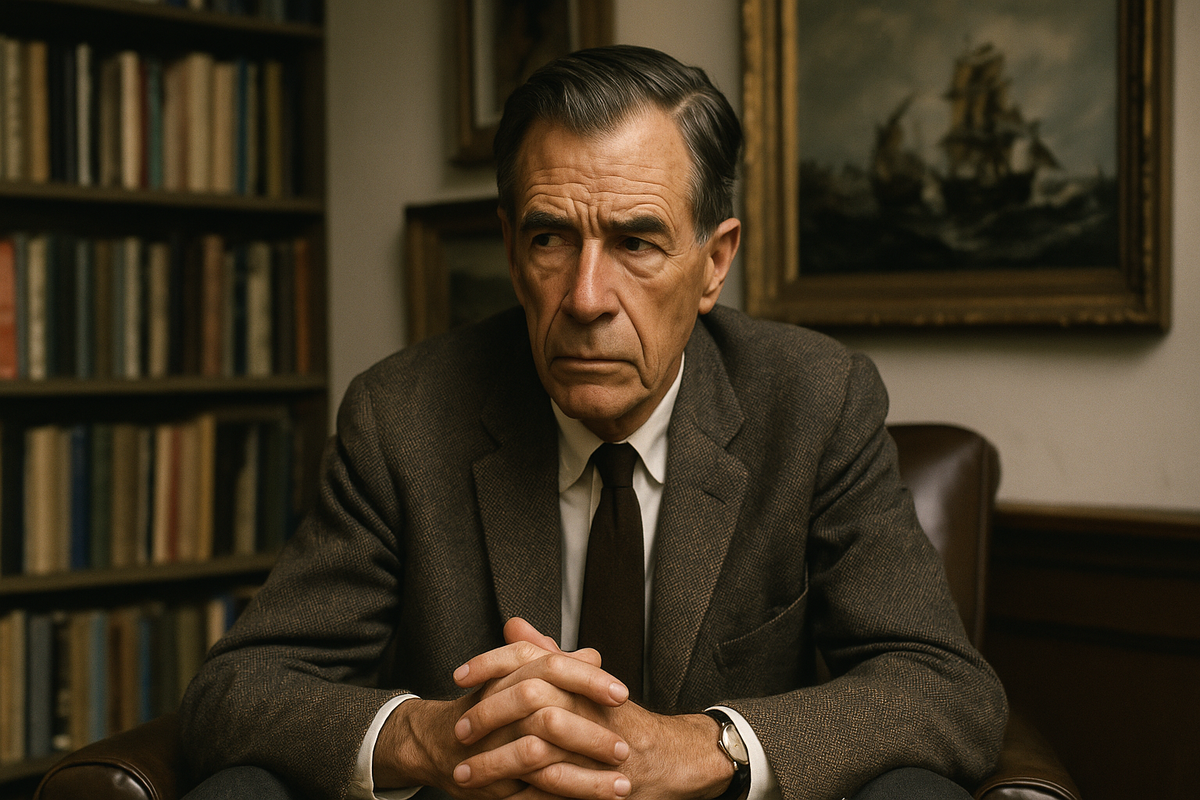
The Economist, The Centerfold, and the Reckoning
John Kenneth Galbraith's June 1968 Playboy Interview and the Magazine That Dared to Mix Ideas with Desire
On newsstands in May 1968, the June issue of Playboy arrived in an America that was coming apart at the seams. Martin Luther King Jr. had been dead for three weeks. Robert F. Kennedy had five days to live. College campuses were occupied territory. The Tet Offensive had obliterated the illusion of imminent victory in Vietnam. And there, beneath the magazine's tangerine masthead and a blonde in a red bikini standing barefoot on sun-bleached sand, was a 10,000-word interview with John Kenneth Galbraith—Harvard economist, Kennedy confidant, and the sharpest tongue in American liberalism.
This was not a celebrity puff piece. This was Playboy deploying one of the most formidable intellects of the 20th century to dissect a nation in crisis. And it worked precisely because of the magazine's fundamental paradox: you could flip from Scandinavian nudes to a scathing indictment of American militarism without ever leaving your coffee table.
For collectors and historians today, the June 1968 issue remains what it was then—an artifact of intellectual firepower wrapped in cultural rebellion.
Archive Profile
Historical Figure: John Kenneth Galbraith, Harvard economist and presidential advisor
Issue Date: June 1968 (on newsstands May 1968)
Archive Source: Playboy Magazine Interview Series
Cultural Context: Published weeks after MLK assassination, days before RFK assassination, height of Vietnam War
1968: The Year America Burned
By June 1968, the American consensus had collapsed. The Tet Offensive in January shattered White House promises that the war was nearly won. Lyndon Johnson, broken by Vietnam, had withdrawn from the presidential race. Cities erupted after King's assassination. Students seized Columbia University. The Democratic Convention in Chicago would soon devolve into televised street warfare.
Into this maelstrom stepped Galbraith, author of The Affluent Society (1958) and The New Industrial State (1967), a man who had advised Franklin Roosevelt, served John F. Kennedy as ambassador to India, and whose books sold in the millions. He represented something increasingly rare: the liberal establishment intellectual willing to call the war a catastrophe and his own party complicit in disaster.
Playboy didn't stumble into this interview. The magazine understood that its readers—millions of them—craved more than escapism. They wanted to understand why their country was tearing itself apart.
The Playboy Interview: Where Icons Came to Talk
By 1968, Playboy's interview format had become the most prestigious long-form platform in American media. Malcolm X, Martin Luther King Jr., Fidel Castro, Muhammad Ali—these weren't promotional stops. These were extended intellectual confrontations, unfiltered and unedited, that revealed more than any television appearance or press conference ever could.
The magazine's genius was structural: it gave subjects space to think aloud, to contradict themselves, to argue. No seven-minute cable news segments. No gotcha questions. Just sustained conversation with some of the most consequential figures alive.
Galbraith's interview fit this tradition perfectly. Here was a man who had walked the corridors of power for three decades, who knew where the bodies were buried, and who was now willing to say what the Johnson administration refused to admit: Vietnam was unwinnable, the political class had failed, and corporate capitalism was devouring democracy.
The Cover: Sunshine and Smoke
The June 1968 cover is pure Playboy: a blonde model, sun-drenched and carefree, against an expanse of beach and sky. The design is sleek, minimalist, aspirational. It sells the fantasy of leisure, of escape, of the good life available to the modern American man.
Turn the page, and you're reading Galbraith call Vietnam "the most disastrous foreign adventure in American history."
This wasn't cognitive dissonance. This was the magazine's entire editorial philosophy. Playboy never apologized for pairing sex with seriousness. It understood that its readers were capable of appreciating both a beautiful woman and a devastating critique of American foreign policy. The magazine treated its audience as adults who could hold contradictions in their heads without short-circuiting.
That editorial confidence is why Playboy became one of the most influential publications of the postwar era, shaping debates over sexuality, consumerism, politics, and what it meant to be a modern American.
Galbraith Unfiltered: Four Themes That Defined the Interview
The June 1968 conversation remains one of Galbraith's most comprehensive public statements on the crises of the late 1960s. Four themes dominate:
Vietnam and the Futility of Escalation
Galbraith was merciless. The war, he argued, was not just a mistake but a moral and strategic catastrophe. Escalation had achieved nothing except deeper failure. His position aligned with the growing antiwar movement but carried added weight—this was a man who had been inside the rooms where such decisions were made.
The Bankruptcy of Both Parties
Galbraith skewered Republicans for exploiting fear without offering solutions and Democrats for abandoning principle in pursuit of electoral survival. With Richard Nixon, Hubert Humphrey, and George Wallace all vying for the presidency, he saw a nation facing a choice between bad options.
The Intellectual's Duty to Dissent
Galbraith defended the role of public intellectuals as essential irritants—figures whose job was to challenge orthodoxy, expose folly, and refuse comfort. His own career embodied this: a Harvard professor who wrote bestsellers, advised presidents, and never stopped arguing.
Corporate Power and Democratic Decay
Revisiting themes from The Affluent Society and The New Industrial State, Galbraith warned that concentrated corporate power was suffocating democracy. Affluence had not eliminated poverty. Growth had not produced justice. The civil rights movement and urban uprisings had made this brutally clear.
Together, these arguments made the interview one of the most important political documents of 1968—a year when the future of American liberalism hung in the balance.
The Legacy: When Sex and Politics Shared a Spine
Looking back, the Galbraith interview illustrates why Playboy's editorial model endures in cultural memory. The magazine refused to segregate pleasure from thought. It brought towering intellectuals into the homes of readers who might never crack open an economics textbook but would devour a 10,000-word interview over a drink.
That editorial courage—publishing Galbraith alongside the centerfold, treating readers as capable of engaging both—remains one of Playboy's most radical gestures. In an era of cultural fragmentation, it insisted that serious ideas and human desire weren't enemies. They were part of the same complicated life.
Why This Issue Matters to Collectors
Historical Timing
Published weeks after King's assassination and days before RFK's, at the height of the Vietnam War and the unraveling of the Great Society.
Landmark Interview
Galbraith's conversation remains essential reading for understanding the liberal critique of American power in the 1960s.
Cultural Duality
The issue encapsulates Playboy's unique editorial model—beachside glamour and blistering political analysis coexisting without apology.
Collector Demand
Issues featuring major interviews, iconic covers, and topical urgency command attention from historians, collectors, and cultural archivists.
Owning this issue means possessing a snapshot of America at the edge—a moment when ideas and images collided, and when Playboy proved it was more than entertainment.
Explore the Archive
The June 1968 issue is one of countless treasures preserved in original form. From the 1950s through the 1970s, Playboy chronicled not only shifting sexual attitudes but also the intellectual debates that defined a generation—interviews with James Baldwin, Gore Vidal, Ayn Rand, and dozens of other figures who shaped American thought.
Browse Playboy Magazine CollectionWhether you're a collector, a cultural historian, or simply curious about how America navigated its most turbulent decades, these magazines are living documents—evidence of a time when a single publication could hold both fantasy and fury, beauty and argument, without flinching.
The June 1968 Playboy interview with John Kenneth Galbraith is more than a vintage magazine. It is a record of a moment when America's brightest minds confronted its darkest crises, when intellectual courage still commanded mass audiences, and when a magazine dared to believe its readers could handle both pleasure and serious thought.
To hold this issue is to hold that belief—and the turbulent world it tried to explain.