
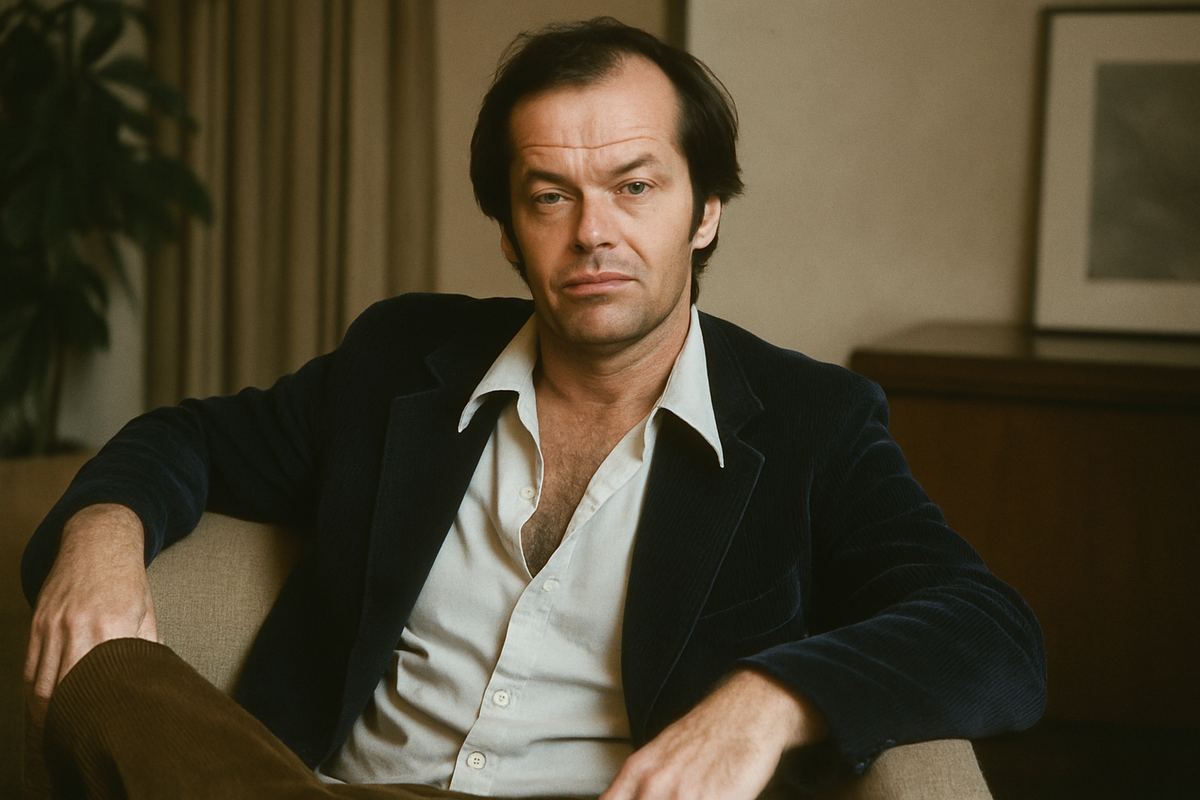
The Counterculture's Reluctant Prophet
Jack Nicholson's 1972 Playboy Confession and the Voice of a Generation in Transition
In April 1972, Jack Nicholson sat down for what would become one of the most revealing conversations of his career. The resulting Playboy Interview didn't just capture a rising star—it froze a cultural moment in amber.
This wasn't the Jack Nicholson of The Shining or Batman. This was a 34-year-old actor still processing his sudden ascent, fresh from Five Easy Pieces and Carnal Knowledge, speaking with a candor that feels almost reckless by today's standards. He discussed LSD as casually as film technique. He dissected fame with the wariness of someone still adjusting to its glare. He treated sexuality, drugs, and American malaise as subjects worthy of honest examination rather than careful PR spin.
The interview remains extraordinary not despite its contradictions, but because of them. Here was the counterculture's most compelling screen presence—and he wasn't entirely sure he believed in the counterculture.
Archive Details
Historical Figure: Jack Nicholson
Issue Date: April 1972
Archive Source: Playboy Magazine
Cultural Context: New Hollywood Era, Post-Vietnam America
America at the Breaking Point
By 1972, the optimism of the 1960s had curdled into something harder to name. Vietnam continued its grinding devastation. Nixon was in the White House. The sexual revolution had rewritten the rules without providing a clear replacement code. The civil rights movement had won legal victories while structural inequality remained entrenched.
Hollywood reflected this instability. The old studio system had collapsed, and in its wreckage emerged New Hollywood—directors and actors who treated film as personal expression rather than corporate product. Francis Ford Coppola was shooting The Godfather. Robert Altman had just released McCabe & Mrs. Miller. Martin Scorsese was working on Mean Streets.
Jack Nicholson stood at the center of this transformation. Easy Rider (1969) had made him a symbol of generational rebellion. Five Easy Pieces (1970) proved he could carry a film as a complex, unsympathetic protagonist. He embodied a specifically American restlessness—the kind that rejects what exists without knowing what should replace it.
Playboy Magazine, meanwhile, had evolved far beyond its reputation. By the early 1970s, it functioned as a cultural clearinghouse where Norman Mailer essays appeared alongside interviews with John Lennon, where Ray Bradbury fiction ran opposite photographic portfolios. The Playboy Interview had become the format where public figures could speak without the usual media constraints.
The combination of Nicholson and Playboy at this particular moment produced something neither could have achieved alone.
What Nicholson Actually Said
The interview sprawled across subjects most mainstream outlets wouldn't touch. Nicholson discussed psychedelics not as scandal but as experience—he'd been among the early experimenters with LSD, and he spoke about it with the analytical distance of someone assessing a concluded chapter. His admission of daily marijuana use landed not as confession but as simple fact.
On fame, he proved unsettlingly perceptive. Stardom distorted relationships, he observed. It made genuine connection harder. Success brought opportunities but also a strange isolation—everyone wanted something from you, and the weight of that wanting changed every interaction.
His comments on sexuality reflected the era's new openness. He linked his personal life to broader cultural shifts around freedom and pleasure, treating sex as a subject for honest discussion rather than coded euphemism. This wasn't provocation for its own sake; it was a refusal to play the publicity game by the old rules.
Most revealing were his ambivalences about the counterculture itself. Even while embodying its values onscreen, Nicholson questioned its excesses and acknowledged his own contradictions. He emerged not as a spokesman for his generation but as someone wrestling with the same questions everyone else was asking.
The result was a portrait of unusual depth. This wasn't a star selling an image. This was a person thinking aloud about subjects that mattered, unafraid to sound uncertain or contradictory.
Consciousness Expansion
Nicholson's frank discussion of LSD and marijuana use reflected the era's experimental relationship with drugs as tools for personal exploration and cultural rebellion.
The Price of Fame
His observations on stardom's isolating effects revealed the psychological complexity behind celebrity—prescient insights that remain relevant today.
Sexual Honesty
Threading his personal experiences with broader cultural transformation, Nicholson embodied the sexual revolution's commitment to openness over Victorian discretion.
Counterculture Skepticism
Even while representing generational change onscreen, Nicholson questioned the movement's contradictions—making him both icon and critic.
The Magazine as Artifact
The April 1972 cover captures the decade's aesthetic shift perfectly. A model in a sheer patterned robe, surrounded by plants, bathed in warm natural light—the image conveys a softer, more bohemian sensibility than the sleek boldness of 1960s Playboy covers. It's intimate rather than provocative, natural rather than staged.
Inside, the Nicholson feature ran with striking black-and-white portraits. Each photograph revealed a different facet—playful intensity in one frame, reflective introspection in another. The images matched the interview's refusal to present a unified, polished persona. They showed Nicholson as he was: searching, contradictory, alive to possibility.
This visual-editorial balance defined Playboy's success. The magazine combined serious long-form journalism with provocative imagery, political essays with fiction, cultural commentary with entertainment. Few publications attempted this synthesis; none executed it as effectively.
Why This Issue Endures
For collectors, the April 1972 Playboy represents more than celebrity memorabilia. It's a primary source document of a specific cultural moment.
The timing matters enormously. This interview captured Nicholson between emergence and superstardom—after Five Easy Pieces established him, before Chinatown (1974) and One Flew Over the Cuckoo's Nest (1975) made him untouchable. It shows an artist still forming, still willing to risk honesty over image management.
The interview itself remains one of the most substantive conversations Nicholson ever gave. As his fame grew, he became more guarded. This early candor became impossible to replicate.
The design and cover have become iconic examples of 1970s Playboy aesthetics—recognizable to collectors and cultural historians as emblematic of the magazine's editorial peak.
Most significantly, the issue functions as cultural history. It preserves voices and perspectives exactly as they appeared, without digital compression or algorithmic filtering. These magazines were absorbed slowly, discussed, saved, passed down. That permanence gives them documentary power that ephemeral digital content can't match.
The Collector's Perspective
Perfect Timing
Captured between emergence and superstardom—after Five Easy Pieces, before Chinatown and Cuckoo's Nest made him untouchable.
Landmark Interview
One of the most substantive and candid conversations Nicholson ever gave, impossible to replicate as his fame grew and guardedness increased.
Iconic Design
The cover and interior photography represent the peak of 1970s Playboy aesthetics—bohemian, natural, and visually striking.
Cultural Document
A time capsule preserving the texture of early 1970s America—Vietnam anxiety, sexual revolution, New Hollywood transformation.
Holding History
Serious collectors view vintage Playboy issues through multiple lenses. Yes, they're entertainment artifacts. But they're also documents of literary history (early Vonnegut stories, Bradbury contributions), political history (interviews with Malcolm X, Fidel Castro), and cultural history (the sexual revolution, New Hollywood, Vietnam-era counterculture).
The Nicholson issue sits at the intersection of all these categories. It's film history, countercultural documentation, and a snapshot of early 1970s America—anxious, experimental, caught between old certainties and unknown futures.
Original issues in good condition have become increasingly valuable as collectors recognize their significance beyond nostalgia. These aren't just magazines; they're time capsules preserving the texture of twentieth-century American culture.
Explore Our Archive
If you're interested in this issue or similar cultural artifacts from Playboy's editorial peak, our collection spans decades of American cultural history—from the 1950s through the 1990s.
Browse Playboy Magazine CollectionThe April 1972 Playboy Magazine stands as a landmark in both celebrity journalism and cultural documentation. Jack Nicholson's interview captured a man and a nation in transition—grappling with identity, freedom, and meaning while old structures collapsed and new ones struggled to form.
To hold this issue is to hold that moment: Nicholson's searching honesty, Playboy's editorial ambition, and the broader American mood suspended between rebellion and uncertainty. For anyone interested in film history, countercultural movements, or the evolution of celebrity, this isn't merely a collectible. It's a living record of how we got from there to here.