
James Baldwin, Celebrity Witness, and the Burden of 1960s America
How Esquire's August 1964 Profile Captured the Paradox of Fame, Race, and Intellect in the Civil Rights Era
In August 1964, James Baldwin couldn't sleep. The insomnia wasn't new—it never was for Baldwin—but that summer it had a particular texture. Weeks earlier, Lyndon Johnson had signed the Civil Rights Act into law. Freedom Summer volunteers were pouring into Mississippi, some of them already dead. And Baldwin, the novelist who'd written Go Tell It on the Mountain in a rented room in Switzerland, now found himself besieged in Harlem bars by strangers pressing manuscripts into his hands, by reporters shoving microphones in his face, by a nation that wanted him to explain Black America in soundbites.
Esquire saw the exhaustion. They sent Marvin Elkoff to document it.
The result—"Everybody Knows His Name," published in the August 1964 issue—stands as one of the most penetrating portraits of Baldwin ever committed to print. This wasn't a celebrity profile. It was a study in what happens when a writer becomes a spokesman, when fame becomes a kind of public consumption, when intimacy and spectacle collide in the same body.
Archive Metadata
Historical Figure: James Baldwin (1924–1987)
Issue Date: August 1964
Archive Source: Esquire Magazine
Feature Title: "Everybody Knows His Name" by Marvin Elkoff
Photography: Bob Adelman
The Weight of Being James Baldwin
Elkoff's essay divides Baldwin into two selves, both real, both inseparable:
The Private Baldwin moved through Harlem like a man at home. In nightclubs and cafés, cigarette burning between his fingers, he was animated, witty, electric. Friends and strangers orbited him. He talked late into the night, his conversation as sharp and unpredictable as his prose. This was Baldwin unguarded—the man who could make a bar feel like a salon.
The Public Baldwin belonged to everyone and no one. At press conferences and rallies, he transformed into symbol. Cameras flashed. Microphones multiplied. Reporters demanded statements. Activists needed his voice. White liberals wanted absolution. Black communities wanted representation. He gave what he could, but the demands never stopped. Elkoff captured a man "thoroughly disreputable" by his own admission, yet treated as prophet, as conscience, as the voice of a movement that no single voice could contain.
The contradiction was crushing. Baldwin's celebrity had become a form of labor—unpaid, unceasing, and impossible to refuse.
Bob Adelman's Camera Tells the Other Half
Elkoff's prose needed a visual counterpart. Bob Adelman provided it.
The most iconic image from the shoot: Baldwin surrounded by a thicket of microphones, his eyes wide, intense, almost hunted. The photograph doesn't glamorize. It indicts. This is what it looked like to be consumed by public expectation in 1964 America—authority and fatigue worn on the same face.
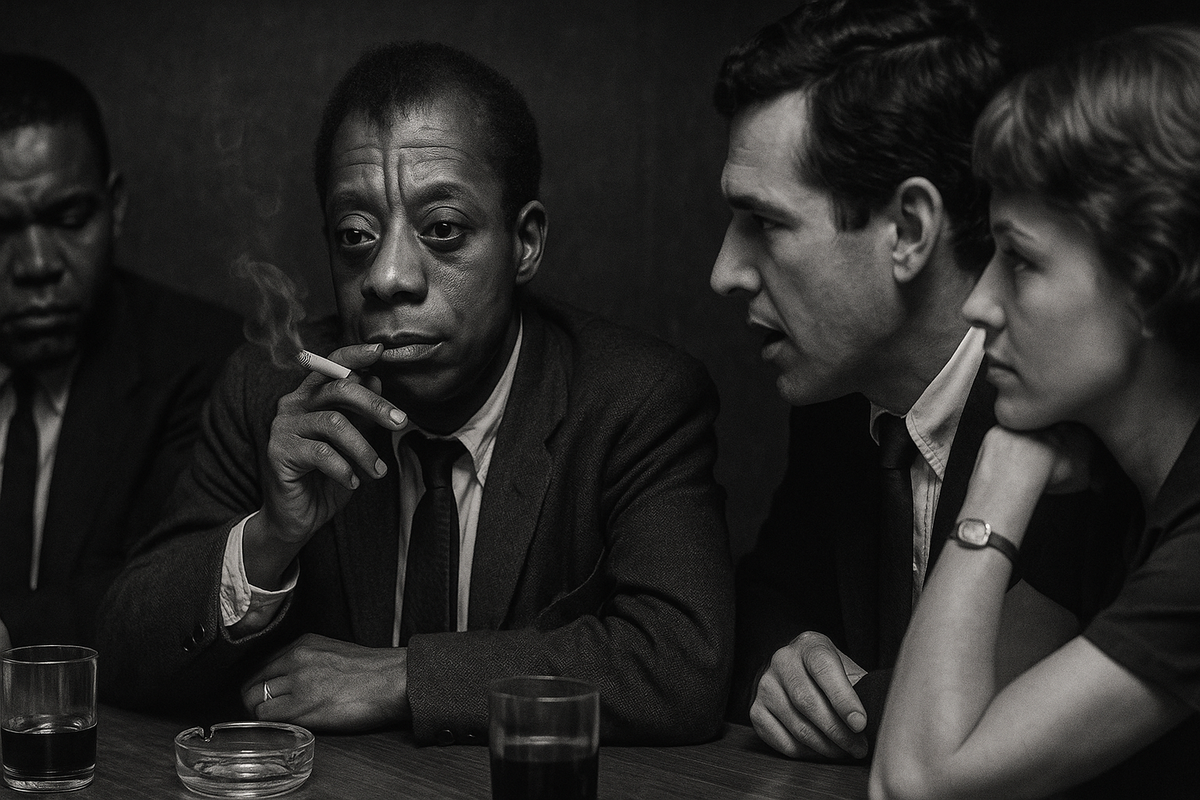
But Adelman also gave readers the other Baldwin. In dimly lit bars and restaurants, the writer leans back, cigarette smoke curling upward, mid-conversation with friends. A night shot captures him walking Harlem streets with actor Ossie Davis—grounded, human, part of a community rather than elevated above it. These weren't posed celebrity portraits. They were documentary evidence of a life split between two incompatible demands: to be intimate and to be everywhere.
Adelman understood what Elkoff wrote: Baldwin was both universally known and fundamentally unknowable.
Esquire's Formula: Literature Meets Cultural Power
The Baldwin feature exemplified Esquire's editorial genius in the 1960s. Under editor Harold Hayes, the magazine had become something unprecedented—a hybrid of sharp fashion coverage, longform journalism, literary fiction, and cultural analysis that refused to stay in its lane.
Esquire didn't just report on the Civil Rights Movement. It profiled its most complex voices with the same seriousness it brought to hemlines and highballs. It published Baldwin alongside Norman Mailer, Gay Talese, and Tom Wolfe. It treated magazine photography as art, elevating shooters like Carl Fischer and Bob Adelman to the level of cultural documentarians.
This wasn't accidental. Esquire in 1964 understood that American masculinity, politics, literature, and style were inseparable. The magazine's readers—educated, urban, culturally ambitious—wanted more than fashion tips. They wanted to understand the country tearing itself apart. Baldwin, caught between art and activism, was the perfect subject.
The Historical Stakes
Timing matters. The August 1964 issue hit newsstands weeks after Johnson signed the Civil Rights Act of 1964—legislation that outlawed segregation in public spaces but couldn't legislate away centuries of violence and contempt. Mississippi was burning. Activists James Chaney, Andrew Goodman, and Michael Schwerner had just been murdered. The country was convulsing.
Baldwin had already published Notes of a Native Son (1955) and The Fire Next Time (1963), essays that combined moral clarity with devastating prose. Television appearances and campus lectures had made him a household name. But fame in 1964 meant something different for a Black intellectual than it did for a white novelist. Baldwin wasn't just analyzed—he was interrogated. His work wasn't just reviewed—it was weaponized in political debates he never asked to referee.
Esquire captured Baldwin at the apex of this impossible position. The article doesn't resolve the contradictions. It presents them honestly: the novelist who wanted to write but was needed as a witness, the artist who craved solitude but was never allowed to be alone.
What Baldwin's Burden Still Teaches
The Artist-Activist Divide
What happens when the public decides an artist must also be an activist? Baldwin's struggle with this dual identity remains urgent for every creative figure navigating political visibility.
The Cost of Representation
Who pays the price when one voice is asked to represent millions? Baldwin's exhaustion speaks to the impossible burden of being made symbolic.
Fame as Consumption
How does celebrity serve those who never sought to be symbols? The piece reveals fame not as elevation but as a form of public devouring.
Magazine as Time Capsule
How do publications shape public understanding of race, politics, and literature? Esquire's approach to Baldwin demonstrates the power of longform journalism to capture complexity.
For the Serious Collector
Historical Synchronicity
Published in the immediate aftermath of the Civil Rights Act, the issue freezes a pivotal moment—hope and violence in equal measure.
Literary Significance
This is Baldwin at peak visibility, documented with unusual depth. The profile stands alongside his own essays as essential primary source material.
Photographic Legacy
Adelman's images have been reproduced in documentaries, textbooks, and museum exhibitions. Owning the original publication means owning the first appearance of these now-canonical photographs.
Peak Esquire
The 1960s represent the magazine's golden age. Issues from this era, especially those featuring major cultural figures, remain in consistent demand among institutions and collectors.
The August 1964 issue of Esquire represents mid-century magazine publishing at its most vital. It combines investigative journalism, literary portraiture, and visual artistry into a single artifact that documents not just Baldwin, but an entire cultural moment when America was forced to confront itself.
For collectors of Civil Rights history, Baldwin scholarship, or vintage Esquire, this issue is foundational.
Explore Original Vintage Magazines
Whether you're building an institutional archive, studying mid-century media, or honoring Baldwin's legacy, issues like this aren't reading material. They're primary sources—direct lines to the struggles, voices, and contradictions that shaped American culture.
Browse Esquire CollectionCoda
"Everybody Knows His Name" endures because it refused to simplify. Elkoff and Adelman gave readers Baldwin in full—brilliant and exhausted, accessible and consumed, private and unbearably public. They showed what it cost to be the man everyone wanted to hear from, and what it meant when the listening never stopped.
Revisiting this issue today isn't nostalgia. It's confronting the price of visibility, the limits of representation, and the ongoing question of what we demand from those we elevate. Baldwin paid that price. Esquire documented it. The record remains.