
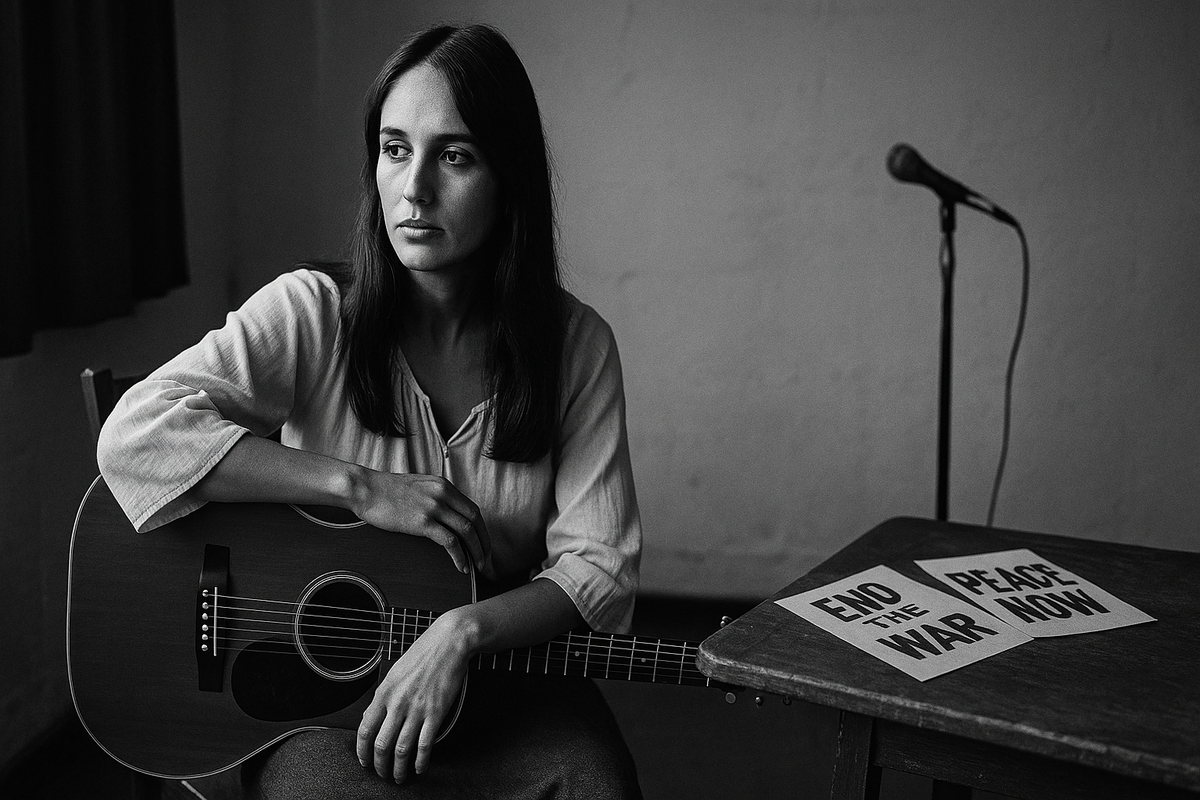
The Interview That Brought the Revolution to Middle America
How Joan Baez's July 1970 Playboy interview delivered the conscience of a generation to millions who'd never attended a protest
Open the July 1970 issue of Playboy Magazine, and you'll find something unexpected wedged between the centerfold and the liquor ads: a manifesto. Not dressed up as one, of course. Just Joan Baez, sitting down for twenty pages, talking about why she refused to pay her taxes, why she'd gone to jail for blocking draft offices, and why nonviolence—not the barricades, not the Molotovs—was the only weapon that mattered.
Two months earlier, National Guardsmen had opened fire on students at Kent State. Four dead. The country was tearing itself apart. And here was Playboy, a magazine built on fantasy and flesh, handing one of the counterculture's most uncompromising voices a microphone that reached millions of American men every month.
It was an improbable alliance. And it worked.
Archive Document
Historical Figure: Joan Baez, Folk Singer & Anti-War Activist
Issue Date: July 1970
Archive Source: Playboy Magazine
Historical Context: Two months after Kent State shootings; Vietnam War at its peak
The Folk Singer Who Wouldn't Compromise
By 1970, Joan Baez had long since transcended her role as Bob Dylan's duet partner or Pete Seeger's protégée. She'd become something more dangerous: a public conscience. Her soprano had soundtracked the civil rights marches of the early sixties. Her body had blocked the gates of military induction centers. Her tax returns—or rather, her refusal to file them—had made her a target of federal investigators.
She wasn't performing activism. She was living it, and paying for it. Multiple arrests. Time in jail. A growing FBI file. When Playboy's interviewer sat down with her, they weren't talking to a celebrity dabbling in protest chic. They were documenting someone who'd chosen a side and burned her bridges.
The interview captured all of it: her commitment to Gandhian nonviolence, even as younger radicals turned toward armed revolution. Her tax resistance, framed not as tax evasion but as moral refusal—why fund bombs when you could starve the war machine instead? Her critique of American consumerism, racism, and militarism, delivered without the safety net of academic distance or celebrity detachment.
And in unguarded moments, she admitted to exhaustion. To doubt. To the loneliness of standing firm when even your allies questioned whether pacifism was naive.
Playboy's Radical Gambit
Playboy in 1970 occupied a strange cultural position. On the surface: nude photography, swinging bachelor fantasies, ads for stereo equipment and sports cars. Underneath: some of the most important long-form interviews in American journalism.
Malcolm X had sat for Playboy in 1963, laying out his philosophy of Black nationalism to an audience that had never heard it unfiltered. Martin Luther King Jr. followed in 1965. Muhammad Ali in 1968, defending his refusal to fight in Vietnam. The magazine's interview franchise had become a platform where controversial figures could speak at length, uncensored, to a readership that might never pick up The Nation or attend a teach-in.
The Baez interview continued that tradition. Playboy didn't soften her edges or bury her radicalism in the back pages. They gave her the feature treatment—twenty pages, prime real estate, no apologies. For middle-class readers navigating the draft, watching their sons disappear into Southeast Asia, or simply trying to make sense of a country that seemed to be disintegrating, Baez's words landed with force.
The magazine's editors understood something crucial: their audience wasn't monolithic. The same man who bought Playboy for the centerfold might also be wrestling with whether to send his draft card back in protest. The magazine met its readers in that contradiction—offering both escape and confrontation, pleasure and politics, often in the same issue.
The Cover They Chose
The cover of the July 1970 issue didn't announce the Baez interview. Instead, it offered a surreal underwater photograph: a nude woman floating upside down, her body suspended in cool blues and greens, more dreamlike than erotic. It was a departure from the standard pin-up glamour—experimental, almost melancholic, reflecting the fractured aesthetics of the late sixties.
Inside, that dreamscape dissolved into hard questions about war, morality, and citizenship. The juxtaposition was deliberate. Playboy had always traded on contradictions: highbrow fiction and lowbrow fantasy, intellectual rigor and hedonistic lifestyle, T.S. Eliot and topless models. The Baez interview embodied that tension perfectly.
What She Said That Mattered
Baez's interview crystallized several arguments that defined the anti-war left in 1970:
Nonviolence as Strategy
She drew a direct line from Gandhi to King to her own activism, insisting that principled refusal carried more power than bombs or riots. At a moment when groups like the Weather Underground were going underground and planting explosives, Baez's pacifism felt both radical and conservative.
Tax Resistance
By refusing to fund the war through her tax dollars, she wasn't just making a symbolic gesture. She was inviting prosecution, risking financial ruin, and daring the government to jail her for her conscience.
The Cost of Dissent
She didn't romanticize activism. She talked about arrests, about sitting in jail cells, about the toll of standing against the current. But she also framed those costs as necessary—moral debts that had to be paid.
Systemic Critique
The war was a symptom, not the disease. Baez pointed to systemic racism, rampant consumerism, and a culture addicted to violence and power. She wasn't interested in minor reforms. She wanted a moral reckoning.
These weren't new arguments in 1970. But hearing them in Playboy—delivered to an audience that might not attend rallies or read underground newspapers—gave them reach. The magazine functioned as a bridge between the counterculture and the mainstream, translating dissent into a language middle America could understand, even if it couldn't accept.
The Legacy of July 1970
Playboy's cultural footprint has always been contested. Critics saw it as exploitative, reductive, a monument to male gaze and disposable pleasure. Defenders pointed to its literary credentials—fiction by Nabokov and Updike, interviews with Ayn Rand and Fidel Castro, journalism that took risks when other outlets played it safe.
The July 1970 issue makes the case for the latter. It's proof that the magazine could be both things at once: a product of its commercial appetites and a serious platform for ideas that mattered. The Baez interview has been cited by historians, reprinted in anthologies, and studied in courses on sixties radicalism. It endures because it documented something real—a woman of principle speaking truth to an audience that desperately needed to hear it, even if they didn't know it yet.
At a time when media was less fragmented than today, when a magazine could still shape national conversation, Playboy used its reach to platform voices that wouldn't have been heard otherwise. That's what makes issues like this one more than nostalgia. They're historical artifacts with weight.
Why Collectors Value This Issue
Historic Interview
The Baez interview ranks among the most politically significant features the magazine ever published. It captured a defining voice of the anti-war movement at full strength, two months after Kent State, when the stakes felt existential.
Experimental Cover Art
That underwater photograph, with its cool palette and unsettling composition, stands out as one of Playboy's most experimental visual choices of the decade. It's a collector's piece on aesthetics alone.
Cultural Document
The real value lies in what the issue represents: a moment when mainstream culture couldn't ignore the revolution anymore. When the politics of resistance crashed into the living rooms of suburban America.
Primary Source Material
For historians studying the era, it's primary source material—a snapshot of how dissent sounded when it reached beyond the usual activist circles. Holding this issue now is like holding evidence of a specific American fracture.
Explore the Archive
Our collection houses thousands of original Playboy magazines spanning the 1950s through the 1980s. Each issue is a window into its moment—tracking not just cultural shifts, but the exact points where politics, art, and commerce collided.
Browse Playboy Magazine CollectionThe Interview That Still Speaks
The July 1970 Playboy Magazine endures not because of its provocative cover or its commercial success. It endures because Joan Baez used those twenty pages to draw a line in the sand—to say that conscience mattered more than comfort, that nonviolence was strength, and that some wars couldn't be fought with anything except refusal.
Fifty-five years later, that message hasn't lost its edge. If anything, it's sharper. Because the questions Baez wrestled with—how to resist without becoming what you oppose, how to maintain moral clarity in a compromised world, how to keep fighting when the odds feel impossible—those questions don't age out.
They just wait for the next generation to answer them.