
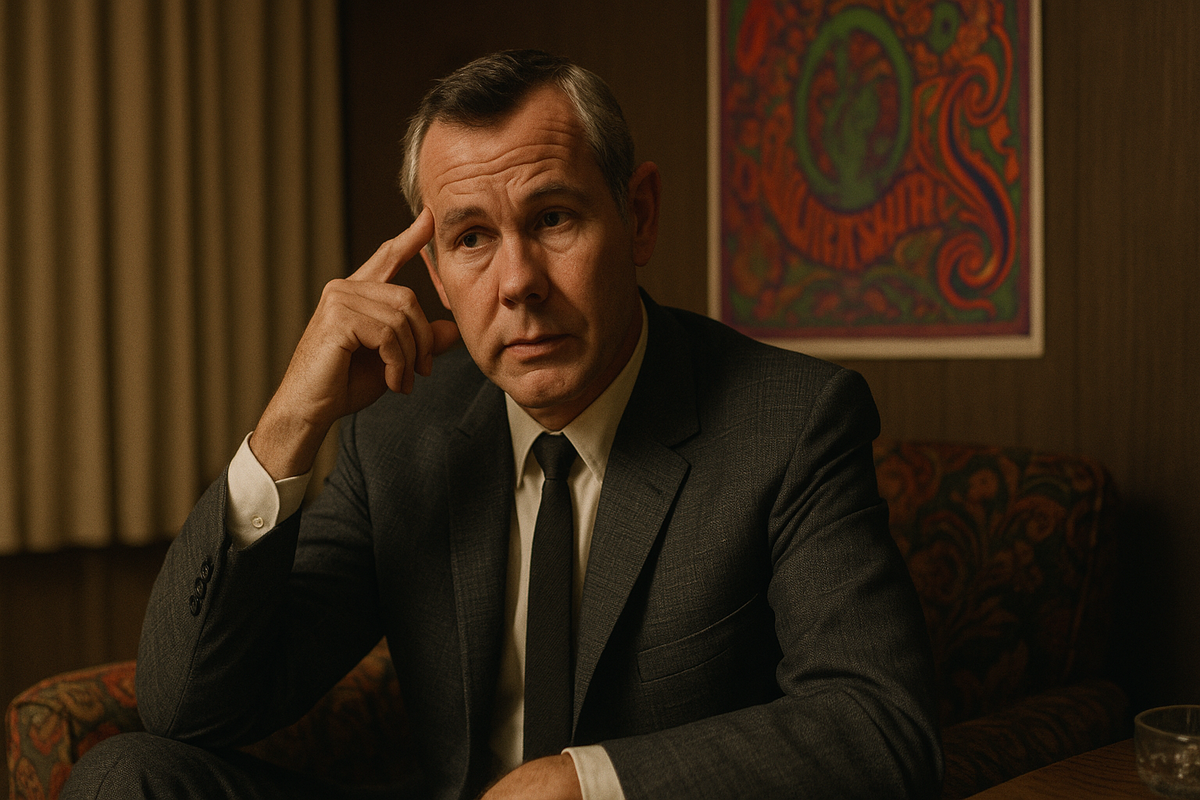
The Night Johnny Carson Confessed
Inside Playboy's Most Revealing 1967 Interview
Open the December 1967 issue of Playboy, and you won't find the Johnny Carson America thought it knew.
No safe network banter. No carefully rehearsed charm. Instead, the man who commanded 10 million viewers five nights a week—the undisputed king of late-night television—admitted something startling: the confident host was a performance, and the real Carson was often insecure, exhausted, and suffocating under the weight of fame.
This wasn't tabloid gossip. It was a 20-page excavation of the psyche behind America's most trusted smile, published at the exact moment when Carson's cultural power peaked and the country's moral compass spun wildly off-axis. The Sexual Revolution was demolishing old taboos. Vietnam protests were tearing campuses apart. And Playboy—with its psychedelic Christmas cover blazing in green, orange, and violet—was documenting it all.
The Carson interview wasn't just entertainment journalism. It was a cultural X-ray.
Archive Details
Historical Figure: Johnny Carson, Host of The Tonight Show
Issue Date: December 1967
Archive Source: Playboy Magazine
Cultural Context: Sexual Revolution, Vietnam War Era, Psychedelic Movement
When Television's Biggest Star Pulled Back the Curtain
By 1967, Johnny Carson had already transformed The Tonight Show into something beyond entertainment—a nightly ritual, a national town square where America processed its anxieties through laughter. His monologues dissected political scandals and cultural absurdities with surgical precision. His interviews with celebrities, politicians, and provocateurs shaped public conversation.
Yet Carson remained enigmatic. Unlike the confessional stars of later decades, he guarded his private self ferociously. The Playboy interview broke that seal.
What emerged was a portrait of profound dislocation. Carson described celebrity as suffocating: "Everybody I meet in public seems to want to audition for me," he revealed, explaining how strangers hijacked his time with unsolicited jokes and routines. He confessed to claustrophobia in crowds, to frustration with constant recognition, to the burden of filling nearly eight hours of live television weekly while maintaining razor-sharp wit for 90 minutes nightly.
The work was relentless. The scrutiny was unending. And the man behind the desk was not the man on camera.
The Critique No One Expected
Playboy gave Carson permission to bite the hand that fed him. He didn't hold back.
Television, Carson argued, was drowning in "junk"—shallow, commercial programming that prioritized ratings over substance. Even as he dominated the medium, he worried it was squandering its power. This wasn't self-deprecation; it was a damning indictment from the inside, reflecting the broader disillusionment many Americans felt toward mass media as the 1960s convulsed with change.
His frankness extended to topics no network host would touch on air. Asked about America's sexual mores, Carson dismissed outdated prohibitions with clarity: it was "ludicrous to declare that sex is wrong if you're not married," he said, noting that most Americans had already rejected such taboos. These weren't throwaway comments—they were declarations aligned with the Sexual Revolution's most provocative arguments, published in a magazine built to challenge convention.
For readers in 1967, this was revelation. The Carson they invited into their living rooms each night held opinions far sharper, more critical, and more liberal than his on-air persona suggested.
Why Playboy Mattered Beyond the Centerfold
The December 1967 issue exemplified why Playboy transcended its reputation. Yes, Hugh Hefner's magazine featured provocative photography. But it also published some of the era's most unflinching journalism and cultural criticism—interviews with Malcolm X, Martin Luther King Jr., Fidel Castro, and Bob Dylan that pushed boundaries and provoked thought.
The Carson interview fit this tradition perfectly: exhaustive, probing, unafraid to explore uncomfortable truths. At 20-plus pages, it granted space for complexity, for contradiction, for the kind of depth television never allowed.
The magazine's psychedelic cover—a swirling, mind-bending reimagining of the Playboy Bunny rendered in countercultural colors—signaled Playboy's willingness to evolve with the times. Inside, the Carson piece sat alongside fiction, investigative reporting, and fashion spreads, creating a cultural document that captured 1967's tensions: tradition versus liberation, private authenticity versus public performance, mass entertainment versus individual truth.
Key Themes from Carson's Confession
Privacy and the Burden of Fame
Carson revealed how celebrity stripped him of anonymity and peace. He described feeling claustrophobic in public, frustrated by constant intrusions, and overwhelmed by strangers demanding his attention. The blessing of fame had become a suffocating curse.
The Demands of Television
Behind the effortless charm was relentless pressure. Carson explained the exhausting reality of producing nearly eight hours of live content weekly, preparing fresh monologues, and maintaining sharp wit night after night. The king of late-night was working harder than anyone knew.
Criticism of Television as a Medium
Even while dominating television, Carson worried the medium was failing. He criticized its shallow commercialism and prioritization of ratings over quality—a damning insider's view of the very industry that made him a star.
Views on Sex and Morality
Aligned with Playboy's editorial mission, Carson spoke candidly about the Sexual Revolution. He dismissed traditional prohibitions as outdated, arguing that Americans had already moved past rigid moral codes about premarital relationships.
The Dual Persona of Johnny Carson
Perhaps the most revealing admission: the confident television host was a performance. The real Carson was more serious, sometimes shy, occasionally insecure. America saw the mask; Playboy readers glimpsed the man.
A Document That Still Resonates
The December 1967 Playboy endures because it documented genuine cultural transformation. Every page—from the kaleidoscopic cover to Carson's confessions—captured a society negotiating massive shifts in values, media, and identity.
Carson's reflections on fame's isolation, television's commercial pressures, and America's evolving morality weren't just timely—they were prophetic. The anxieties he articulated in 1967 have only intensified: celebrity culture has metastasized, media has fractured into endless channels and platforms, and debates over privacy, authenticity, and public performance remain unresolved.
To read this interview today is to recognize how little has changed about the fundamental tensions between who we are and who we perform for others.
Why This Issue Matters to Collectors
Historical Timing
Carson at 42, five years into his Tonight Show tenure but decades before retirement—captured at the height of his influence and the peak of cultural upheaval.
Iconic Design
The psychedelic Christmas cover ranks among Playboy's most distinctive 1960s artwork, a visual artifact of counterculture aesthetics entering mainstream publishing.
Cultural Rarity
Carson gave few candid interviews. This 20-page conversation represents one of the only unfiltered windows into his worldview during his prime.
Archival Significance
The issue functions as a time capsule—Vietnam, the Sexual Revolution, television's golden age, and psychedelic art converging in a single publication.
Own a Piece of Late-Night History
For collectors of vintage magazines, cultural historians, or anyone fascinated by American media's evolution, the December 1967 Playboy with Johnny Carson's interview is essential. It's not just a celebrity profile—it's a primary source document revealing how one of television's most guarded figures understood his own moment in history.
Browse Playboy Magazine CollectionFrom the 1950s through the 1980s, each issue tells a story—not just of sexuality, but of politics, literature, cultural upheaval, and the evolution of American identity. These aren't magazines. They're archives.
The December 1967 issue of Playboy remains a cultural landmark: a psychedelic cover reflecting an era's aesthetic rebellion, an interview exposing television's greatest host at his most vulnerable, and a publication unafraid to document America's most turbulent transformations. For anyone who collects history rather than just reads about it, this is the artifact that brings 1967 into focus—raw, honest, and impossibly relevant.