
The Storm Before the Vaults
When The New Yorker Found Beauty in Manhattan's Buried Dead
Three fashionable young people cling to each other beneath a tree. Lightning splits the August sky. Their picnic lies abandoned—bottles toppled, basket forgotten. The storm has arrived without warning.
This was the cover of The New Yorker on August 4, 1934. Inside, past the cartoons and the cocktail advertisements, past the fiction and the theater reviews, readers discovered something stranger than the weather: an essay about corpses beneath their feet.
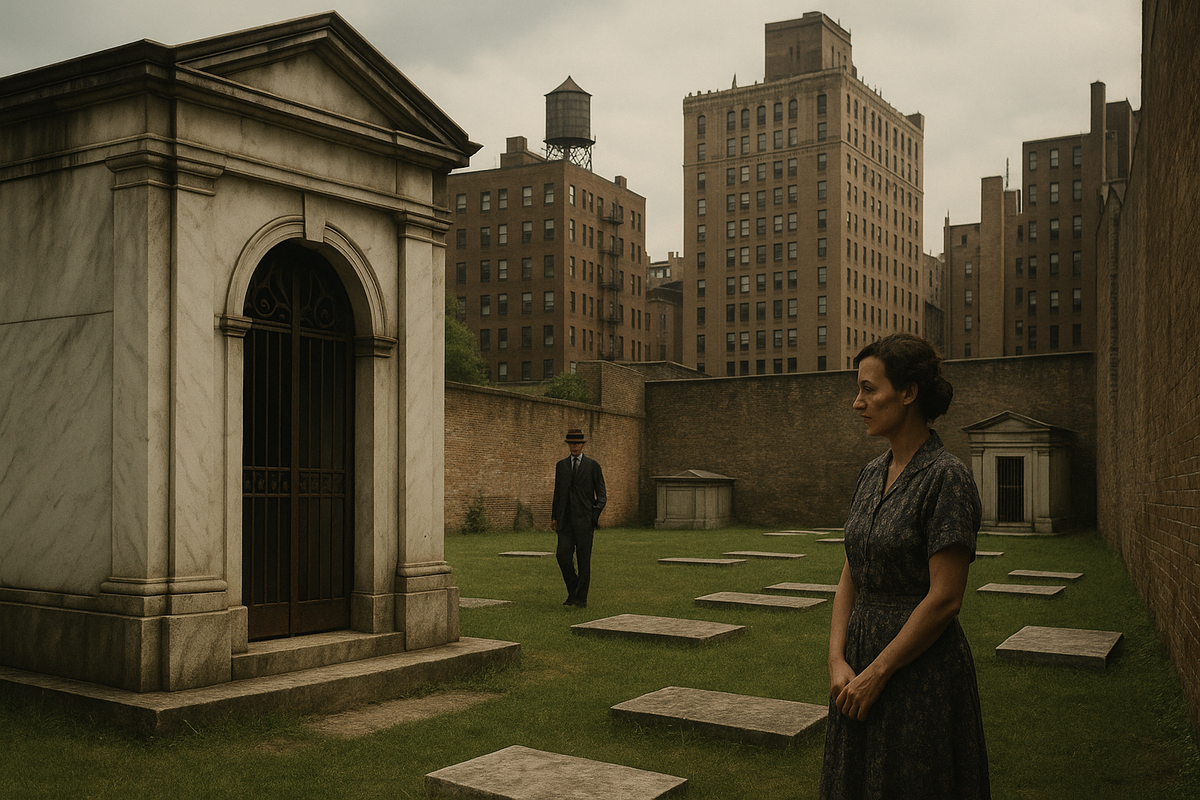
"A Reporter at Large: The Marble Cemeteries" pulled back the iron gates on one of Manhattan's most peculiar secrets—the private burial vaults of the 1830s and 1840s, still standing in a city that had long forgotten them. While the Depression raged above ground and Mayor Fiorello La Guardia remade the city's infrastructure, The New Yorker asked a different question: What happens to memory when a city refuses to stand still?
The answer lay in marble, behind brick walls, in neighborhoods where no one thought to look anymore.
Issue Details
Publication: The New Yorker
Issue Date: August 4, 1934
Featured Article: "A Reporter at Large: The Marble Cemeteries"
Historical Context: Great Depression Era, New York City
Cover Art: Art Deco illustration of storm-swept picnic scene
A City Built on Cholera and Class
By 1934, the Marble Cemeteries had been invisible for decades. Apartment buildings rose around them. Commercial storefronts blocked their entrances. They had become architectural ghosts—expensive, permanent tombs rendered obsolete by the relentless churn of urban development.
But in the 1830s, when cholera swept through Manhattan's crowded streets, these cemeteries represented salvation. Overcrowded churchyards bred disease. The city's elite sought "sanitary" alternatives, and the Marble Cemeteries answered: enclosed plots, underground vaults lined with white marble, iron gates that locked out both contagion and the common classes.
They were not just burial grounds. They were declarations—of wealth, of permanence, of the belief that some families deserved to be remembered while others did not.
The New Yorker understood this perfectly. The magazine had built its reputation on exposing the ironies of New York life, and here was irony incarnate: monuments to permanence that the city had already begun to forget.
The Reporter at Large, or How Journalism Became Literature
The Marble Cemeteries piece arrived at a pivotal moment in American journalism. By 1934, The New Yorker had established itself as the city's most sophisticated cultural observer, pioneering a hybrid form that blended reportage with literary craft. E.B. White and Joseph Mitchell had shown that journalism could transcend mere facts—that a city's forgotten corners could become windows into the human condition.
This was the early architecture of what would become the magazine's signature "Reporter at Large" format: detailed observation, understated irony, and an almost archaeological attention to what everyone else had stopped noticing.
The writing refused to sensationalize. Instead, it described the marble vaults, the brick walls, the iron gates with such careful precision that they became something more than physical objects. They transformed into symbols—of memory's fragility, of class distinction's persistence, of the tension between what we build to last and what we allow to vanish.
For readers in 1934, living through economic collapse in a city where even skyscrapers felt temporary, this meditation on buried permanence carried particular weight. The marble endured. The families who commissioned it? Forgotten.
Decoding the Marble: Key Themes
Hidden in Plain Sight
The cemeteries were tucked behind brick walls, invisible unless you knew where to look. Their secrecy gave them an air of mystery that persisted even as the city transformed around them.
Class and Exclusivity
Unlike public graveyards, these vaults were reserved for prominent New York families. They reflected social hierarchies that persisted even in death.
Architecture of Memory
With white marble vaults, iron gates, and carefully laid plots, the cemeteries embodied the 19th-century belief in order, permanence, and visibility.
The Irony of Time
Once symbols of wealth and distinction, the cemeteries by the Depression era had become relics, their grandeur out of place in a rapidly modernizing metropolis.
Why the Past Refuses to Stay Buried
The New Yorker of the 1930s succeeded because it understood a fundamental truth: sophistication requires both humor and depth, both irony and genuine feeling. In an era of breadlines and public works projects, the magazine offered its readers something necessary—a space where wit and seriousness could coexist, where forgotten cemeteries could matter as much as mayoral politics.
These issues remain compelling because they capture how a generation processed upheaval. The cartoons, the covers, the Reporter at Large essays—they form a complete portrait of urban consciousness during one of America's most turbulent decades.
More than ninety years later, they still speak. The wit has not faded. The observations remain sharp. The tension between permanence and impermanence? Still unresolved.
What Makes This Issue Invaluable
Historical Timing
Depression-era New York hovers between catastrophe and reinvention. The city's anxieties saturate every page, yet the magazine refuses either despair or false optimism.
Art Deco Masterpiece
That storm-swept picnic captures the magazine's entire philosophy in a single image—sophistication interrupted by forces beyond control, irony rendered in ink.
Literary Significance
This issue represents the magazine's early experiments with long-form urban reportage, the foundation of a tradition that would reshape American nonfiction.
Cultural Artifact
To hold this issue is to hold a specific moment in New York's intellectual and cultural life—when memory and ambition occupied the same contested space.
Coda
The Marble Cemeteries still exist. If you know where to look in Manhattan, you can find them—behind modern buildings, past locked gates, in spaces the city has built around but never quite erased.
Like those vaults, the August 4, 1934 issue of The New Yorker persists. Not because anyone planned for its survival, but because some things—marble, memory, the right combination of words—resist erasure better than others.
To hold this issue today is to hold buried history made visible again. The storm on the cover has long since passed. The picnickers have vanished. The marble remains.
The Collection
If the August 4, 1934 issue has captured your attention, thousands more await. Our archive spans from the 1920s through the modern era—each decade preserving its own voice, its own anxieties, its own vision of what mattered.
Browse The New Yorker Magazine CollectionWhether you collect for investment, research, or the simple pleasure of holding history in your hands, these magazines offer direct access to how the past understood itself.