
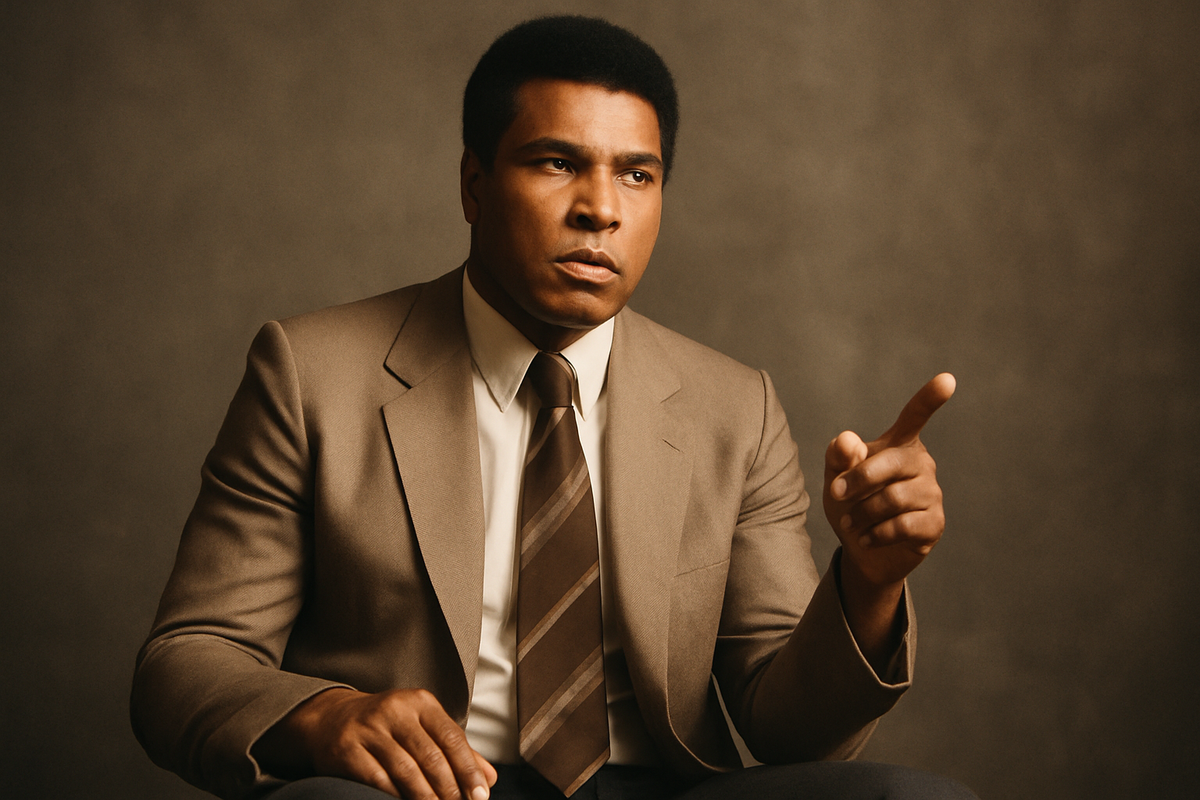
Muhammad Ali, Black Power, and the Global Struggle for Dignity
Inside the November 1975 Playboy Interview That Defined an Era
When Americans tore open the November 1975 issue of Playboy Magazine, they had no idea they were about to encounter a reckoning.
Beneath a cover promising "More Sex in Cinema" lay something far more explosive: Muhammad Ali—unfiltered, unrepentant, and unwilling to play the role America had scripted for him. This wasn't another puff piece about boxing. This was a 33-year-old heavyweight champion at the absolute zenith of his power, using Playboy's microphone to deliver a manifesto on race, religion, and revolution that would make suburban coffee tables across the country a little less comfortable.
For readers expecting sports talk, what they got instead was philosophy, fury, and poetry. Ali had just pulled off the impossible in Zaire, knocking out George Foreman in the "Rumble in the Jungle." He had reclaimed his crown after the U.S. government tried to destroy him for refusing the Vietnam draft. And now, in the pages of America's most provocative magazine, he was explaining exactly why he would do it all again.
This wasn't just an interview. It was a cultural inflection point—captured in ink and glossy paper, preserved for posterity.
Archive Details
Historical Figure: Muhammad Ali
Issue Date: November 1975
Archive Source: Playboy Magazine
Cultural Context: Post-Vietnam America, Black Power Movement, Sexual Revolution
The America That Made Muhammad Ali Necessary
The mid-1970s were a nation coming apart at the seams. Vietnam had collapsed in humiliation just months earlier. Nixon had resigned in disgrace the previous year, leaving Watergate's stench hanging over Washington. Gas lines snaked around city blocks. Inflation devoured paychecks. The country that had promised to lead the free world was now asking whether it could lead itself.
For Black Americans, the moment was even more fraught. The Civil Rights Movement's legislative victories—the Civil Rights Act, the Voting Rights Act—had delivered legal equality on paper. But the dream of integration was curdling into something angrier, more defiant. The Black Power Movement, led by voices like Stokely Carmichael, Angela Davis, and the Nation of Islam, rejected the notion that freedom meant assimilation into white institutions. They demanded self-determination, economic autonomy, and a pride in Blackness that didn't require white approval.
Muhammad Ali stood at the crossroads of all these forces. He had been stripped of his heavyweight title in 1967 for refusing induction into the Army, declaring with devastating simplicity: "I ain't got no quarrel with them Viet Cong." The stance cost him nearly four years in his physical prime, but it transformed him from athlete into icon—a living symbol of resistance for antiwar activists, civil rights supporters, and colonized peoples worldwide.
By November 1975, Ali had roared back. His eighth-round knockout of George Foreman in Kinshasa had been more than a boxing match—it had been theater, strategy, and psychological warfare rolled into one unforgettable night. The world was watching Ali again. And Playboy was ready to let him speak.
Why Playboy Mattered in 1975
By the mid-1970s, Playboy had evolved into something far stranger and more significant than its critics acknowledged. Yes, it was the flagship of the sexual revolution, pushing boundaries with provocative photography that scandalized parents and pastors alike. But it was also a cultural laboratory—a place where serious journalism, literary fiction, and intellectual debate coexisted with centerfolds and bachelor-pad advertising.
The magazine's legendary Playboy Interview series had become essential reading for anyone tracking the cultural and political currents of the era. Malcolm X, Martin Luther King Jr., John Lennon, Jimmy Carter—Playboy gave these figures space to speak at length, unedited and unafraid. The interviews were marathons, not soundbites. Readers came for the titillation; they stayed for the ideas.
The November 1975 issue embodied this duality perfectly. The cover—a blonde model posed provocatively with popcorn, teasing the "More Sex in Cinema" feature—promised the usual Playboy formula. But turn past the advertisements and the fiction, and there was Ali: dozens of pages of raw, unvarnished conversation about race, faith, boxing, and the future of Black America.
Playboy didn't sanitize him. It didn't try to make him palatable. And that's precisely why the interview still matters.
Inside the Interview: What Ali Actually Said
The Ali who emerges from the November 1975 Playboy Interview is not the sanitized, sentimental figure we remember from later decades. This is Ali at his most uncompromising—brilliant, confrontational, and utterly convinced that America, as structured, could never deliver real freedom to Black people.
On Black Independence
Ali didn't mince words. He argued that integration was a fantasy, that Black Americans needed to control their own institutions—schools, businesses, neighborhoods—if they ever hoped to be truly free. Freedom, he insisted, couldn't be granted by white America. It had to be seized, built, and defended.
On Islam as Liberation
Ali spoke about his conversion to Islam and his allegiance to Elijah Muhammad and the Nation of Islam as the defining transformation of his life. The faith gave him discipline, purpose, and a framework for resisting the pull of assimilation. It wasn't just religion—it was armor.
On the "Rumble in the Jungle"
Ali walked readers through his legendary 1974 fight in Zaire with the precision of a general recounting a campaign. He explained the "rope-a-dope" strategy—letting Foreman punch himself into exhaustion—as psychological warfare as much as physical tactics. Boxing, Ali revealed, was chess played with fists.
On American Hypocrisy
Ali connected the dots between America's wars abroad and its oppression at home. A country that preached democracy while denying equality to millions of its own citizens had no moral authority, he argued. Vietnam, racism, and poverty weren't separate problems—they were symptoms of the same disease.
The Poet Fighter: Throughout the interview, Ali's trademark wordplay and rhymed couplets turned the conversation into performance art. He wasn't just answering questions—he was composing a legacy in real time, proving that his genius extended far beyond the ring.
What made the interview electrifying wasn't just what Ali said—it was that Playboy let him say it. No other mainstream publication in 1975 would have given him that platform, that freedom, that respect.
The Legacy of Playboy's Interview Series
Long before podcasts or 24-hour cable news, Playboy's interview series defined what an in-depth conversation could be. The magazine gave subjects room to breathe, to contradict themselves, to reveal complexities that soundbite culture would have flattened.
For Ali, Playboy was the ideal platform. No other mainstream outlet would have allowed him to discuss Black nationalism, Islam, and American imperialism alongside his boxing career with such freedom. Playboy amplified his voice and ensured it reached millions who might never have encountered it otherwise.
That tradition—bold, unfiltered, intellectually serious—is what makes vintage issues like this more than just collectibles. They're historical documents, capturing voices and moments that shaped the world we inherited.
Why This Issue Matters to Collectors
Historical Timing
Published just a year after Ali's triumph in Zaire, it captures him at the absolute peak of his cultural and athletic power—a man who had conquered both the ring and the U.S. government's attempts to silence him.
Landmark Journalism
The Ali interview ranks among the most cited and studied in Playboy's history. It remains required reading for scholars of race, religion, sports, and 20th-century American culture.
Cultural Contradiction
The issue itself is a perfect artifact of the 1970s—sexual liberation and political rebellion, hedonism and revolution, all bound together in one glossy package.
Collector Demand
Issues that pair iconic interviews with celebrity presence are consistently the most valuable. This one, with Ali's voice at its center, commands serious attention from historians and collectors alike.
To own this issue is to hold a time capsule—a moment when America was forced to reckon with one of its most dangerous and brilliant citizens, and when a magazine had the courage to let him speak without apology.
Explore the Archive
Thousands of original Playboy magazines, spanning the 1950s through the 1990s, are available in our collection. Trace entire decades of cultural transformation—from the sexual revolution and civil rights to politics, art, and fashion—as they unfolded in real time.
Browse Playboy Magazine CollectionThe November 1975 issue of Playboy Magazine remains one of the most significant cultural documents of the 1970s. Its interview with Muhammad Ali—fighter, poet, Muslim, revolutionary—gave readers an intimate, unvarnished look at one of the most influential and controversial figures of the 20th century.
To hold this issue is to hold a piece of history: a moment when a heavyweight champion used his platform not merely to discuss boxing but to challenge the entire structure of American power. Thanks to Playboy's willingness to let dangerous ideas breathe, that conversation is preserved—waiting for anyone brave enough to engage with it nearly fifty years later.