
When "The Nature Boy" Declared War on the Future
Inside Wrestling's 1990 Portrait of a Champion Who Refused to Fade
March 1990. Ric Flair stood at a precipice most champions never face: the moment when a decade of dominance becomes a question mark.
At newsstands across America, Inside Wrestling published something rare in sports entertainment journalism—not a puff piece, not a hit job, but a psychological profile of a man who'd spent ten years as "The Man" and couldn't fathom why that should ever end. The magazine's "Hotseat" feature didn't just chronicle Flair's reign. It captured him mid-defiance, sweat-stained and snarling, as a new generation of challengers—bigger, younger, hungrier—closed in from every direction.
This wasn't retirement planning. This was a declaration of war.
Archive Details
Historical Figure: Ric Flair, NWA World Heavyweight Champion
Publication: Inside Wrestling, March 1990 Issue
Feature: "Hotseat" Interview – One Decade of Dominance Isn't Enough
Historical Context: NWA-to-WCW Transition Era
The Numbers That Built a Legend
By the time Inside Wrestling went to press, Flair's résumé read like a fantasy booking sheet made flesh: six NWA World Championship reigns, feuds with Dusty Rhodes and Harley Race that had redefined what main events could be, and a 1989 trilogy with Ricky Steamboat that wrestling historians still dissect frame by frame.
But the magazine's most staggering revelation came in a single statistic: Flair had held the NWA United States Championship for a combined 2,686 days during the 1980s. That's not a typo. Nearly three-quarters of the decade, Flair wore secondary gold while simultaneously building his World Championship legacy—a workload that would destroy lesser performers.
The article didn't present this as trivia. It weaponized it. Every number became ammunition in Flair's case that he'd earned the right to decide when—and if—he'd ever step aside.
The Enemies at the Gate
Terry Funk: The Man Who Made Flair Bleed
If there's a hierarchy of pain in professional wrestling, Terry Funk had shown Flair depths he didn't know existed. Their 1989 "I Quit" match—a brutality so visceral that even kayfabe couldn't fully contain it—had left scars beyond the physical.
In the Inside Wrestling interview, Flair's words carry an edge sharper than any promo: he respected Funk, but trust? That was gone. Funk had crossed lines that most opponents wouldn't dare approach, and Flair knew that kind of violence couldn't be walked back. The article frames this not as a settled feud but as an uneasy truce—two gunslingers who'd proven they could destroy each other, now circling at a distance.
The Great Muta: Flash vs. Foundation
Then there was the specter from Japan. The Great Muta represented everything American wrestling was terrified of in 1990: youth, innovation, and a style so unpredictable it seemed to bend the rules of physics. Inside Wrestling described him as "terrifyingly agile," and the accompanying photo—Flair cranking a leglock while Muta's body contorts in mid-counter—tells the story of two philosophies colliding.
Flair's assessment? Clinical. He acknowledged Muta's gifts but framed the rivalry as experience versus experimentation. Flair had spent a decade proving that fundamentals outlast flash. Muta would be the test case for whether that era was ending.
Lex Luger: The Heir Who Wouldn't Wait
But the real target of Flair's venom was Lex Luger—the "Total Package," chiseled from a bodybuilder's fever dream and packaged as the future whether Flair liked it or not. The magazine captures Flair's contempt in high definition: Luger had improved since their 1988 wars, sure, but improvement wasn't championship material. Luger lacked the one thing Flair valued above all else: mental toughness.
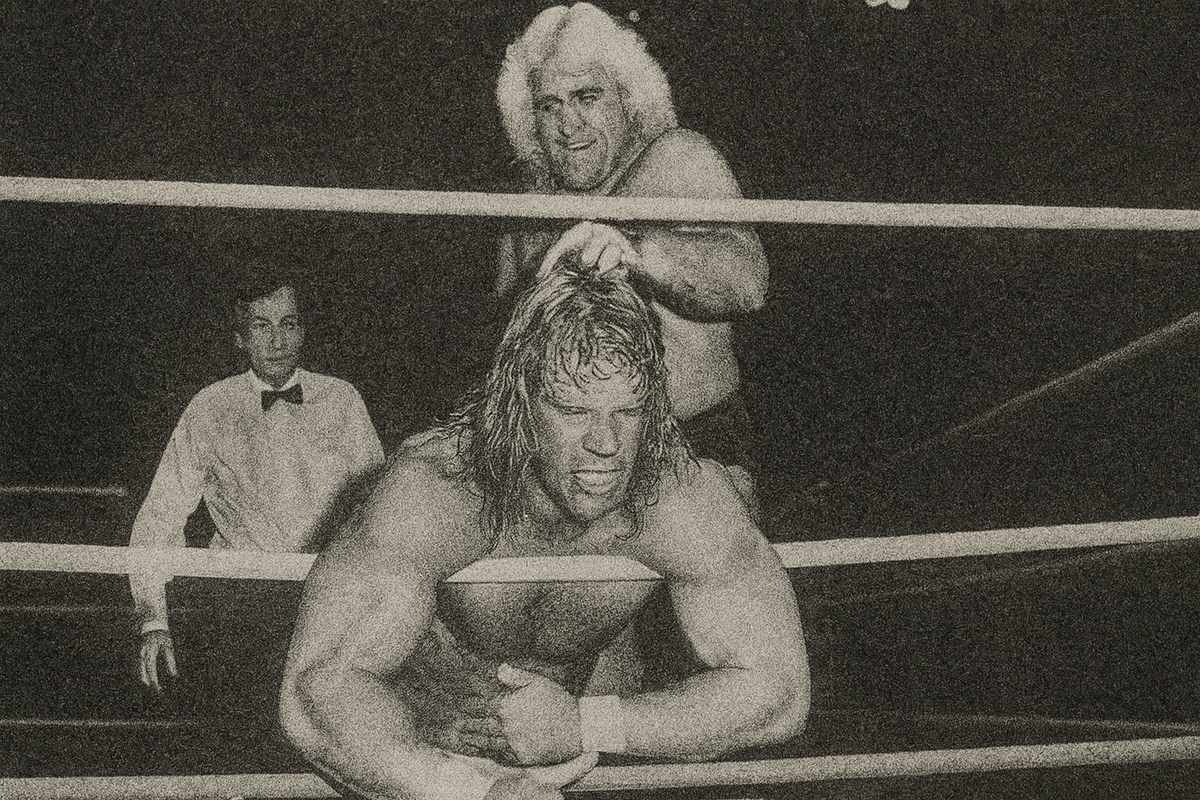
One photo says it all—Luger straining against the ropes, muscles flexed, while Flair grinds him down with technique that requires no theatrics. It's a visual thesis: power is nothing without the psychology to wield it. Flair wasn't just defending his title against Luger. He was defending the entire philosophy that had defined his generation.
The Fragility Beneath the Strut
For all his bravado, Flair couldn't hide the cracks. The article reveals he'd been sidelined for 76 days with a neck injury—a significant admission in an era when champions worked through pain as a badge of honor. But Flair reframes even this vulnerability as strength: his opponents couldn't handle what he'd endured. His resilience became another weapon, another reason why he—and only he—deserved to carry the NWA World Championship into the year 2000.
That timeline matters. In 1990, the year 2000 wasn't just a date. It was mythology, the distant future where flying cars and moonbases would exist. Flair's declaration that he'd still be champion then wasn't confidence. It was madness. Beautiful, defiant madness.
Why Inside Wrestling Captured What Others Missed
Wrestling magazines in 1990 operated in a unique space—too smart to be pure propaganda, too loyal to the business to break kayfabe entirely. Inside Wrestling mastered this tightrope. The "Hotseat" format gave Flair room to speak in his own voice while the magazine's framing added layers of analysis that elevated the content beyond transcription.
The photography deserves special mention. One image—Flair backstage, championship belt gleaming against his chest, "Nature Boy" robe hanging like a royal standard—isn't just documentation. It's iconography. The sweat isn't wiped away. The exhaustion isn't hidden. This is what dominance looks like when the cameras stop rolling: tired, battered, and utterly unwilling to surrender.
The captions did more than describe—they contextualized. A leglock wasn't just a hold; it was Flair's answer to Muta's innovation. A rope break wasn't just a pause; it was a test of Luger's conditioning. For fans in the pre-internet era, these magazines were the only deep dive available, and Inside Wrestling understood that readers craved meaning, not just results.
The Moment Wrestling Changed Directions
March 1990 sits at a fascinating crossroads in wrestling history. The NWA's grip on the industry was loosening. WCW was emerging as a separate entity. Hulk Hogan's WWF had conquered mainstream America, leaving regional promotions scrambling for relevance. And Flair—the embodiment of the old system—was trying to prove that territorial wrestling's greatest champion could survive the national television era.
This Inside Wrestling feature captures that tension with unusual clarity. Flair's insistence on carrying the title another decade reads differently now, knowing what came next: his 1991 departure to WWF, the "Real World's Champion" angle, his return to WCW, and ultimately a career that stretched far beyond what anyone in 1990 could have predicted. But the article doesn't have that hindsight. It presents Flair at the apex of uncertainty, which makes every claim and every boast feel genuinely precarious.
The new generation Flair dismissed? Luger would indeed become champion. Muta would influence an entire style of wrestling. Even Funk, at 45, would keep reinventing himself for decades. Flair was right that he'd endure—but wrong about the terms. The world he fought to preserve was already disappearing.
Deep Dive: Key Revelations from the Archive
The Decade Declaration — Flair proclaims his intention to carry the NWA World Championship into the year 2000, a bold statement that underscores both his confidence and the era's uncertainty.
The Funk Violence — Terry Funk is identified as the opponent who inflicted the most physical and psychological damage, with Flair admitting trust was permanently broken despite maintaining respect.
The Muta Test — The Great Muta represents the new wave of international innovation, with Flair framing the rivalry as fundamentals versus flash in a battle for wrestling's future direction.
The Luger Contempt — Lex Luger emerges as Flair's primary target, with the champion questioning whether physical gifts alone could compensate for lack of mental toughness.
The Injury Reality — Flair reveals a 76-day absence due to neck injury, using his recovery as proof of superiority over opponents who couldn't endure similar hardship.
The Statistical Dominance — The magazine documents Flair's 2,686 days as NWA U.S. Champion during the 1980s, a record that contextualizes his unparalleled workload and longevity.
When Magazines Were the Only Gateway
Today's fans have instant access to match footage, shoot interviews, and statistical databases. In 1990, Inside Wrestling was the gateway. These magazines weren't just entertainment; they were infrastructure for fandom. They created the vocabulary fans used to debate in school cafeterias and on playground monkey bars. They shaped how we understood the storylines we watched on Saturday mornings.
Revisiting this issue now reveals how sophisticated that narrative construction was. The magazine didn't just report that Flair faced three challengers—it explained why each rivalry mattered, what psychological weaknesses each opponent exposed, and how Flair's philosophy of wrestling was being tested by changing times. This wasn't journalism; it was mythology-building in real-time.
And mythology, unlike news, doesn't decay with age. It becomes more valuable as the distance from the original moment grows.
Why This Issue Belongs in Every Serious Collection
The End of an Era's Beginning
This issue marks the precise moment when Flair's 1980s dominance became a 1990s question mark, preserved in real-time before anyone knew what would happen next.
Statistical Preservation
The 2,686-day U.S. Championship record, the six World Title reigns, the specific injury timelines—these details exist in few other places, making the magazine an irreplaceable reference.
Visual Archive
The photos aren't promotional stills. They're action shots and backstage moments that capture Flair's physical condition, his opponents' intensity, and the aesthetic of late-NWA/early-WCW presentation.
Cultural Time Capsule
Even the advertisements and design choices reflect 1990's wrestling culture: the typography, the muscle magazine aesthetic, the way kayfabe was honored even in "candid" interviews.
Generational Bridge
For fans who lived through this era, the issue triggers specific memories. For younger historians, it's a window into how wrestling discourse worked before the internet.
Scarcity Factor
Original copies in good condition have become increasingly scarce as attics are cleared and collections are liquidated. What survives serves as both artifact and evidence.
Own the Moment Flair Refused to Surrender
The March 1990 issue of Inside Wrestling isn't just a magazine—it's a snapshot of ambition colliding with inevitability. Holding this issue means holding the exact words and images that fans studied in 1990 as they wondered whether "The Nature Boy" could actually make it to the year 2000 as champion.
Browse Inside Wrestling Magazine CollectionWhether you're a completist collector, a wrestling historian, or someone preserving family memories of an era when wrestling magazines were sacred texts, these artifacts offer something digital archives never can: the physical weight of history.
The Champion Who Wouldn't Fade
In the final analysis, Inside Wrestling's March 1990 feature on Ric Flair matters because it captured a specific kind of hubris that only champions possess—the belief that will and talent can suspend time itself. Flair's declaration that ten years wasn't enough rings differently now, knowing he'd wrestle for another two decades. But in that moment, with Funk's violence still echoing, Muta's innovation accelerating, and Luger's muscles threatening to redefine what champions looked like, Flair's defiance was genuine uncertainty dressed in confidence.
The magazine preserved that uncertainty in amber. And for collectors, historians, and fans who understand that wrestling's greatest moments often happen in the space between victories, this issue remains essential—not despite its age, but because of it.
"The Nature Boy" eventually did fade, as all champions must. But on the pages of this magazine, he's frozen at the summit, refusing to descend, daring the future to make him.
That moment—that refusal—is what makes this issue collectible, memorable, and irreplaceable.