
The April 1993 Issue That Captured Gaming's Civil War
How Electronic Games Magazine documented Sega's improbable challenge to Nintendo's empire—in real time
Pick up the April 1993 issue of Electronic Games Magazine today, and you're not holding nostalgia. You're holding a battlefield dispatch.
This wasn't just another magazine hitting newsstands that spring. It was published at the exact moment Sega's Genesis had Nintendo pinned against the ropes for the first time in a decade—when the outcome of the 16-bit console war was still uncertain, when "Genesis Does What Nintendon't" wasn't a punchline but a legitimate threat. The issue's centerpiece, "The Genesis Story: Sega's Rocky Road to Success," remains one of the most vital contemporary records of how an underdog rewrote the rules of an industry.
For collectors and historians, this single issue functions as a time capsule from gaming's most consequential turning point. The analysis inside didn't have the benefit of hindsight. It was written in real-time, while the war was still being fought.
The Landscape Before the Storm
Context matters. By 1989, Nintendo didn't just dominate home gaming—it was home gaming. The NES had rescued the industry from the smoking crater of the 1983 crash, establishing a monopoly so complete that "Nintendo" became American shorthand for video games themselves. Retailers stocked what Nintendo approved. Developers published where Nintendo allowed. Parents bought what their kids called "a Nintendo," regardless of what system actually sat beneath the television.
Then Sega launched the Genesis, a 16-bit system promising arcade-quality graphics and faster gameplay. The initial response? Indifference. Nintendo's grip seemed unbreakable. The NES had become household infrastructure.
What happened next defied every business forecaster's expectations.
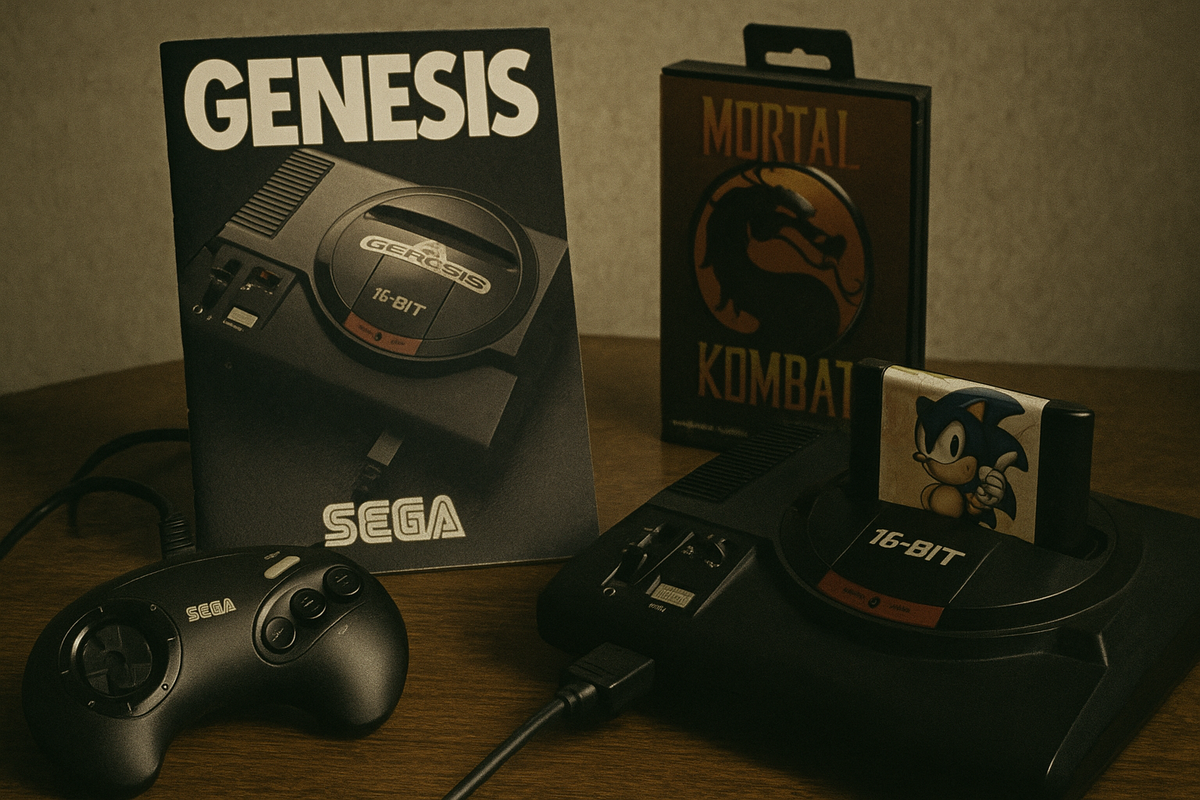
Sega didn't try to out-Nintendo Nintendo. It repositioned the entire battlefield. Instead of competing for the same eight-year-olds playing Super Mario Bros. 3, Sega targeted teenagers and young adults with edgier content, aggressive advertising, and a mascot who embodied speed and attitude over family-friendly charm. By 1991, Sonic the Hedgehog had arrived—not just as a game, but as a cultural symbol of what the Genesis represented.
By 1992-93, the impossible had happened: Nintendo's dominance was genuinely threatened. The Super Nintendo had launched as a counterstrike, but Sega held critical ground in the United States. The console war was no longer hypothetical.
Electronic Games Magazine documented this upheaval as it unfolded.
Archive Details
Publication: Electronic Games Magazine
Issue Date: April 1993
Featured Article: "The Genesis Story: Sega's Rocky Road to Success"
Historical Context: Published during the peak of the 16-bit console wars
Why This Issue Mattered Then—and Now
Electronic Games had established itself as the first major publication devoted entirely to video games, and its editors understood something crucial: readers didn't just want cheat codes and reviews. They wanted to understand the forces shaping what they played.
The April 1993 issue delivered that understanding with surgical precision. "The Genesis Story" wasn't promotional fluff or corporate public relations. It was serious industry journalism that made the console wars tangible for readers who couldn't access shareholder meetings or quarterly earnings reports. Teenagers reading this issue learned how Sega built its identity through calculated risk-taking. They learned why Mortal Kombat's Genesis version—complete with blood and fatalities—outsold Nintendo's sanitized port. They learned how advertising campaigns became cultural phenomena.
The magazine transformed business strategy into narrative drama. Readers encountered market share diagrams, side-by-side console comparisons, and screenshots of iconic titles, each element annotated to explain not just what was pictured, but why it mattered. This wasn't entertainment coverage—it was war correspondence from the front lines of a cultural conflict.
For many fans in 1993, this issue represented the closest they would come to witnessing the corporate chess match that determined their after-school entertainment. The writing made the stakes real.
The Strategic Anatomy of an Upset
The feature dissected Sega's strategy with remarkable clarity, identifying the precise tactics that allowed a challenger to threaten an empire:
The Underdog Positioning
Sega embraced its outsider status rather than fighting it. The company cultivated an edgier, faster image aimed squarely at teenagers and young adults, effectively creating a demographic Nintendo had neglected.
The Sonic Revolution
The magazine credited Sonic the Hedgehog with transforming Sega's fortunes completely. With its blistering speed, attitude-driven mascot, and the now-iconic Green Hill Zone, Sonic became more than a game. He was a symbol—Sega's answer to Mario, designed for players who'd outgrown mushroom kingdoms.
The Mortal Kombat Gamble
In one of the issue's most striking insights, the feature highlighted how Sega's willingness to include blood and fatalities in Mortal Kombat—unlike Nintendo's censored version—cemented the Genesis as the system for "serious gamers." It was a calculated risk that paid off in both sales and brand perception.
Marketing as Warfare
Full-page spreads recounted the "Genesis Does What Nintendon't" campaign, one of the rare advertising efforts that transcended commercials to enter genuine pop culture. The magazine documented how Sega's relentless messaging across television, billboards, and print media drove home a singular competitive message: Nintendo was the past, Genesis was now.
The Human Element
Interviews with executives, developers, and players gave readers access to the personalities driving the conflict. The article framed Sega's rise not as abstract business, but as a human story of creativity, resilience, and calculated defiance.
The cumulative effect was profound: Sega wasn't defeated. Nintendo wasn't invincible. The global gaming industry had space for real competition.
The Collector's Perspective
Historical Timing
This issue documents Sega at its cultural and financial apex, published before Sony's PlayStation would arrive to restructure the industry entirely. It captures a brief, unrepeatable moment when the 16-bit war was the only war that mattered.
Primary Source Value
Contemporary journalism like this functions differently than retrospective analysis. The writers didn't know how the story would end. Their observations carry the urgency and uncertainty of real-time reporting.
Cultural Artifact Status
This issue exists as a physical object that kids and teenagers held in 1993 while deciding whether to lobby their parents for a Genesis, a SNES, or both. The pages carry the fingerprints of that moment.
Market Demand
Vintage Electronic Games magazines remain consistently sought after by retro gaming enthusiasts and media historians. Issues tied to watershed moments—the Sonic phenomenon, the console wars, the rise of competitive gaming—hold exceptional value.
Why Print Endures
Electronic Games outlives its era because it functioned as more than reporting. It created permanent records. Every page preserves the excitement, rivalries, and anxieties of a specific cultural moment. Today, when most gaming coverage evaporates within hours of publication, these printed magazines stand as physical evidence that history was once consumed slowly, debated across school lunch tables, and preserved in bedroom collections.
That permanence explains why vintage Electronic Games issues matter to collectors. They serve as tangible witnesses to gaming's formative decades, holding stories essential for understanding how video games evolved into the global cultural force they represent today.
When you examine a copy of this April 1993 issue, you're not browsing old content. You're handling documentation of the 16-bit revolution, preserved in the same format that shaped how an entire generation understood video games.
Building Your Archive
Original Electronic Games magazines spanning the early 1980s through the 1990s are available, allowing you to trace entire decades of gaming culture, hardware innovation, and legendary corporate rivalries as they were documented in real-time.
Browse Electronic Games Magazine CollectionThe April 1993 issue of Electronic Games Magazine stands as one of the most significant gaming publications of its decade. Its coverage of Sega's improbable rise delivered both insight and immediacy to readers at a pivotal moment. Three decades later, those stories remain not just historically significant, but genuinely collectible.
To hold this issue is to hold the moment when the console war's outcome hung in balance—when Sega's speed, attitude, and strategic boldness combined to challenge what had seemed like an unbreakable monopoly. Electronic Games documented that challenge with journalism that still resonates.
For anyone who values history, vintage video game magazines aren't simply reading material. They're primary sources. And through them, the past speaks with undiminished clarity.