
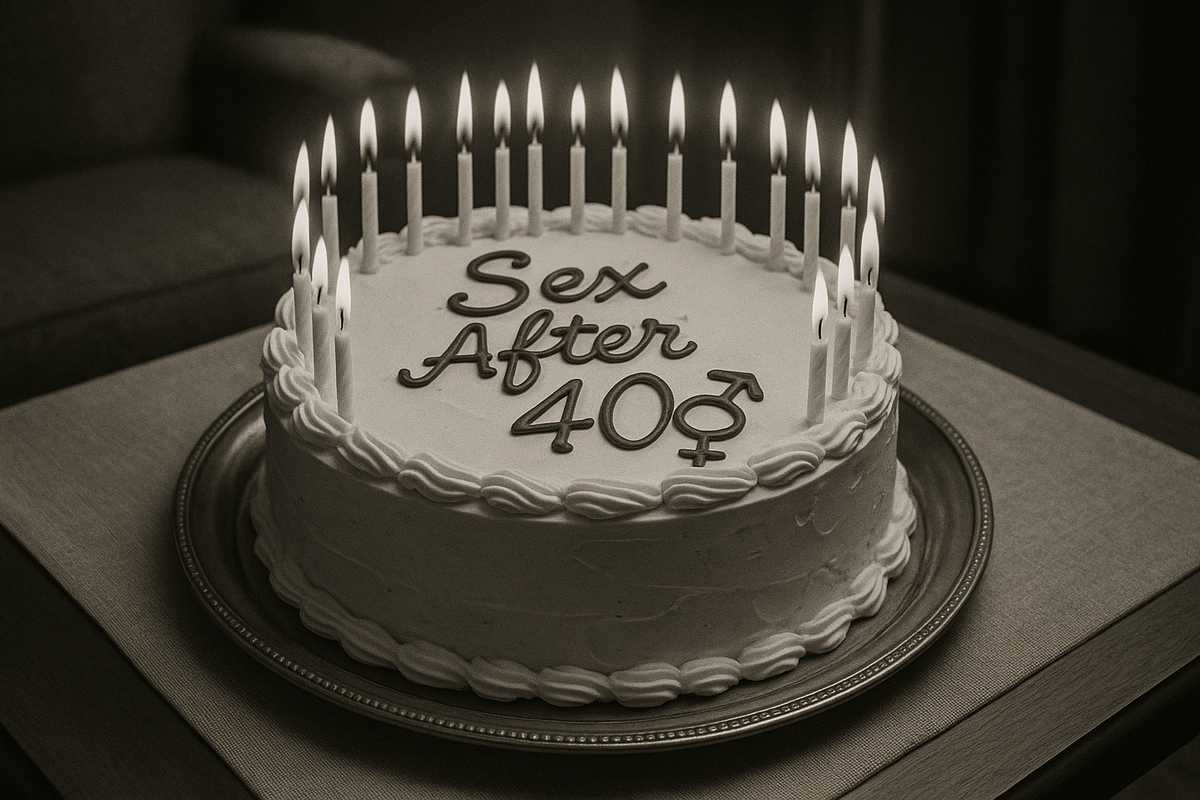
When Ladies' Home Journal Put a Birthday Cake on the Cover of Middle-Aged Sexuality
How a March 1973 article shattered America's most suffocating taboo and gave millions of women permission to reclaim their bodies
In March 1973, a frosted cake appeared in the pages of Ladies' Home Journal—candles blazing, icing spelling out "Sex After 40" in bold letters, flanked by the male and female symbols.
It wasn't a recipe feature.
It was a declaration of war against one of America's most suffocating taboos: the myth that women's sexuality expired at middle age. For millions of readers who'd been raised to believe menopause meant the end of intimacy, this wasn't just an article. It was permission.
The Revolution Was Already in the Living Room
By 1973, the ground was shifting under American womanhood. Betty Friedan's The Feminine Mystique had detonated a decade earlier, exposing the quiet desperation of suburban domesticity. Title IX was rewriting the rules for girls in schools. Roe v. Wade would land in the Supreme Court that January, reshaping the very concept of bodily autonomy.
But even as younger women marched and organized, middle-aged women were expected to vanish quietly into irrelevance. Menopause was whispered about like a shameful illness. Aging meant decline, not renewal. And sex after 40? That was fantasy—or worse, indecent.
Ladies' Home Journal refused to accept this script.
The magazine had always occupied a peculiar space in American culture: part homemaker's handbook, part literary salon, part advice column for navigating modern life. It was respectable, mainstream, trusted. Which made its decision to run "Sex After 40" all the more radical. This wasn't a fringe publication testing boundaries—this was the magazine your mother read, speaking truths your grandmother never could.
Archive Details
Publication: Ladies' Home Journal
Issue Date: March 1973
Featured Article: "Sex After 40"
Historical Context: Published weeks after Roe v. Wade and during the height of second-wave feminism
Cultural Figures Referenced: Alfred Kinsey, Masters and Johnson, Cornelia Otis Skinner, Betty Friedan
The Science That Shattered the Silence
The article's power came from its refusal to rely on sentiment alone. It marshaled hard evidence from the era's most groundbreaking sex researchers.
Alfred Kinsey's studies from the 1950s had revealed what many suspected but few dared say: women in their 40s, 50s, even 60s remained sexually active—and often more satisfied than they'd been in youth. Masters and Johnson's work in the 1960s and early '70s demolished the final myth: menopause did not end sexual response. Biology wasn't the problem. Culture was.
The Journal framed this research not as clinical data but as liberation. Women didn't need to shrink from their bodies or apologize for desire. They needed accurate information and the confidence to reject decades of conditioning.
Actress Cornelia Otis Skinner's anecdote—her laughter at the very idea of Kinsey interviewing older women about sex—captured how unthinkable the subject had been just twenty years earlier. Now it was front and center, illustrated with cartoons, surrounded by earnest commentary, impossible to ignore.
The Visual Language of Permission
That birthday cake photograph was a masterstroke of subversive optimism.
Dozens of candles. Celebratory frosting. The unmistakable symbols of male and female intertwined with the number 40. The image said: This is not an ending. This is a beginning. Light the candles. Enjoy what comes next.
The surrounding pages deepened the message. Cartoons poked fun at marital frustrations—one showed a couple locked out of a room marked "Closed During Prime Time." Ads for Albolene beauty cream, Cuticura medicated soap, and Dixie paper dispensers created a dizzying juxtaposition. In a single issue, women were told how to remove carpet stains, maintain youthful skin, and reclaim their sexual identity.
That tension—between domestic duty and personal liberation—was the defining contradiction of 1970s womanhood. The Journal didn't resolve it. It held it up for examination.
What the Magazine Said (and What It Meant)
The article's core findings were as much cultural intervention as medical education:
Biology vs. Myth
Menopause was not the end of intimacy. The barriers were psychological and social, not biological.
Confidence Over Age
Self-assurance and knowledge mattered more than any number. Women needed permission to reject conditioning.
Science Over Stigma
Kinsey and Masters and Johnson weren't fringe voices—they were authorities whose research deserved respect.
Dignity as a Right
Middle-aged women deserved pleasure and fulfillment—not as a luxury, but as a fundamental right.
For readers who'd spent decades absorbing messages about fading relevance, these words carried weight. They shaped conversations in bedrooms, doctors' offices, consciousness-raising groups, and between mothers and daughters who'd never spoken this frankly before.
The Magazine as Witness
Just as Life gave Americans a visual record of war and social upheaval, Ladies' Home Journal gave women a record of their private revolutions. It proved that the personal was political—that even something as intimate as sex after 40 belonged in national conversation.
In an age of digital media and disposable content, these vintage magazines endure as physical artifacts of change. They are evidence of what was fought for, what was won, and how much further there was still to go.
Why This Issue Matters to Collectors
Historical Gravity
It captured feminism and the sexual revolution colliding in real time, not in activist pamphlets but in a mainstream publication read by millions.
Iconic Imagery
That cake-and-candles photograph is instantly recognizable, a visual shorthand for the era's boldness and cultural shift.
Cultural Completeness
The ads, cartoons, recipes, and features together form a complete portrait of how American women lived in 1973—the freedoms they were claiming and the expectations still shackling them.
Archival Rarity
Complete copies in good condition are increasingly scarce. This isn't just ephemera—it's a primary source for historians of gender, media, and cultural change.
Explore the Archive
Original copies of Ladies' Home Journal are available to collectors, historians, and anyone interested in the real story of 20th-century womanhood. From the late 19th century through the final decades of the 20th, you can trace how women's roles, fashion, health, and cultural identity were documented in real time.
Browse Ladies' Home Journal Magazine CollectionFinal Word
The March 1973 issue of Ladies' Home Journal remains a monument to a moment when millions of women refused to accept the terms society had handed them. With its "Sex After 40" article, the magazine gave voice to desires long suppressed by myth and shame.
It blended rigorous science with humor and reassurance. It took an intimate subject and made it undeniable. And in doing so, it captured the contradictions of a decade when women were balancing new freedoms against lingering expectations.
For anyone who values cultural history, this magazine isn't just reading material. It's a living artifact—witness to change, courage, and the long, unfinished journey toward women's equality.