
Suede Revolution, International Style, and the New Face of Masculinity
How Esquire's December 1963 issue redefined American masculinity in the shadow of tragedy
Three weeks after Dallas, American men opened their December 1963 Esquire to find something unexpected: a fashion spread that refused to mourn.
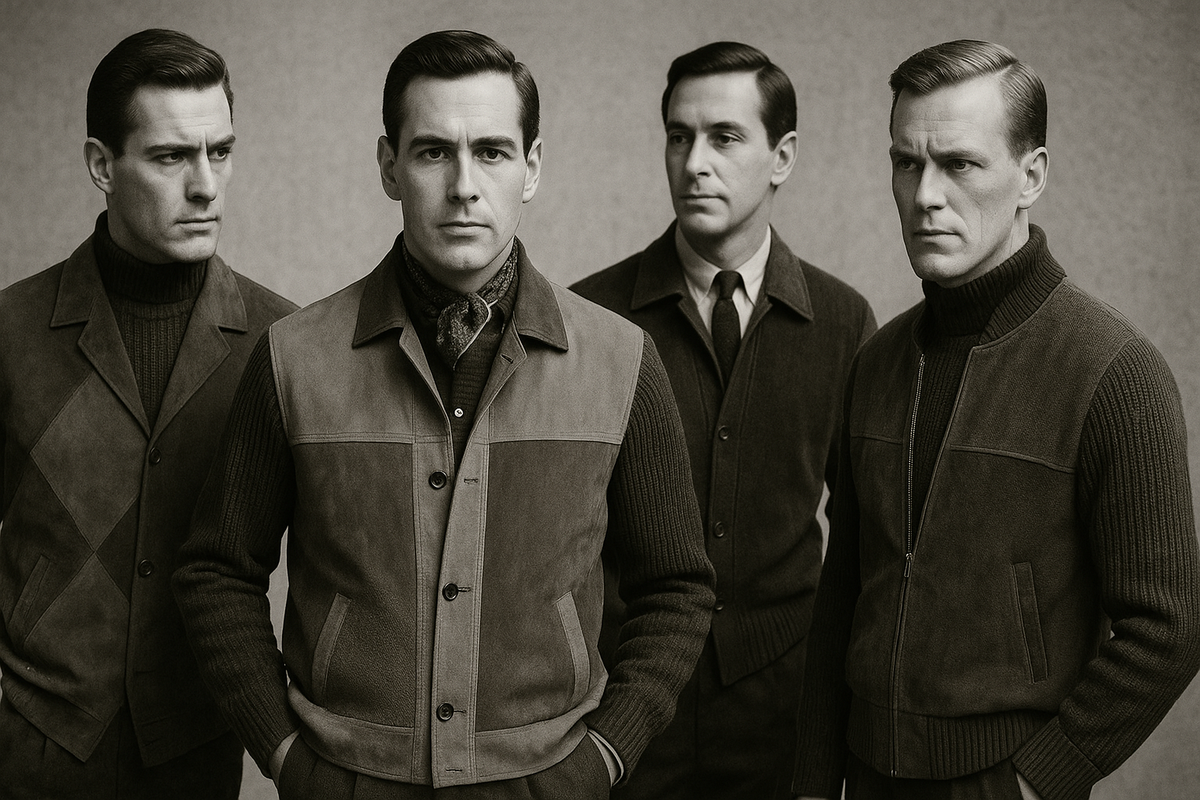
While the nation processed Kennedy's assassination in black-and-white television replays, Esquire's "Suede: Nouvelle Vogue" feature presented a different kind of gravitas—Continental jackets in brown and green suede, ribbed knitwear with European cuts, and models photographed like statesmen rather than mannequins. This wasn't escapism. It was an argument about what kind of man America needed next.
The Quiet Revolution in Masculine Dress
By December 1963, Esquire had evolved beyond a men's magazine into a cultural authority that shaped how American men understood their place in a fragmenting world. Editor Harold Hayes had built an editorial machine that could publish Norman Mailer's cinema criticism alongside Carl Fischer's stark fashion photography—and make both feel equally urgent.
The suede spread embodied this editorial philosophy. Suede, once relegated to Western wear and hunting jackets, was being repositioned as the fabric of cosmopolitan masculinity. The jacket designs featured in "Nouvelle Vogue" weren't asking men to abandon American identity—they were asking them to expand it.
Consider the deliberate nod in the spread's title. Nouvelle Vague—the French New Wave cinema movement that had exploded just years earlier with Godard and Truffaut—represented a break from Hollywood conventionality. Esquire was making an explicit parallel: just as the New Wave had shattered cinematic norms, suede and bold tailoring could redefine what American masculinity looked like.
This wasn't fashion advice. It was cultural strategy.
Archive Details
Publication: Esquire Magazine
Issue Date: December 1963
Feature: "Suede: Nouvelle Vogue"
Photography: Carl Fischer
Editor: Harold Hayes
Historical Context: Published three weeks after President Kennedy's assassination
The Architecture of the New Look
Fischer's photography for the spread stripped away mid-century optimism. Shot in high-contrast black and white, the images emphasized texture over fantasy—you could see the grain of the suede, the raised ribs of the knit, the weight of the fabric. The models stood rigid, formal, almost European in their bearing. They weren't selling aspiration; they were modeling authority.
The featured pieces told the story of American fashion looking outward:
The Harlequin Jacket – Brown and green suede in a bold diamond pattern, $60 from Muse's in Atlanta. Regional sophistication proving that Continental style wasn't confined to coastal elites.
The Cassini Panel Jacket – Three shades of suede separated by knitwork panels, $100. Oleg Cassini, already famous as Jackie Kennedy's couturier, brought couture logic into men's ready-to-wear.
The Wool-and-Suede Hybrid – Raised-rib knit body with suede accents, $70 from Arden for Men in New York. The fusion of American comfort with European construction.
The Gino Paoli Design – $65 from Indianapolis, combining suede panels with bold knit sleeves. International design vocabulary being localized and adapted for the American Midwest.
The Brioni Masterpiece – From Bonwit Teller, representing Italian tailoring at its apex. Brioni's inclusion signaled that European luxury was no longer foreign—it was aspirational and attainable.
Each garment represented a thesis: American men could adopt international sophistication without surrendering their identity. The suede jacket became the vehicle for that transformation.
Context and Consequence
The timing of this issue matters. Published in the immediate aftermath of Kennedy's assassination, the December 1963 Esquire arrived when Americans were searching for stability and meaning. The Civil Rights Movement was accelerating. The Vietnam conflict was expanding. Cultural certainties were collapsing.
Fashion, in this moment, wasn't frivolous—it was symbolic infrastructure. How a man dressed signaled his relationship to modernity, to Europe, to tradition, to change. The "Nouvelle Vogue" spread proposed that suede—soft, textured, European—could be the material that bridged old masculinity and new.
The spread's aesthetic choices reinforced this. Where other fashion features used color and movement, Fischer's photography was austere, almost militaristic. The models wore ascots and collared shirts beneath their suede jackets, maintaining formality even as they embraced Continental innovation. This was reform, not revolution—a careful negotiation between American conservatism and European modernity.
Why Collectors Pursue This Issue
Historical Timing
Published weeks after Kennedy's death, it captures America at an inflection point when cultural leadership was being renegotiated.
Design Influence
The suede-and-knitwear combinations introduced here would define mid-1960s menswear and resurface repeatedly in contemporary fashion.
Designer Legacy
Featuring Oleg Cassini and Brioni makes this issue essential documentation of how European luxury entered American mainstream consciousness.
Photographic Innovation
Fischer's stark, texture-focused approach represented a departure from the softer, aspirational fashion photography that had dominated the 1950s.
Editorial Integration
The issue exemplified Esquire's unique ability to synthesize politics, literature, and style into a unified cultural vision.
Cultural Documentation
Reading this magazine meant understanding the full spectrum of educated masculine life in 1963—a complete cultural portrait.
For collectors of 20th-century print media, issues like this aren't just magazines—they're primary source documents. Holding the December 1963 Esquire means holding the exact pages that American men studied to understand how to navigate a world being remade.
The Artifact Versus the Archive
Mid-century magazines like Esquire functioned differently than modern media. They were designed to be kept, studied, and referenced. The paper stock was substantial. The photography was museum-quality. The editorial voice assumed a reader who would return to these pages multiple times, extracting new meaning with each reading.
This physicality matters. Unlike digital content, which updates and disappears, vintage magazines are fixed cultural witnesses. They can't be edited retroactively or removed from circulation. What was printed in December 1963 remains exactly as it was—a permanent record of how American culture understood itself at that precise moment.
That's why serious collectors pursue original issues rather than digital scans. The artifact carries weight that the archive cannot replicate.
Holding History
The "Suede: Nouvelle Vogue" spread in the December 1963 Esquire introduced American men to a new vision of masculine style—international, textured, sophisticated without being foreign. In the shadow of national tragedy and cultural upheaval, Esquire proposed that how a man dressed could help him navigate uncertainty.
More than sixty years later, this issue remains a crucial document of American masculinity in transition. For collectors, historians, and anyone interested in how style intersects with identity, it represents a moment when fashion carried genuine cultural stakes.
Explore the Archive
From the 1930s through the 1970s, Esquire didn't just document men's wardrobes—it documented the evolution of American identity itself.
Browse Esquire Collection