
Tennessee Williams, Suburban Satire, and America in a "Period of Adjustment"
When Esquire Published a Complete Broadway Play and Held Up a Mirror to Middle-Class America
When readers cracked open the December 1960 issue of Esquire, they found something unexpected wedged between the whiskey ads and holiday gift guides: a full Broadway play by Tennessee Williams.
Not an excerpt. Not a profile. The entire script—Period of Adjustment—laid out across the magazine's pages like a dare. This wasn't supposed to happen in a men's lifestyle magazine. But in 1960, Esquire wasn't playing by anyone's rules.
Archive Details
Playwright: Tennessee Williams
Publication: Esquire Magazine, December 1960
Play Title: Period of Adjustment (subtitled "a serious comedy")
Historical Context: Published during the Kennedy transition era, at the height of suburban American expansion
The Cultural Moment
The year 1960 sat at a hinge point in American history.
John F. Kennedy had just won the presidency. Suburban ranch houses were multiplying across the landscape. Television sets glowed in living rooms from coast to coast, broadcasting an idealized vision of middle-class prosperity. The postwar economic boom had created a new American archetype: the comfortable suburbanite, living in tract housing, driving finned sedans, and shopping at gleaming supermarkets.
But the cracks were showing. The civil rights movement was accelerating. Cold War anxieties simmered beneath backyard barbecues. Traditional gender roles—despite Madison Avenue's best efforts—were beginning to chafe.
Enter Tennessee Williams with Period of Adjustment, subtitled "a serious comedy." The phrase itself captured the contradictions of the moment: optimistic but uneasy, prosperous but hollow. While lighter in tone than A Streetcar Named Desire or Cat on a Hot Tin Roof, the play still carried Williams' signature obsessions—loneliness, repression, and the suffocating weight of ordinary life.
The Play on the Page
Williams opened Period of Adjustment with four lines of verse:
"For tenderness I would lay down
The weapons that holds death away,
But little words of tenderness
Are those I never learned to say."
Even in comedy, Williams couldn't shake melancholy.
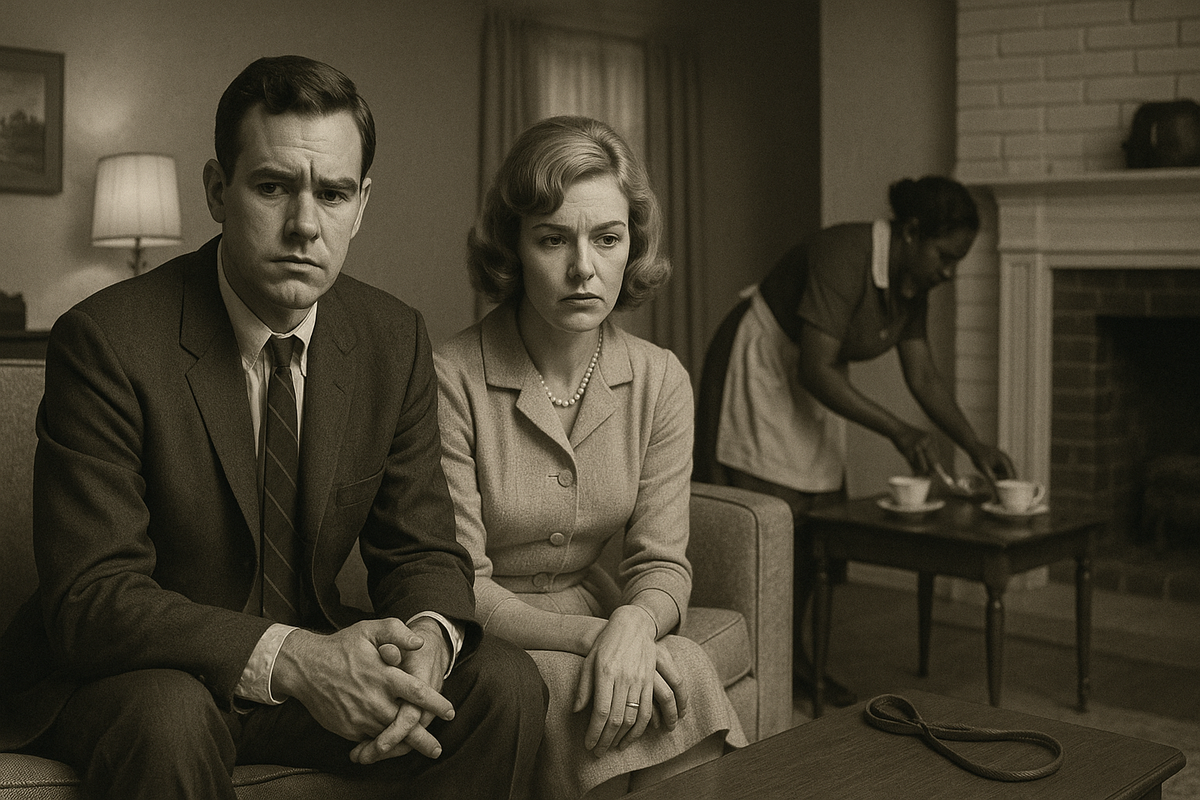
The cast list read like a suburban census: Ralph and Dorothea Bates, a married couple on the rocks. George and Isabel Haverstick, newlyweds already faltering. Mr. and Mrs. Stuart McGillicuddy, older suburbanites. Susie, a colored maid. A young policeman. Even a cocker spaniel.
On the surface, it looked like drawing-room fare—light domestic comedy for the holiday season. But Williams had other plans. His characters parodied television commercials, obsessed over appearances, and stumbled through emotional conversations they'd never learned to have. By weaving mass-media language directly into dialogue, Williams blurred the boundary between theatre and the living room TV set.
The setting—a modest suburban bungalow—was instantly recognizable to Esquire's readers. Williams was holding up a mirror to the very people flipping through the magazine: middle-class couples navigating conformity, consumption, and desires they couldn't quite articulate.
Esquire as Cultural Forum
Publishing a complete Broadway play wasn't a casual editorial decision. It was a statement about what Esquire believed a men's magazine could be.
The Contradiction Was the Point
On one page, Williams' stage directions described a cramped living room where two couples confronted their failing marriages. On the facing page, a full-color Botany 500 advertisement featured sharply dressed men carving a holiday ham at a picture-perfect suburban dinner party.
The Esquire Formula
By the late 1950s, Esquire had evolved far beyond a typical men's magazine. Its covers carried high-contrast photography that radiated sophistication rather than wholesomeness. Its editorial voice was urbane, witty, and unafraid to provoke.
This wasn't an accident. Esquire understood that American masculinity in 1960 existed at exactly this crossroads—between literary introspection and aspirational consumption, between emotional authenticity and performed success.
That December issue mixed Williams' play with sports coverage, political commentary, travel features, and gift recommendations—acknowledging that its readers were not just consumers but participants in American cultural life. Esquire published Hemingway, Mailer, Baldwin, and Capote alongside cocktail recipes and style advice because it believed men could handle complexity.
Few other publications would dedicate such prominent real estate to a Broadway script. That choice revealed Esquire's ambition: to be both tastemaker and provocateur, capturing American life in all its contradictions.
Why This Issue Matters to Collectors
For those who seek out vintage Esquire issues, December 1960 holds particular significance:
A Literary Landmark – This is the first printed publication of a Tennessee Williams play. For theatre historians and Williams scholars, it's a primary source document.
A Cultural Snapshot – The play satirizes suburban America at the precise moment when television, advertising, and middle-class affluence were reshaping national identity. Reading it alongside the magazine's ads creates an unintentional meta-commentary.
Editorial Audacity – Esquire's willingness to publish a complete play demonstrated its commitment to treating readers as serious cultural participants, not just style-conscious shoppers.
Holiday Issue Premium – December issues from this era are particularly prized by collectors. They're dense with seasonal advertising, gift guides, and year-end cultural commentary—rich artifacts of mid-century consumer culture.
Design Value – The advertisements alone—Botany 500 suits, premium whiskey, luxury goods—make this issue attractive to collectors of mid-century graphic design and advertising history.
This isn't just reading material. It's a three-dimensional artifact of American cultural history, capturing the moment when postwar prosperity met artistic critique.
The Enduring Appeal
Mid-century Esquire issues remain collectible because they operated on multiple registers simultaneously:
They are time capsules, preserving the anxieties and aspirations of their historical moment with documentary precision.
They are aesthetic objects, featuring photography, illustration, and layout that remain visually compelling decades later.
They are literary archives, having published early work by writers who became titans of American letters.
Owning the December 1960 issue means holding a document from a specific cultural crossroads: suburban prosperity on one side, artistic skepticism on the other, with Tennessee Williams staging the confrontation in the pages of a men's magazine.
Collector Significance
Literary First
First printed publication of Tennessee Williams' Period of Adjustment—an essential document for theatre historians and Williams scholars.
Cultural Artifact
Captures the contradictions of 1960 America: suburban prosperity, Cold War anxiety, and the dawn of the Kennedy era.
Editorial Vision
Demonstrates Esquire's role as cultural forum, publishing serious literature alongside lifestyle content.
Design History
Premium mid-century advertising and photography make this a prized piece for collectors of graphic design and consumer culture.
For Collectors and Cultural Historians
If you're drawn to theatre history, mid-century American culture, or the evolution of literary magazines, the December 1960 Esquire is essential. It captures a moment when a major American playwright used a men's lifestyle magazine to satirize the very lifestyle that magazine was selling.
Browse Esquire Magazine CollectionWhether you're researching the cultural landscape of 1960, building a collection of significant literary publications, or preserving artifacts from an era that shaped modern America, issues like this offer something rare: a chance to witness the conversation between high art and mass culture as it actually unfolded.
Conclusion
The December 1960 Esquire stands as more than a holiday magazine. It was a stage for Tennessee Williams' suburban critique, a mirror of American consumer culture, and evidence of the magazine's editorial boldness.
At the dawn of the 1960s, when America was caught between Kennedy-era optimism and deeper cultural unease, Williams' Period of Adjustment captured the absurdity of suburban life with both humor and sorrow. Placed alongside glossy advertisements for suits and cocktails, it demonstrated how Esquire could hold high art and everyday consumption in creative tension within a single issue.
For today's collectors, this issue reminds us why vintage Esquire magazines remain valuable: they are living documents, blending style, literature, politics, and culture into artifacts that reward repeated examination.