
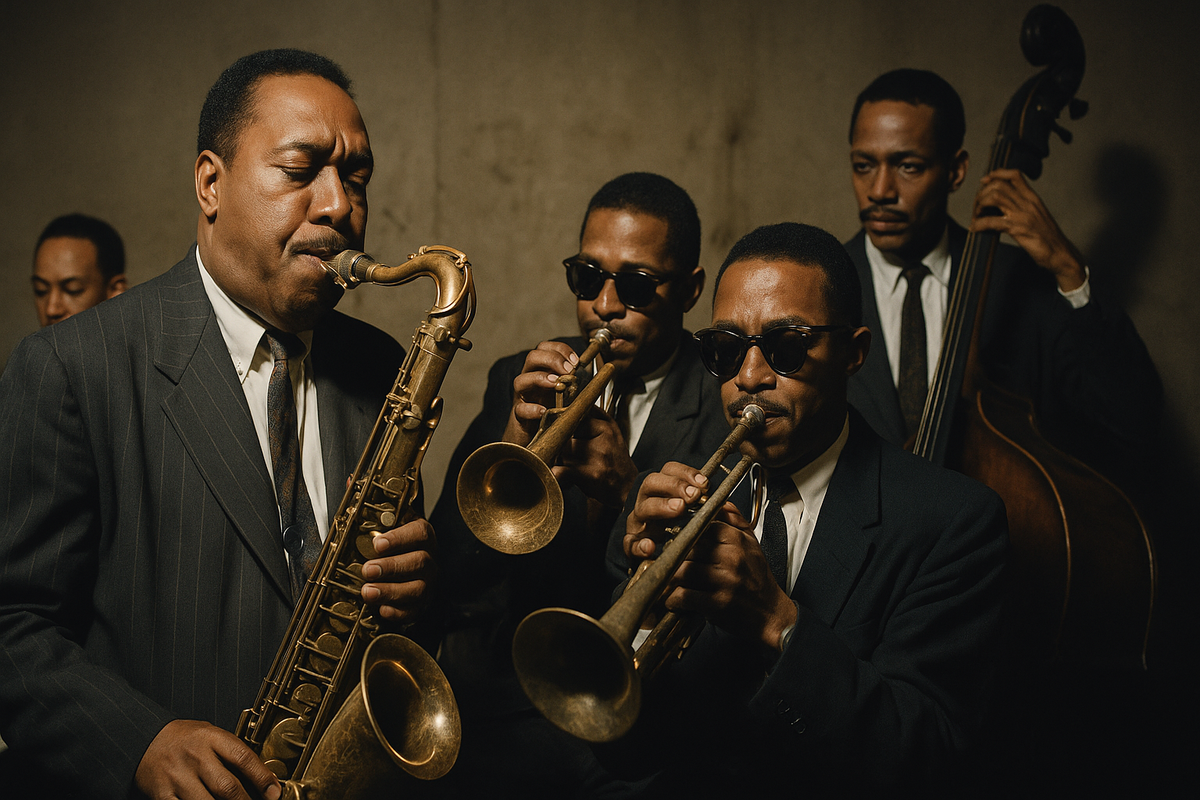
The Golden Age of Jazz: How One Magazine Issue Became a Cultural Prophecy
Esquire Magazine's January 1959 masterpiece captured the moment jazz transformed from entertainment into art—and predicted the most legendary year in music history
When readers pulled the January 1959 issue of Esquire from their mailboxes, they had no idea they were holding a prophecy.
Within weeks, Miles Davis would enter the studio to record Kind of Blue. Dave Brubeck would release Time Out. John Coltrane would lay down Giant Steps. Ornette Coleman would unleash The Shape of Jazz to Come. The year 1959 would become the most legendary twelve months in jazz history—and Esquire had already written its prologue.
The magazine's sprawling feature, "The Golden Age of Jazz," was more than cultural commentary. It was a declaration: jazz had matured from nightclub entertainment into America's defining art form. Ralph Ellison traced its revolutionary origins. John Clellon Holmes chronicled its global conquest. Thelonious Monk, Dave Brubeck, and John Lewis forecast its future—in their own words, unfiltered, visionary.
This wasn't journalism. It was consecration.
And today, that single issue stands as one of the most collectible magazines of the twentieth century.
Archive Details
Publication: Esquire Magazine
Issue Date: January 1959
Feature: "The Golden Age of Jazz" (multi-part series)
Contributors: Ralph Ellison, John Clellon Holmes, Thelonious Monk, Dave Brubeck, John Lewis
Historical Context: Published months before the release of Kind of Blue, Time Out, Giant Steps, and The Shape of Jazz to Come
A Nation at the Crossroads
The late 1950s were deceptive. Surface prosperity masked seismic shifts. Eisenhower's America projected confidence, but the Civil Rights Movement was gaining unstoppable momentum. Rock and roll had captured teenage rebellion. The Cold War made anxiety a national pastime.
Jazz embodied all of it—the contradictions, the aspirations, the unresolved tensions. By 1959, it had migrated from Harlem jam sessions to European festivals, from jukeboxes to concert halls. Critics debated whether it was folk music or high art. Audiences couldn't decide if it was America's past or its future.
Esquire answered: both.
The magazine's editorial team understood what many didn't—that jazz wasn't just evolving, it was about to explode. Their timing was uncanny. The feature appeared months before the albums that would canonize modern jazz. It reads today like a writer describing a storm while standing in the eye of it.
Three Movements: Past, Present, Future
The feature's structure mirrored jazz itself—three movements, each building on the last.
Time Past opened with Ralph Ellison at Minton's Playhouse in 1941, where Charlie Parker and Dizzy Gillespie forged bebop in after-hours crucibles. Ellison wrote not as a critic but as a witness to revolution. His essay was paired with a photograph that became iconic: Parker's grave, a saxophone case resting atop the stone. Genius and tragedy, frozen in gelatin silver.
Time Present belonged to John Clellon Holmes, who captured jazz as the soundtrack of postwar modernity. He profiled Armstrong, Ellington, and Lester Young as living monuments while documenting how festivals and recordings had carried the music worldwide. The portraits accompanying his text were extraordinary—Armstrong silhouetted at sunset, Ellington veiled in shadow, Young reflected in mirrors. Each image demanded interpretation, not passive viewing.
Time Future gave the microphone to the musicians themselves. Monk insisted on uncompromising self-expression. Brubeck imagined fusions of rhythm and harmony that would break every rule. Lewis argued for discipline and architectural form. Printed side by side, their contrasting visions revealed jazz as a music perpetually arguing with itself—and thriving because of it.
The feature closed with a single symbolic image: multiple hands gripping a clarinet together. Jazz as collective inheritance. Jazz as relay race. Jazz as democracy in motion.
The Visual Language of Modernism
Esquire in 1959 was operating at the height of mid-century design sophistication.
The photography rejected convention. These weren't promotional portraits or performance shots. They were interpretive, almost abstract—Armstrong as silhouette suggested endurance, Ellington's shadows evoked refinement, Young's reflections hinted at complexity layered upon complexity. The Charlie Parker memorial photograph functioned as visual elegy.
The layout employed theatrical restraint: large spreads, clean Helvetica typography, generous white space. The pages felt curated, almost museum-like. This was intentional. Esquire wasn't reporting on jazz—it was enshrining it.
The editorial voice fused cultural criticism with stylistic confidence. Readers encountered jazz alongside fiction, political commentary, travel writing, and advertisements defining mid-century masculinity (Arrow shirts, Grant's Scotch, the aspirational geometry of modern life). Where Life specialized in photojournalism, The Atlantic in literature, and Playboy in lifestyle, Esquire synthesized all three. It didn't just reflect taste—it manufactured it.
The Photographs That Became Icons
Charlie Parker Memorial
Saxophone case above the gravestone. Bebop's brightest light, extinguished at thirty-four.
Armstrong at Sunset
The elder statesman in contemplation. Not the showman, but the architect.
Duke Ellington in Shadow
Mystery and elegance. The composer as enigma.
Lester Young Reflected
Multiple images in mirrors. Influence refracting influence.
The Harlem Group Photo
Dozens of musicians across three generations. A dynasty in a single frame.
Hands on a Clarinet
The metaphor made flesh. Jazz as shared lineage.
Each photograph transcended documentation. They became the visual language through which jazz history is still remembered.
The Magazine as Cultural Barometer
Mid-century Esquire occupied unique territory. It wasn't pulp, wasn't purely literary, wasn't academic. It was the magazine for men who took culture seriously without taking themselves too seriously—who wanted to understand Thelonious Monk and also know which scotch to order.
"The Golden Age of Jazz" feature exemplifies this editorial philosophy. It treated jazz with the seriousness reserved for literature while maintaining accessibility. It assumed readers were intelligent but not specialists. It offered depth without condescension.
This approach feels almost radical today, when cultural writing tends toward either scholarly inaccessibility or clickbait superficiality. Esquire in 1959 proved a third path was possible: sophisticated, substantive, and stylish.
Revisiting these issues reveals not just jazz history, but the history of how culture was consumed, debated, and celebrated when magazines mattered—when they set the terms of national conversation rather than merely responding to it.
Why Collectors Covet This Issue
Cultural Timing
It captured the precise moment jazz transitioned from popular music to canonical art form—before that transition was complete.
Literary Weight
Essays by Ralph Ellison and John Clellon Holmes aren't journalism—they're primary texts in American cultural history.
Musical Authority
Direct commentary from Monk, Brubeck, and Lewis. Not interviews filtered through reporters, but the artists forecasting their own medium.
Photographic Legacy
Some of the most iconic jazz images ever published in a general-interest magazine.
Prophetic Resonance
Published months before the albums that would define modern jazz. It reads like foresight, not hindsight.
Physical Rarity
Mid-century Esquire issues with major cultural features are increasingly scarce in collectible condition.
Owning this issue isn't nostalgia. It's possessing a primary document—the same pages that shaped how Americans understood their own culture in 1959.
For Collectors and Historians
If you're searching for the January 1959 Esquire, you're not just acquiring a vintage magazine. You're obtaining an artifact that stands at the intersection of music history, cultural criticism, mid-century design, and American identity formation.
This is the issue serious collectors prioritize. This is the issue that belongs in university archives and private collections alike.
Browse Esquire Magazine CollectionEvery issue is more than paper and ink. It's testimony—proof that magazines once functioned as cultural architects, not just cultural reporters.
Coda
The January 1959 issue of Esquire remains a monument to what magazine publishing could achieve: history, criticism, photography, and prophecy bound together in seventy-two pages.
For its original readers, it validated jazz as art—as America's singular contribution to world culture. For us, it serves as reminder that the best cultural criticism doesn't just analyze the present. It shapes how we remember the past and imagine the future.
The music it celebrated has never stopped evolving. The magazine that captured it remains frozen in time—a perfect document of the moment jazz became immortal.