
The September 1970 Vogue That Declared American Fashion Independence
How Diana Vreeland staged a revolution with leopard print, Persian paisley, and boots that conquered the world
When Diana Vreeland staged a revolution, she didn't issue manifestos. She published leopard print.
The September 1, 1970 issue of Vogue opened with a spread so audacious it functioned as a declaration of war—not against readers, but against the century-old assumption that Paris alone could dictate what the world wore. "Vogue's Eye View: The New York Collections" wasn't coverage. It was coronation. American designers had arrived, and Vreeland made sure every page screamed it: animal prints colliding with Persian paisley, canary-yellow chinchilla coats, painted Tartar leathers, boots in every frame. This was New York announcing it no longer needed Europe's permission.
For collectors and historians, this issue represents more than fashion documentation. It captures the precise moment American design stopped apologizing and started leading.
The World That Opened This Magazine
September 1970 landed on newsstands during a year of fractures. The Women's Liberation Movement had moved from fringe to front page. The Vietnam War dominated evening news. Kent State was four months in the rearview mirror. American women were reassessing everything—careers, marriages, hemlines—and fashion, ever the cultural seismograph, registered every tremor.
What Vreeland understood, and what makes this issue historically significant, is that upheaval doesn't demand austerity. Sometimes it demands ostrich feathers.
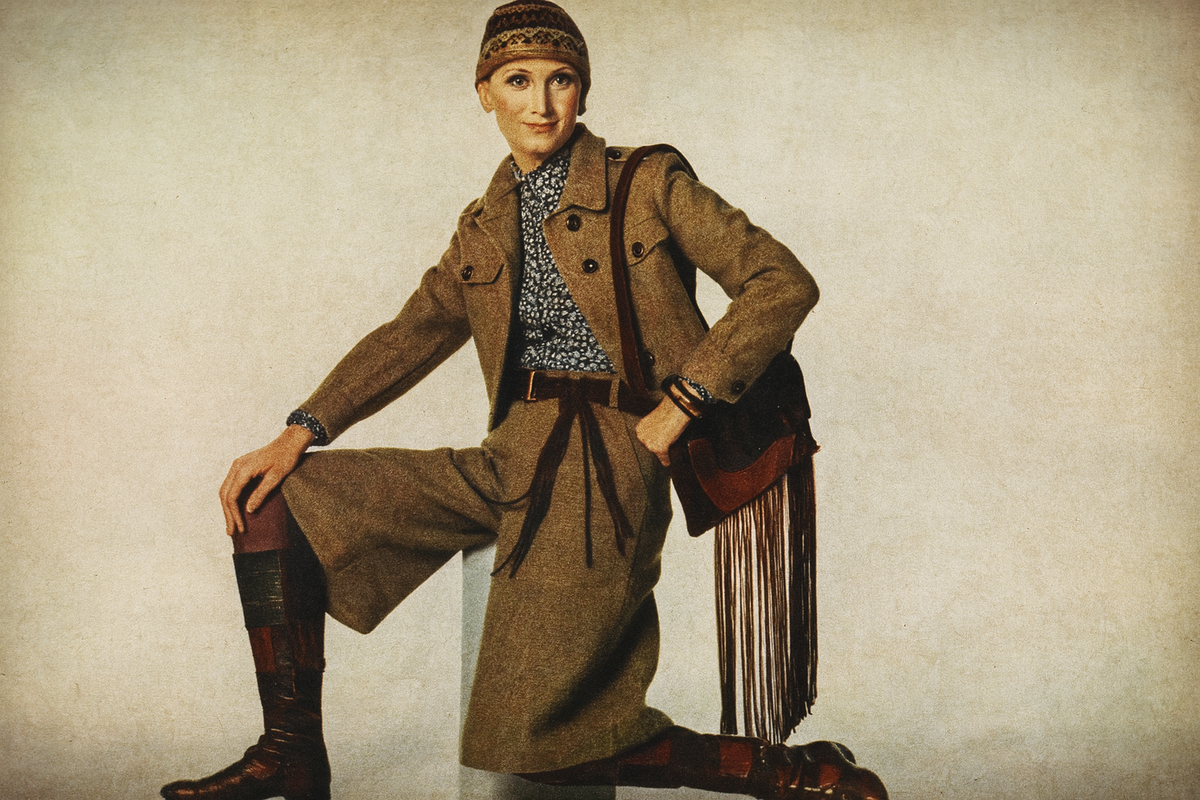
The clothes in this spread—gaucho pants tucked into scarlet boots, sweeping capes worn like armor, fur-lined fantasies in improbable colors—offered readers both power and escape. Practicality and fantasy weren't opposites; they were co-conspirators. A woman could command a boardroom in Victor Joris's tailored gaucho suit, then transform into something from a Persian folktale by nightfall. Fashion was no longer about obedience to a single silhouette. It was about options, and options meant freedom.
Archive Details
Publication: Vogue Magazine
Issue Date: September 1, 1970
Editor-in-Chief: Diana Vreeland
Featured Spread: "Vogue's Eye View: The New York Collections"
Key Designers: Oscar de la Renta, Bill Blass, Pauline Trigère, Victor Joris, Revillon
Featured Model: Lauren Hutton
Vreeland's Editorial Vision: Chaos as Strategy
At the spread's opening, Vreeland delivered her manifesto: "Don't worry—and never enter about skirt lengths today… Many paths you can take."
The phrasing is vintage Vreeland—breathless, ungrammatical, impossible to ignore. She wasn't writing fashion copy; she was issuing permission. Forget the hemline wars. Forget Parisian dictates. Choose your own adventure.
Her editorial structure mirrored this philosophy. Daytime looks grounded themselves in wearable drama—coats, suits, boots that strode confidently through Manhattan streets. Nighttime exploded into full fantasy: embroidered velvets, paisley that glowed like stained glass, furs in colors nature never intended. The magazine became a Choose Your Own Adventure before the term existed, each page offering a different identity, a different possible self.
The Looks That Made History
The photography didn't whisper. It roared.
Leopard & Ostrich Drama
Chiffon paired with ostrich feather wraps—wild glamour that borrowed from Old Hollywood but twisted it into something urgent and modern.
Russian Sable Luxury
Revillon's hooded and cuffed coats dripping with Old World luxury but styled for the jet age.
De la Renta's Patchwork Furs
Uneven hems and dangling tails—theatrical proportions that rejected symmetry in favor of movement and drama.
Bill Blass's Persian Fantasy
Paisley velvet coats and Shiraz-inspired chiffons in maroons and crimsons that looked ripped from a Safavid miniature painting.
The Great Tartar Invasion
De la Renta's painted leather midcoats, described in copy that mixed military conquest with romantic fantasy, as if Genghis Khan had opened an atelier.
Trigère's Purple Cape
The Inverness cape, pleated and sweeping, worn like modern armor by women who knew they were being photographed for posterity.
Joris's Gaucho Suits
South American-inspired with fringe details and those ubiquitous boots—always boots.
The Boot Revolution
Silver satin, scarlet leather, painted snakeskin, patchwork exotic skins—footwear transformed from accessory to statement.
Lauren Hutton appears in Oscar de la Renta fur, her presence underscoring the era's shift toward supermodels as cultural figures rather than anonymous mannequins.
Cultural Translation as Design Philosophy
Vreeland's genius wasn't just in selecting clothes—it was in framing them. By invoking Shiraz, Tartar invaders, Persian carpets, and Russian sable, she transformed American fashion into something with historical weight and geographic reach. These weren't just garments; they were arguments.
The subtext: American designers could mine global culture with the same sophistication as their European counterparts, but with a New World confidence that Europe, bound by tradition, couldn't match. Oscar de la Renta, Bill Blass, Pauline Trigère, Victor Joris—these weren't imitators. They were translators, alchemists who turned cultural reference into wearable drama without pastiche.
No other magazine blended high fashion, cultural aspiration, and editorial artistry with Vogue's particular alchemy. Under Vreeland, the magazine didn't just report on fashion. It created the conditions under which fashion became art, history, and identity simultaneously.
The Enduring Relevance
Vintage Vogue issues persist as collectibles because they offer something digital archives cannot: the experience of encountering this content exactly as 1970 readers did. The paper stock, the ad placements, the typography, the editorial sequencing—these aren't incidental details. They're part of the historical record.
The September 1970 issue resonates beyond nostalgia because its core themes—freedom of choice, global inspiration, bold self-expression—anticipated the modern fashion landscape. We live in Vreeland's world now, where trends are diverse, international, constantly evolving, and where personal style matters more than prescribed uniformity.
Owning an original copy means holding fashion's declaration of independence—the moment American designers stepped out from Europe's shadow and proved they could define style on their own terms.
Why Collectors Pursue This Issue
Historical Timing
This issue marks the inflection point when New York fashion stopped being "American fashion" (provincial, derivative) and became simply "fashion" (authoritative, original).
Editorial Boldness
"The New York Collections" spread remains one of the most visually arresting presentations of American design in the early 1970s—no other issue from that year captures the same combination of confidence and cultural ambition.
Designer Pedigree
Oscar de la Renta, Bill Blass, Pauline Trigère, Victor Joris, Revillon—this reads like a who's who of designers who would define American luxury for the next three decades.
Lauren Hutton's Presence
As one of the defining faces of 1970s fashion, her appearance adds both visual and historical value.
Vreeland's Final Peak
By 1970, Vreeland had perfected her editorial voice—this issue captures her at full creative power, a year before she would leave Vogue for the Costume Institute.
Visual Impact
The color photography, dramatic styling, and cultural references make this an artifact of both fashion history and editorial history—it documents not just what people wore, but how fashion media taught them to imagine themselves.
Continue Your Exploration
Each collectible Vogue magazine functions as a primary source, a physical artifact capturing the clothes, language, and aspirations of its moment. If this issue's blend of cultural confidence and editorial artistry speaks to you, the archive runs deep.
Browse Vogue Magazine CollectionFrom the 1920s through the 1990s, each decade of Vogue traces not just what people wore, but how they imagined themselves and the world around them.
Final Word
The September 1, 1970 issue of Vogue magazine wasn't an autumn preview. It was an announcement: American fashion had arrived, on its own terms, with its own voice.
From leopard chiffon and Persian paisley to painted Tartar coats and sweeping capes, the spread celebrated variety, drama, and confidence. Boots, fur, and color anchored every look, while Diana Vreeland's editorial philosophy reminded readers that fashion was never about rules—it was about joy, individuality, and power.
Like all significant collectible Vogue magazines, this issue endures because it transcends style guidance. It's a living document of cultural history—an artifact showing us how 1970 looked, felt, and dreamed. For today's collectors, it remains proof that fashion is always about more than clothes. It's about identity, culture, and the courage to make your own statement.