
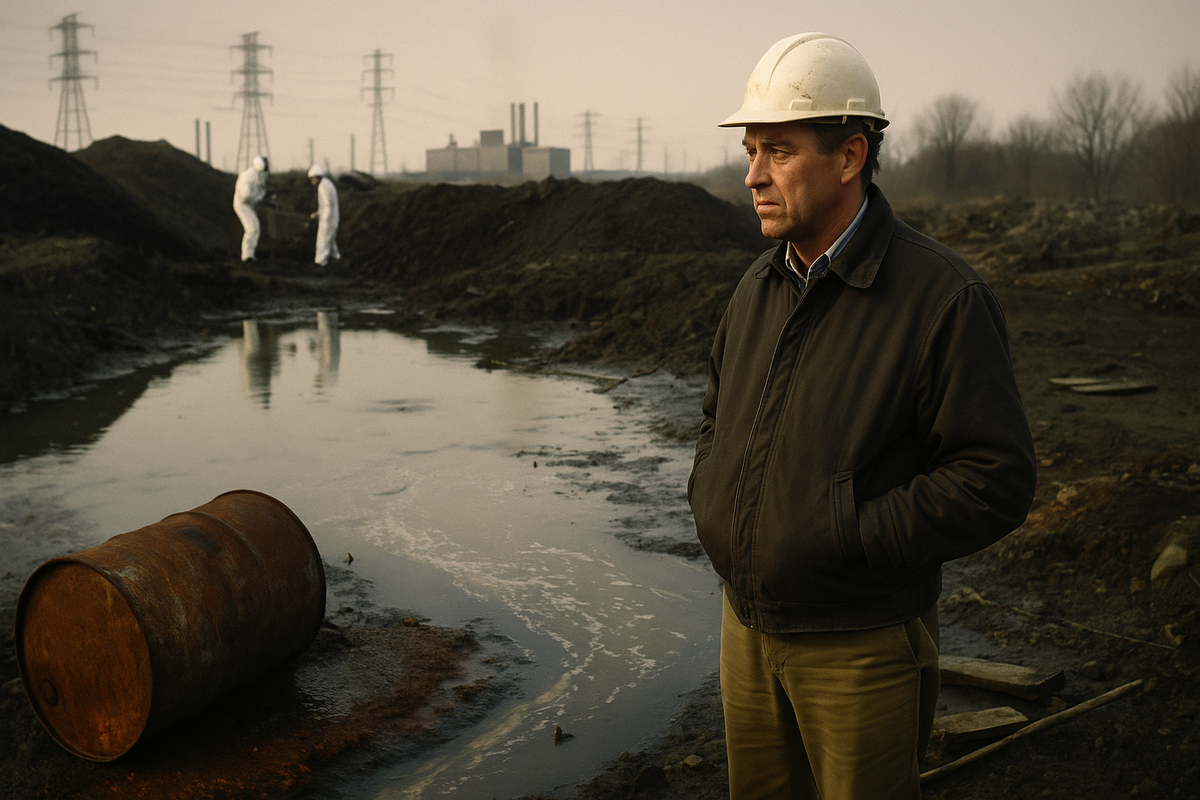
When America Discovered the Ground Beneath Its Feet Was Poisoned
Time Magazine's October 14, 1985 exposé that made toxic waste undeniable
October 14, 1985. Breakfast tables across America. A father unfolds his copy of Time Magazine and freezes. The cover doesn't show Soviet missiles or Wall Street crashes. It shows something closer: a chemical wasteland, and a headline that reads like an epitaph—"A Problem That Cannot Be Buried."
Subtitle: The Poisoning of America Continues.
For millions of readers that morning, the abstract notion of "toxic waste" became immediate. Not a problem for distant factory towns or Rust Belt casualties, but for their towns. Their schools. Their children's playgrounds. This wasn't environmental journalism. It was a diagnosis delivered to a nation that had been living sick without knowing it.
Thirty-nine years later, this issue remains one of the most consequential pieces of environmental reporting in American history—not because it broke the story, but because it made the crisis undeniable.
The Buried Bargain: How America Poisoned Itself
The toxic waste emergency of the 1980s wasn't an accident. It was the bill coming due for a century of unregulated industrial ambition. Factories had transformed America—chemicals for fertilizers, plastics for consumer abundance, fuels for the open road. But disposal was an afterthought: barrels dumped in rivers, pits filled with corrosive sludge, waste buried where subdivisions would later rise.
By the late 1970s, the consequences surfaced.
Love Canal, 1978 – A middle-class neighborhood in Niagara Falls, New York, built atop 21,000 tons of chemical waste, became the flash point. Families reported mysterious illnesses. Children suffered birth defects. The site became shorthand for corporate negligence and government failure, a wound in the national psyche that refused to close.
Superfund, 1980 – Congress responded with the Comprehensive Environmental Response, Compensation, and Liability Act, creating the EPA's $1.6 billion "Superfund" program to locate and remediate hazardous sites. It was sold as deliverance—America's environmental Manhattan Project.
By October 1985 – Time shattered that illusion. More than 18,000 hazardous waste sites had been identified. Only 850 made the EPA's priority list. Cleanup was stalled. Bureaucracy metastasized. Communities were abandoned to wait.
The magazine framed it starkly: "The great toxic-waste mess has clawed its way into the nation's consciousness, and its dimensions are barely understood."
Issue at a Glance
Publication: Time Magazine
Issue Date: October 14, 1985
Cover Story: "A Problem That Cannot Be Buried"
Historical Context: Mid-point between Love Canal (1978) and major environmental reforms of the late 1980s
Archive Significance: Definitive environmental journalism of the Reagan era
How Time Made the Invisible Lethal
Environmental catastrophe resists visualization. Contamination is microscopic, molecular, invisible. Time's genius was making the unseen visceral.
The Cover: No abstraction. No metaphor. Photographs of chemical ponds leaking into soil. Rusted barrels cracked open. Children playing near Superfund perimeters. The typography was unforgiving—bold, sans-serif, declarative. This wasn't a story you could scroll past.
The Maps: One infographic became iconic—a sprawl of red dots across the United States marking contamination sites. For suburban readers scanning the page over coffee, the horror was immediate: there was probably a red dot near them. The poison wasn't "over there." It was here.
The Investigative Edge: Time's reporters gutted the bureaucratic euphemisms. They named failures—EPA paralysis, corporate evasion, Congressional dithering. They profiled families in Greenwood, Mississippi, and Montclair, New Jersey, ordinary Americans living beside hazmat teams testing their yards.
In an era before cable news saturation or internet virality, Time Magazine was the lens through which middle America understood its crises. This issue weaponized that reach.
What the October 14 Issue Revealed
The Human Toll
By 1985, toxic chemicals were linked to 1,500 injuries and 135 deaths. But the numbers understated the dread. The real terror was cumulative: cancers that wouldn't emerge for decades, birth defects not yet born, aquifers poisoned for generations.
The Political Stalemate
Billions allocated. Minimal progress. The EPA's Superfund was drowning in litigation, jurisdictional disputes, and political cowardice. Critics accused officials of downplaying severity to avoid electoral backlash.
The Price Tag
Estimates for a nationwide cleanup: $100 billion. The original Superfund allocation of $1.6 billion looked like a joke. The question Time posed was brutal in its simplicity: How much is clean land worth?
The Unanswered Future
The magazine distilled the crisis into a haunting axiom: The poisons buried yesterday will define the health of generations tomorrow. That sentence aged like prophecy.
Design as Alarm: The Visual Grammar of Crisis
The October 14, 1985 cover belongs to a rare class of Time issues where design itself became argument. This wasn't a polished portrait of a president or a glossy celebration of innovation. It was environmental decay rendered as national emergency.
Typography as Verdict: "A Problem That Cannot Be Buried" wasn't a headline—it was an indictment. The phrasing echoed the futility of concealment. You can't bury what keeps surfacing.
Photography as Evidence: Interior spreads showed hazmat-suited workers crouched over contaminated soil. Chemical sludge oozing through cracked earth. Families standing in front of condemned homes. The images weren't sensationalized—they were clinical, which made them more damning.
Editorial Authority: Time's editorial voice blended reportage with moral witness. The magazine positioned toxic waste not as an environmental issue but as a civilizational reckoning—a test of whether America could confront the consequences of its own progress.
This combination of fact, image, and narrative voice is why Time shaped American opinion for half a century.
The Archival Permanence of Environmental Journalism
Time's environmental coverage endures because it documented transformation, not just contamination. These weren't disposable news cycles—they were turning points that reshaped the EPA, rewrote environmental law, and birthed the modern activist movement.
They function as time capsules: snapshots of debates when outcomes were unknown.
They preserve visual evidence: photographs that retain shock value four decades later.
They stand as warnings: reminders that toxic waste isn't resolved history but ongoing struggle.
For collectors, this permanence elevates value. For historians, these issues remain primary sources—unfiltered records of how America processed crisis.
Why This Issue Endures as a Collectible Artifact
Historical Timing
Published at the apex of America's toxic waste reckoning, five years after Superfund's creation and three years before major environmental reforms reshaped federal law. It captures the moment of maximum uncertainty.
Visual Legacy
The maps and photographs remain definitive. Decades later, they're still reproduced in environmental history courses, documentaries, and museum exhibitions.
Cultural Pivot
This issue marks the shift when environmental concern moved from activist margins to mainstream anxiety. Owning it means owning the inflection point.
Rarity Factor
Celebrity covers and pop culture moments dominate the vintage market. Environmental exposés—especially ones this stark—had shorter newsstand lives. Well-preserved copies command attention.
To hold this magazine is to hold the specific dread of mid-1980s America: the realization that prosperity had been built on borrowed land, and the bill was coming due in poison.
Conclusion: The Magazine That Made Poison Real
The October 14, 1985 issue of Time Magazine—"A Problem That Cannot Be Buried"—remains one of the most haunting pieces of environmental journalism ever published. It revealed to Americans that the enemy wasn't abroad. It was underfoot—leaking into water, seeping into soil, accumulating in children's bodies.
The magazine didn't break the toxic waste story. It made the story unavoidable.
Holding this issue today isn't nostalgia. It's archaeology. The pages still speak—not just about what America discovered in 1985, but about what it chose to do, and what it chose to ignore, in the decades since.
For anyone who values history as lived experience rather than sanitized narrative, vintage magazines like this are irreplaceable. They are the unedited record—the moment when the ground shifted, and America had to look down.
Start Your Archive
If environmental history fascinates you—if you want original documentation of America's reckoning with industrial consequence—this issue belongs in your collection. Vintage Time magazines aren't reading material. They're artifacts of transformation.
Browse Time Magazine CollectionFrom WWII propaganda covers to Cold War paranoia, from Watergate to Woodstock, from Love Canal to this—the archive is a living museum of the 20th century, preserved in ink and paper.