
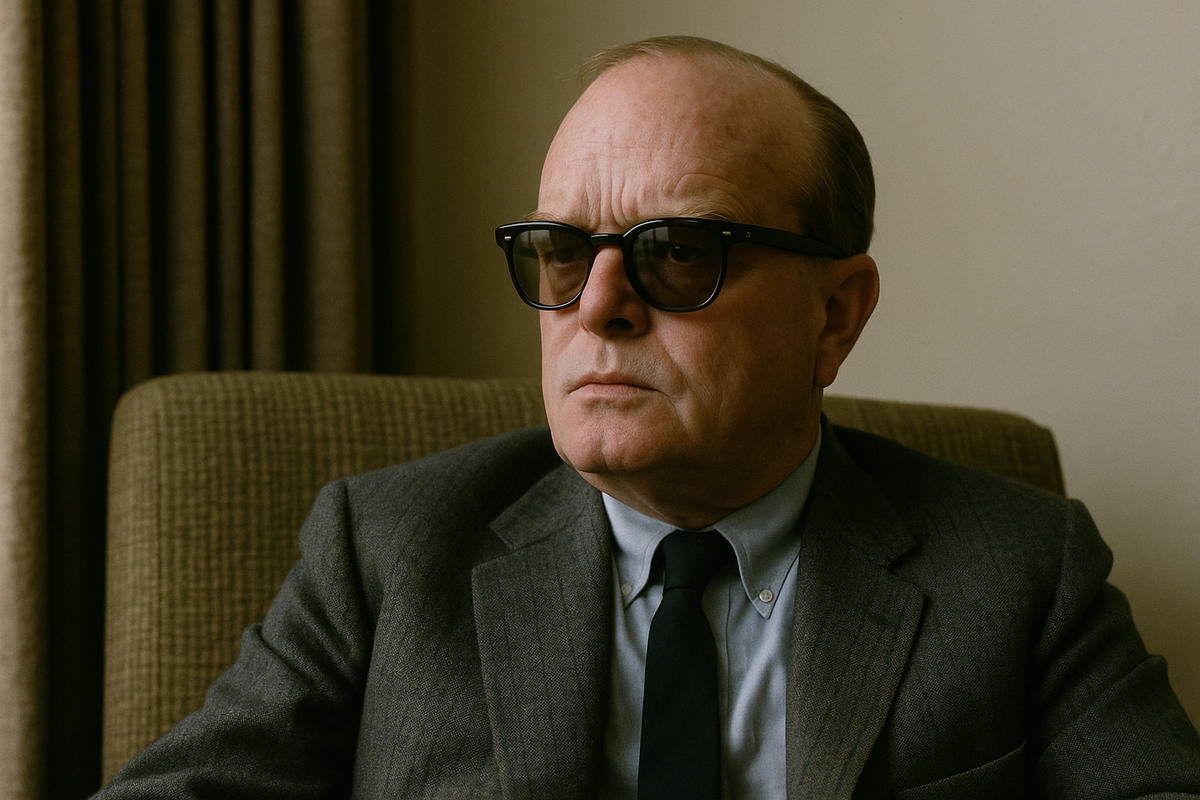
The Confessional: Truman Capote's 1968 Playboy Interview
When celebrity consumed literature, and one writer became the story he tried to tell
In March 1968, as American cities burned and students occupied campuses, Truman Capote sat for what would become one of the most revealing interviews of his career. The venue was unexpected: Playboy Magazine, a publication that had transformed itself from pin-up quarterly into the unlikely forum for America's most dangerous conversations.
The timing was surgical. Two years after In Cold Blood had made him the most famous writer in America, Capote was both worshipped and reviled—hailed as the inventor of a new literary form, condemned as a vulture who had monetized murder. The Playboy interview captured him at the apex of his fame and the beginning of his unraveling, a moment when celebrity and literature collided with consequences neither Capote nor American culture fully understood.
What readers found in those pages wasn't just an interview. It was a blueprint for how writers would become brands, how journalism would devour its subjects, and how the line between observer and participant would disappear entirely.
Archive Documentation
Historical Figure: Truman Capote (1924-1984)
Publication: Playboy Magazine, March 1968
Cultural Context: Post-In Cold Blood era, height of New Journalism movement
Archive Source: Original vintage issue from private collection
The Magazine That Talked
By 1968, Playboy had established itself as the most improbable cultural arbiter in American publishing. Hugh Hefner's creation had evolved far beyond its initial promise of sex and sophistication. The magazine's interview series had become a proving ground for public figures willing to speak without handlers, without talking points, without the careful choreography that was already calcifying political and cultural discourse.
Malcolm X had sat for Playboy. So had Martin Luther King Jr., Fidel Castro, and Bob Dylan. These weren't puff pieces or promotional vehicles. They were extended interrogations that assumed readers had the patience for complexity and the appetite for ideas that didn't arrive pre-digested.
For Capote, whose entire career had been an exercise in calculated self-invention, the Playboy interview was both opportunity and risk. Here was a platform that reached millions, that conferred legitimacy precisely because it made no apologies for its erotic content. The magazine's hybrid identity—part Esquire, part gentleman's quarterly, part literary journal—mirrored Capote's own fusion of high art and mass appeal.
The Writer as Spectacle
The interview arrived at a moment when Capote had become something American literature had rarely produced: a writer as famous for his persona as for his prose. The high-pitched voice, the dark glasses, the claim to have attended the Black and White Ball with "everyone who matters"—these weren't accidents of personality. They were strategic choices that had transformed a small gay man from the South into one of the most recognizable figures in American culture.
In Cold Blood had completed the transformation. Six years of research. Four thousand pages of notes. Intimate relationships with the killers Perry Smith and Dick Hickock that ended only when Kansas executed them in 1965. Capote had invented what he called the "nonfiction novel," a form that applied literary technique to journalistic material, that treated real murder with the same narrative intensity previously reserved for fiction.
The book was both a masterpiece and a scandal. Critics praised its prose and questioned its ethics. Had Capote exploited the Clutter family's tragedy? Had he delayed legal appeals to preserve his ending? Had he paid for access, and if so, what did that mean for journalism?
The Playboy interview gave Capote space to answer—or, more accurately, to perform his answers. He defended the nonfiction novel as a legitimate form. He discussed the emotional toll of spending years inside a murder case. He reflected on American violence, capital punishment, and the cult of celebrity that he himself had cultivated.
What emerges from these pages is a man acutely aware of his own contradictions. Capote understood that he was both artist and celebrity, truth-teller and performer, observer and participant. The interview captures him managing these tensions with characteristic wit, deflecting serious questions with sharp one-liners while simultaneously revealing more than he might have intended.
New Journalism's Golden Child
Capote's appearance in Playboy placed him at the center of what was then called New Journalism—a movement that included Tom Wolfe, Joan Didion, Gay Talese, and Norman Mailer. These writers rejected the false objectivity of traditional reporting, inserting themselves into their stories, deploying fictional techniques, and acknowledging that observation always changes what's being observed.
In Cold Blood was New Journalism's proof of concept, evidence that literary ambition and journalistic rigor could coexist. But it also revealed the form's dangers. When the writer becomes part of the story, when empathy shades into identification, when narrative demands override ethical obligations—what then?
The Playboy interview doesn't resolve these questions. Instead, it documents a moment when American journalism was reinventing itself, when the boundaries between fiction and nonfiction seemed thrillingly porous, before the consequences of that porousness became clear.
The Making of In Cold Blood
Capote recounts the six-year ordeal of researching and writing his masterwork, revealing the psychological cost of immersing himself in murder and its aftermath.
American Violence
Long before capital punishment became mainstream debate, Capote dissected the nation's obsession with crime, punishment, and state-sanctioned death.
Fame and Persona
He acknowledges his flamboyant image as both shield and prison, admitting to being simultaneously amused and exhausted by his own celebrity.
Writing and Truth
A defense of the nonfiction novel as legitimate form, insisting journalism and art could merge to reveal deeper truths about American society.
The Cover as Statement
The March 1968 cover announced Playboy's ambitions without apology. A model's body transformed into canvas through body painting, the rabbit logo integrated into the design, the human form as pop art. This wasn't eroticism for its own sake—it was a visual argument about art, commerce, and liberation that reflected the decade's experimental spirit.
Inside, black-and-white photography captured Capote behind his signature dark glasses, the visual presentation reinforcing his status as both literary figure and cultural phenomenon. Playboy's layout gave the interview room to breathe: long columns of uninterrupted text, extended Q&A that respected both interviewer and subject, space for ideas to develop without the constant interruption of sidebars and pull-quotes.
This was journalism as event, presentation as argument. The magazine understood that form shapes meaning, that how you publish something is inseparable from what you're publishing.
The Long Shadow
Revisiting the Capote interview in our current moment reveals how much has changed and how little. We live in an era when everyone performs their identity online, when privacy has become quaint, when the boundaries between public and private have dissolved almost completely. Capote navigated this territory early, constructing a public persona that was simultaneously authentic and theatrical, revealing and concealing.
The questions the interview raises about journalism's ethics, about the relationship between truth and narrative, about the costs of ambition—these haven't been resolved. They've intensified. In an age of true crime podcasts, immersive journalism, and constant self-documentation, Capote's example remains both cautionary and exemplary.
The March 1968 Playboy interview reminds us that magazines once had the space and the will to publish conversations that mattered, that assumed readers could handle complexity, that treated ideas with the same seriousness as entertainment. In today's landscape of algorithmic feeds and diminishing attention spans, that assumption seems almost revolutionary.
Why Collectors Hunt This Issue
Historical Intersection
The issue captures multiple trajectories converging—Capote at his peak, New Journalism establishing legitimacy, American culture fracturing along generational and political lines. It's a snapshot of 1968, that hinge year when postwar consensus shattered.
Cultural Artifact
This interview documents the emergence of the writer-as-celebrity, a phenomenon that would reshape literature and journalism. Capote pioneered a model that countless others would follow, for better and worse.
Design Excellence
The body-painted cover ranks among Playboy's most iconic, a visual encapsulation of 1960s experimentation. For collectors of magazine design, it's essential.
Archive Value
As print journalism contracts and long-form interviews migrate online, vintage Playboy issues become increasingly significant as records of when magazines were central to cultural conversation. The Capote interview exists in a tradition that includes landmark conversations with Muhammad Ali, John Lennon, and Martin Luther King Jr.
Owning this issue means possessing a fragment of the moment when American journalism expanded its boundaries, when literary ambition merged with mass media, and when one writer's celebrity became a case study in fame's costs.
Building Your Archive
For collectors serious about documenting 20th-century culture, the March 1968 issue represents essential acquisition. Our archive includes thousands of original Playboy issues spanning the 1950s through the 1970s—each one a window into how American culture evolved through its most turbulent period.
Browse Playboy Magazine CollectionWhether you're a Capote scholar, a collector of magazine history, or someone fascinated by the moment when journalism became art and celebrity became currency, this issue belongs in your collection.
The March 1968 Playboy doesn't just document Truman Capote's career. It captures the instant when American culture realized that privacy was ending, that fame would devour everything, and that the writer who thought he was observing the story had become the story himself.
That realization still echoes.