
The Shirt That Changed Wrestling
Inside the 1987 Magazine That Immortalized Betrayal
The golden cross hit the canvas first.
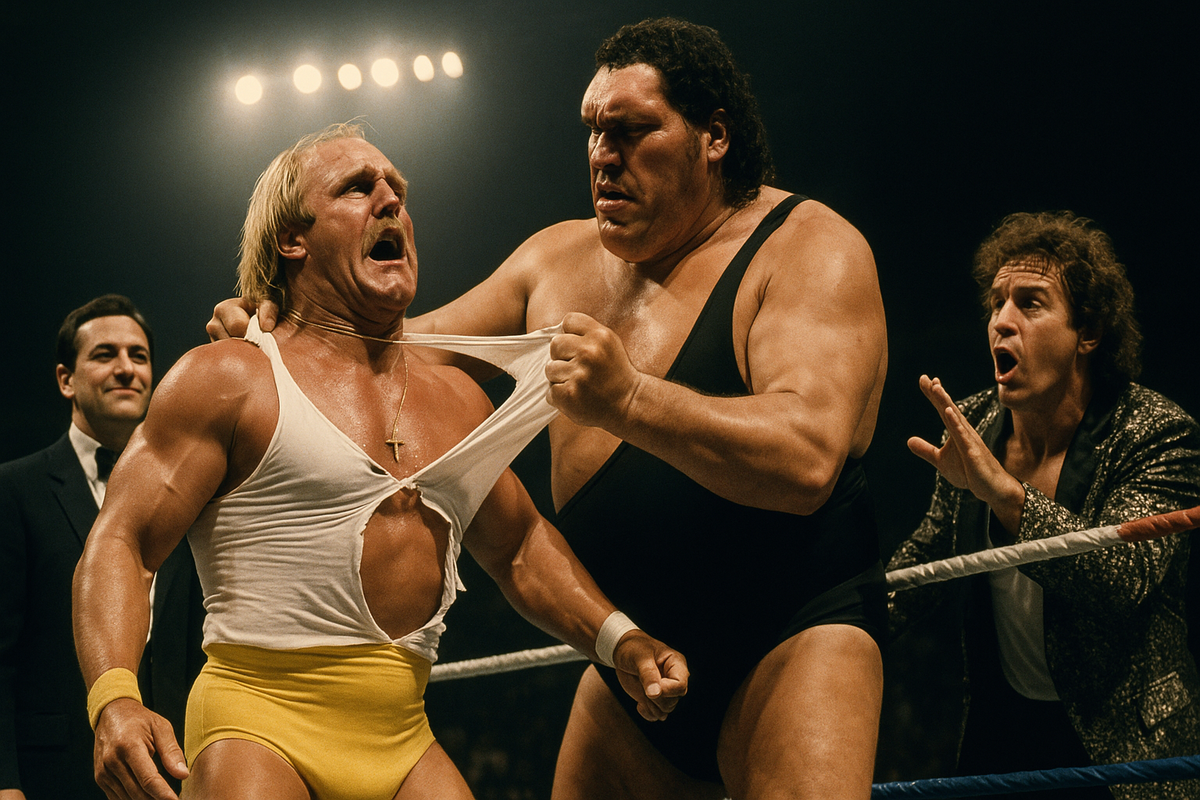
Then came Hulk Hogan's shirt—torn from his chest by the massive hands of Andre the Giant, the man who had once been his friend. Fans watching Piper's Pit that night in early 1987 witnessed something unthinkable: the gentle giant had turned villain. But for those who couldn't watch, or couldn't believe what they'd seen, proof arrived weeks later in their mailboxes.
The April–May 1987 issue of WWF Magazine didn't just report the betrayal. It crystallized it into permanence.
When Print Mattered More Than Replay
In 1987, you couldn't rewind live television. VHS recordings were expensive and grainy. If you missed Saturday Night's Main Event, you relied on two sources: playground rumors and WWF Magazine. The latter carried institutional weight. Published by the WWF itself, the magazine served as official record—the difference between "I heard Andre attacked Hogan" and "Here's photographic evidence of Andre ripping Hogan's cross off."
The Hulk vs. Andre feature spread across multiple pages, each one designed to make the impossible real. Close-ups captured Hogan on his knees, clutching torn fabric and broken chain. Wide shots showed Andre towering above him, Bobby "The Brain" Heenan smirking at his side. Roddy Piper, mid-commentary, pointed at Hogan's chest and delivered the line that became legend: "Hogan, you're bleeding."
These weren't action photos. They were crime scene documentation.
Archive Details
Publication: WWF Magazine
Issue: April–May 1987
Feature Article: "Hulk vs. Andre: Three Years Is a Long Time"
Historical Context: Pre-WrestleMania III (March 29, 1987)
Cultural Significance: Documentation of wrestling's most iconic betrayal
The Soap Opera Made Tangible
Wrestling in the 1980s understood something television executives are still learning: spectacle needs testimony. The match itself would happen at WrestleMania III on March 29, 1987. But the magazine, arriving in homes weeks before, transformed anticipation into obsession.
The article, titled "Hulk vs. Andre: Three Years Is a Long Time," framed the confrontation as a friendship destroyed by ambition and manipulation. Heenan, wrestling's greatest antagonist, had done the unthinkable—turned the industry's most beloved giant into its most dangerous heel. The magazine captured Heenan's expression perfectly: not triumphant, but calculating. He knew what he'd unleashed.
Hogan's response, printed in bold: "Yes." One word, accepting Andre's challenge for the WWF World Heavyweight Championship. The magazine closed on that declaration, leaving readers to count down the days until 93,173 fans would pack the Pontiac Silverdome.
Why Collectors Hunt This Issue
Thirty-eight years later, the April–May 1987 WWF Magazine commands prices far beyond its original newsstand cost. The reasons are historical, cultural, and aesthetic.
Historical Significance
WrestleMania III remains the most-attended wrestling event in North American history. This magazine documented the buildup to Hogan body-slamming a 520-pound man—a moment replayed in every wrestling documentary since.
Cultural Artifact
The issue captures the apex of Hulkamania, when wrestling had fully colonized mainstream America. MTV partnerships, action figures, Saturday morning cartoons—Hogan wasn't just a wrestler; he was a franchise.
Visual Documentation
The photography is brutal in its intimacy. The image of Hogan gathering his broken cross transcended kayfabe. It looked like genuine anguish.
The Heel Turn That Worked
Andre's betrayal succeeded because it was unthinkable. The magazine recorded every step, making the storyline feel inevitable in retrospect.
The Magazine as Time Capsule
Flip through this issue today and you're not just reading wrestling coverage. You're seeing 1980s design philosophy: bold sans-serif headlines, high-contrast photography, layouts that prioritized impact over whitespace. The aesthetic is aggressive, unapologetic, perfectly matched to wrestling's energy.
The advertisements alone tell a story—action figures, ice cream bars, upcoming house shows in cities that no longer have wrestling venues. The editorial voice speaks directly to children and teenagers, the demographic that made Hulkamania possible. There's no ironic distance, no winking acknowledgment of wrestling's predetermined nature. The magazine treats Hogan vs. Andre with the seriousness of a heavyweight boxing match.
This sincerity is what makes vintage wrestling magazines so compelling to modern collectors. They capture a moment when the performance was treated as sport, when millions of fans suspended disbelief completely, when a torn shirt could symbolize genuine tragedy.
The Business of Preservation
Finding original copies of this issue requires navigating the collector market—auction sites, specialty dealers, comic shops with vintage magazine sections. Condition varies wildly. Some copies show wear from repeated readings, pages creased from being carried to school. Others remain pristine, saved by collectors who recognized significance in real-time.
The irony: magazines designed to be disposable now serve as archival material. Researchers studying 1980s pop culture cite WWF Magazine alongside MTV programming and Reagan-era marketing campaigns. The publication documented not just wrestling storylines but the construction of celebrity, the mechanics of mass media storytelling, the aesthetics of an entire decade.
Why This Moment Still Matters
Wrestling has evolved dramatically since 1987. Storylines have grown more complex, production values have skyrocketed, and the internet has demolished the barrier between performance and reality. Yet the Hogan-Andre rivalry remains the template—the friendship betrayed, the impossible challenge, the hero forced to overcome both physical and emotional obstacles.
The April–May 1987 WWF Magazine captured that template at its purest. No Twitter reactions, no spoilers leaked online, no reality show behind-the-scenes footage. Just the story, told through dramatic prose and stark photography, delivered to mailboxes and newsstands, waiting to be discovered.
Holding this magazine now is like holding evidence of a disappeared world—when wrestling was magic, when magazines were primary sources, when a torn shirt and broken cross could make millions of people believe in betrayal.
Collector Significance
Rarity & Demand
Original copies in good condition command premium prices among wrestling memorabilia collectors and cultural historians.
Historical Documentation
Official WWF publication serving as primary source material for one of wrestling's most important storylines.
Cultural Impact
Captures the peak of 1980s wrestling mania and the mechanics of sports entertainment storytelling.
Investment Value
As physical media becomes scarcer, vintage wrestling magazines continue to appreciate among serious collectors.
For Collectors and Historians
Original WWF magazines from the 1980s and 1990s remain available through specialized dealers and archive collections. These publications trace the evolution of sports entertainment from regional territory system to global entertainment empire, documenting the careers of legends and the storylines that defined generations.
Browse WWF Magazines CollectionWhether you're researching pop culture history, building a wrestling memorabilia collection, or rediscovering the media you consumed as a child, these magazines offer something no digital archive can replicate: the physical artifact, preserved exactly as it was consumed.