
The Notebooks of James Thurber
When America's Sharpest Wit Met the Postwar Void
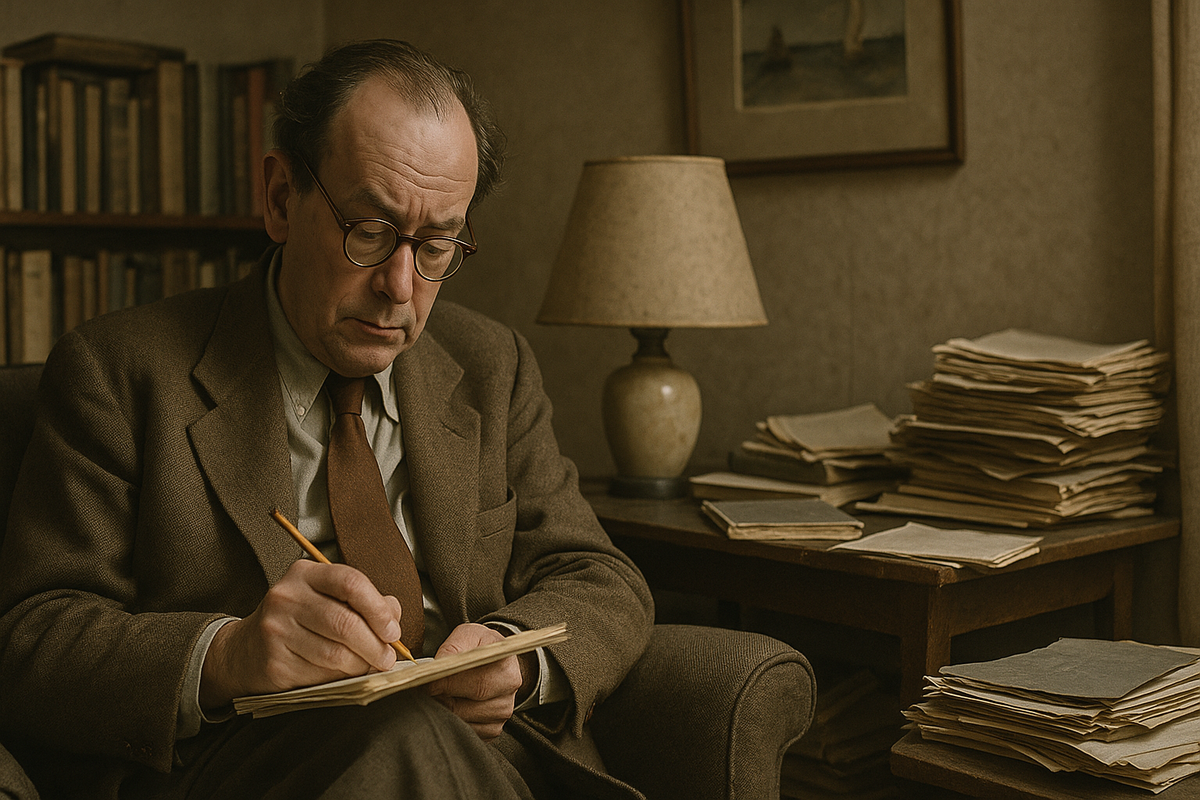
On a February morning in 1949, while Harry Truman contemplated the Soviet threat and veterans traded combat stories for mortgage applications, James Thurber sat down to write about scraps of paper.
Not just any scraps—those maddening fragments every writer accumulates. Half-remembered jokes. Beginnings without middles. Cryptic notes that once seemed brilliant at 2 a.m. In "The Notebooks of James Thurber," published in The New Yorker's February 5, 1949 issue, America's master of controlled chaos turned literary debris into a meditation on memory itself. What looked like whimsy was actually something harder: a writer confronting how little of our inner lives survives us, and how much of what does survive makes no sense at all.
The essay arrived at a peculiar moment. Four years after V-J Day, America was simultaneously exhausted and restless. The baby boom was underway. The GI Bill was minting a new educated class. NATO would form within months. And hanging over everything—the Cold War's first desperate winter, with Berlin kept alive by airlift while Washington debated whether the atomic monopoly would hold.
Literature was changing too. The earnest realism of the war years was giving way to something more slippery: irony, modernist fragmentation, the sense that grand narratives had failed. Thurber, already a New Yorker institution by then, embodied this shift perfectly. He could make you laugh while pulling the floor out from under meaning itself.
Archive Details
Featured Writer: James Thurber
Essay Title: "The Notebooks of James Thurber"
Publication: The New Yorker
Issue Date: February 5, 1949
Historical Context: Cold War Beginning, Berlin Airlift, Pre-NATO Formation
The Magazine That Mirrored the Moment
By 1949, The New Yorker had become something more than a weekly magazine—it was the house journal of a certain kind of American mind. Not the mass market. Not the intellectual quarterlies. Something in between: urbane without being precious, serious without being solemn, metropolitan but never provincial.
Harold Ross had built it that way deliberately. In its pages, political cartoons sat beside Shirley Jackson stories. E.B. White's essays on Manhattan shared space with John Hersey's reporting from Hiroshima. The magazine assumed its readers were smart, skeptical, and tired of being shouted at. After a decade of Depression and a half-decade of war, that assumption resonated.
The February 5th issue delivered exactly what its audience needed. Thurber's "Notebooks" piece anchored a lineup that mixed the ephemeral and the enduring—cartoons that captured postwar anxiety in a single panel, poems that processed trauma through indirection, profiles that revealed character through accumulated detail rather than grand pronouncements.
This wasn't just entertainment. It was a tutorial in how to think about a world that no longer made the sense it once did.
When the Cover Tells the Truth
The cover illustration tells you everything about The New Yorker's strategy. No screaming headlines. No celebrities. Just a snow-covered street scene: children sledding, families moving through their routines, a delivery truck parked beneath winter trees. Suburban and serene—the America everyone was supposed to be building.
But look closer, and the irony emerges. This is the magazine that would publish Salinger, that had already run Hersey's atomic bomb reporting, that understood the disconnect between official optimism and private dread. The gentle cover wasn't naïve. It was knowing. It said: We see what you're doing, this performance of normalcy. We'll play along, but we both know what's underneath.
Inside, Thurber's essay worked the same territory. He joked about misplaced notes and unfinished stories, about literary executors puzzling over indecipherable handwriting. But the real subject was existential: How do we make meaning when memory is unreliable? How do we construct a coherent self from fragments? What survives us, and does it matter?
These were not abstract questions in 1949. They were the questions of a generation that had survived catastrophe and wondered what came next.
The Fragments That Remain
Thurber's genius was making philosophy feel like gossip. He presented himself as both serious artist and bumbling fool—the writer who couldn't remember what his own notes meant, who found half-finished manuscripts and wondered who'd written them. The persona was calculated. Behind the self-mockery lay real anxiety about legacy, about whether any of this scribbling added up to anything.
The essay moved between memoir and meditation, between specific anecdotes and larger reflections on the creative process. Thurber understood that readers didn't want sermons; they wanted company. Someone willing to admit that most of what we do disappears, and that maybe that's fine, and maybe it's terrifying, and maybe both things are true simultaneously.
The New Yorker's cartoons amplified this perfectly. Placed alongside the text, they created a dialogue between word and image, between Thurber's written wit and the visual absurdism the magazine had made its signature. The layout itself became part of the argument: meaning emerges from juxtaposition, from fragments in conversation.
This was postwar American culture learning to live with uncertainty, using humor as both shield and scalpel.
The Fragmentary Life of Writers
Thurber's essay explored how much of a writer's legacy consists of unfinished notes, jokes, and false starts, raising questions about memory and meaning that resonated with a generation processing wartime trauma.
Humor as Survival Tool
With wry wit, Thurber turned misplaced scraps and scribbled outlines into a portrait of creativity itself—showing postwar Americans how to laugh at confusion rather than pretend it didn't exist.
The Writer's Dual Persona
Thurber presented himself as both serious and self-mocking, embodying the contradictions of mid-century American letters—capable of profound insight while refusing to take himself too seriously.
Visual-Textual Dialogue
Placed alongside classic New Yorker cartoons, the piece gained another layer of humor through visual irony, demonstrating how meaning emerges from juxtaposition and fragments in conversation.
The Magazine as Time Machine
Vintage New Yorker issues resist obsolescence in ways newspapers never could. They captured not just events but sensibilities—how people talked, what they found funny, which anxieties they could name and which they could only hint at. The advertisements alone tell stories: what products promised escape, what aspirations marketers assumed, what version of "the good life" seemed plausible in 1949.
Reading this issue now means encountering a world still in formation. The postwar consensus hadn't calcified. The 1950s hadn't happened yet. Television was still a curiosity. America was simultaneously triumphant and uncertain, powerful and afraid, optimistic and traumatized.
Thurber's essay works as a guide to that dissonance. By writing about fragments and lost meanings, he was really writing about how his generation would preserve their experience—what would survive in notebooks and memories, what would be lost, whether any of it added up to wisdom or just accumulated debris.
Seventy-five years later, the questions still resonate.
Why This Issue Endures
For collectors of literary magazines and cultural ephemera, the February 5, 1949 New Yorker represents something beyond nostalgia. It's a document of transformation—the moment when American culture pivoted from wartime clarity to Cold War ambiguity, when humor became a tool for navigating dread rather than escaping it.
Historical Inflection Point
Published as the Berlin Airlift entered its final months and NATO negotiations intensified, the issue captures America between wars, between certainties, searching for a new cultural vocabulary.
Thurber at Peak Form
Mid-century work by Thurber commands consistent interest among collectors of American humor and literary magazines. His essays from this period represent his mature voice: less whimsical than his earlier work, more philosophically engaged, but still devastating in their comic precision.
Visual Archive
The winter cover illustration exemplifies The New Yorker's aesthetic strategy—understated, observational, sophisticatedly accessible. For collectors of mid-century illustration, these covers document the evolution of American visual culture.
Literary Ecosystem
Issues from this era featuring Thurber, White, Jackson, and early Salinger consistently rank among the most sought-after in the vintage magazine market. They represent a moment when weekly periodicals could still shape national literary conversation.
Owning this issue means possessing an intact artifact of that conversation—not a reprint, not a summary, but the actual object that sat on coffee tables from Manhattan to Berkeley, that readers marked up and argued over and kept because something in it felt essential.
Explore the Archive
This issue is part of a larger collection spanning The New Yorker's entire run, from the Jazz Age through the digital present. Each issue offers a window into its moment—the advertisements and cartoons, the fiction and reporting, the tone and preoccupations that defined how Americans understood themselves.
For collectors, literary historians, and anyone fascinated by how culture evolves, these original issues provide something digitized archives cannot: the physical experience of discovery, the weight and texture of history, the sense of holding a conversation that happened decades ago but continues.
Browse The New Yorker Magazine CollectionCoda
The February 5, 1949 New Yorker remains relevant not despite its age but because of it. Thurber's "Notebooks" essay captures something timeless about creative work and human memory while remaining utterly specific to its postwar moment. It's funny and melancholy, self-aware and genuine, trivial and profound.
That paradox—that ability to be multiple things simultaneously without collapsing into incoherence—defines The New Yorker's achievement in this period. The magazine understood that Americans in 1949 needed wit more than certainty, company more than answers, permission to laugh at confusion rather than pretend it didn't exist.
Holding this issue now is like eavesdropping on a smarter, more literate version of America talking to itself. The conversation is worth joining.