
When White Miners Crossed the Color Line to Save a Black Child's Life—And Then Went Home to Segregated Schools
Inside the April 16, 1959 issue of Jet Magazine that captured the full complexity of American conscience
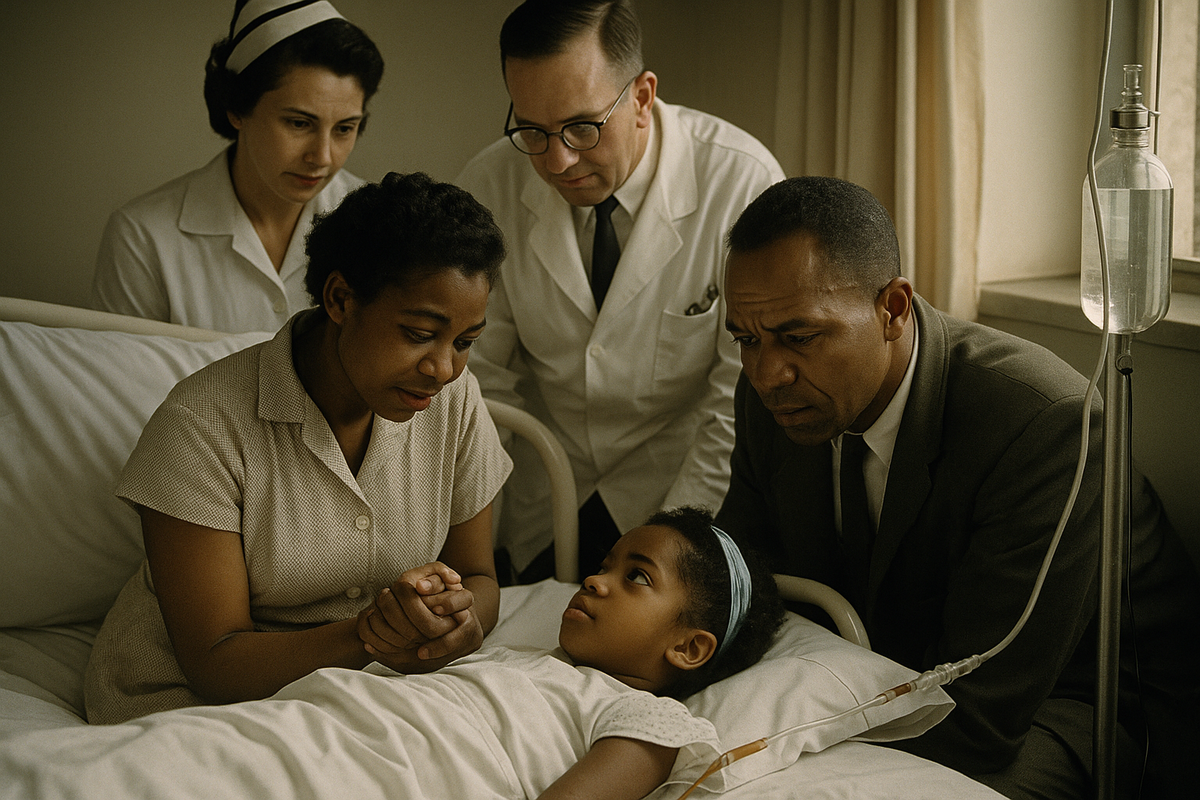
April 16, 1959. St. Louis, Missouri. Twenty-three white coal miners from Colp, Illinois, filed off a chartered bus and entered a hospital where eight-year-old Priscilla Harrison lay opened on an operating table, her damaged heart exposed to surgical lights.
The miners had traveled 250 miles to donate blood—not stored plasma, but live transfusions—because the girl's delicate condition demanded it. For twelve hours, they waited. They gave. And when it was over, Priscilla Harrison survived.
Then they went home to a town that still refused to integrate its schools.
This is the story Jet Magazine published that spring, and it remains one of the most haunting documents of American contradiction ever printed.
The Moment, The Movement, The Magazine
Jet Magazine didn't traffic in illusions. Founded in 1951 by John H. Johnson, it had become the essential chronicle of Black American life—unflinching in its documentation of both triumph and terror. By 1959, the magazine's readers had seen the mutilated face of Emmett Till. They had watched federal troops escort the Little Rock Nine through screaming mobs. They knew what America was.
So when Jet's reporters traveled to Colp and St. Louis to cover Priscilla Harrison's surgery, they understood they were documenting something more complex than a feel-good story. They were capturing a paradox that defined the era: the same hands that donated blood to save a Black child's life also signed petitions to keep Black children out of white classrooms.
The article made no attempt to resolve this contradiction. It simply held it up to the light.
Issue Details
Publication: Jet Magazine
Issue Date: April 16, 1959
Cover Story: "Negro Stars Key to Pennant Races in Both Leagues"
Featured Subject: Priscilla Harrison, 8-year-old heart surgery patient
Historical Context: Mid-Civil Rights Movement, school integration battles
The Girl Born with a Broken Heart
Priscilla Harrison had lived eight years with a hole in her heart. Born into a coal mining community where Black families were few and medical resources fewer, she had grown up frail, her childhood marked by breathlessness and fatigue. By 1959, surgical techniques had advanced enough to make her operation possible—but barely. The twelve-hour procedure required constant blood transfusions. Stored plasma wouldn't suffice. The blood had to be fresh, living, matched.
When the call went out, Colp responded. White miners who worked alongside Priscilla's father. Their wives. Their neighbors. Twenty-three white donors and three Black donors boarded the bus to St. Louis. Jet's photographers captured them in the hospital hallways, waiting to be called. The images show working-class Americans in their Sunday clothes, faces weary from the road, waiting to give what they could.
The surgery succeeded. Priscilla lived.
The Conscience That Couldn't Cross the Schoolhouse Door
But Jet's reporters didn't stop there. They interviewed parents back in Colp—the same parents who had donated or whose neighbors had donated. And there, the American contradiction spoke plainly: Yes, they would give blood to save the child. No, they would not send their own children to integrated schools.
The magazine printed their words without editorial cushioning. This was Jet's genius—to document both the capacity for grace and the persistence of prejudice within the same community, sometimes within the same person. The article refused the easy narrative. It gave readers the truth: that humanity could coexist with hatred, that a man might save a life one day and vote against equality the next.
For Black readers in 1959, this was not surprising. It was Tuesday.
Inside This Historic Issue
The Medical Struggle
Priscilla's twelve-hour heart surgery required live blood transfusions—a medical marvel of 1959 that pushed the boundaries of cardiac surgery and survival.
The Donors' Journey
Twenty-six donors traveled 250 miles by bus, crossing economic and racial lines to provide what modern blood banks could not.
The Contradictions of Colp
White families gave blood to save a Black child while simultaneously resisting school integration—a paradox Jet documented without flinching.
The Cover's Context
Six Black baseball legends graced the cover—Ernie Banks, Willie Mays, Hank Aaron, Elston Howard, Minnie Miñoso, and Larry Doby—reflecting Jet's unique ability to honor triumph and document struggle in one issue.
Why This Issue Matters to History—And to Collectors
The April 16, 1959 issue carried a cover that seemed, at first glance, unrelated to Priscilla's story. Six Black baseball legends—Ernie Banks, Willie Mays, Elston Howard, Hank Aaron, Minnie Miñoso, and Larry Doby—stared out under the headline: "Negro Stars Key to Pennant Races in Both Leagues." This juxtaposition was pure Jet: Black excellence on the diamond, Black survival on the operating table, both existing in the same magazine because both were part of the same American experience.
For collectors and historians, this issue represents a critical artifact. It captures the precise moment when America's racial contradictions were most visible—when integration battles raged in schools and courtrooms, yet individual acts of cross-racial compassion still broke through. The visual documentation alone—photographs of the donors, of Priscilla in recovery, of a Black family navigating a white medical system in the Deep Midwest—makes this issue irreplaceable.
Issues that combine civil rights documentation with iconic cultural coverage command the highest interest among serious collectors. This is one of them. To hold it is to hold the full complexity of the era: not just the marches and speeches, but the intimate, uncomfortable human moments that revealed who Americans actually were.
What the Story Still Teaches
Priscilla Harrison's surgery won't appear in most civil rights timelines. There were no federal troops, no Supreme Court rulings, no martyrs. But Jet understood something essential: history is made not only in Montgomery and Little Rock, but also in a small Illinois coal town where people made contradictory choices and lived with them.
The story asked a question that still echoes: Is compassion in crisis enough? Can a nation claim decency if it saves a life on Thursday but maintains segregation on Friday?
Jet didn't answer. It simply reported. And in that restraint, it created a document more powerful than any editorial could have been.
Collector Significance
Historical Timing
Published during the height of school integration battles, this issue captures the contradictions of race relations in mid-century America with unprecedented clarity.
Cultural Documentation
The combination of iconic baseball legends on the cover and intimate civil rights reporting inside represents Jet's editorial genius at its peak.
Visual Archive
Rare photographs document interracial cooperation in 1950s medical settings—images that provide irreplaceable historical evidence of the era's complexity.
Primary Source Value
For researchers, educators, and serious collectors, this issue offers unfiltered access to how Black journalism documented both hope and hypocrisy in real time.
Explore the Archive
The full collection of original Jet Magazines—including this historic April 16, 1959 issue—remains available for collectors, educators, and families preserving cultural memory.
Browse Jet Magazine CollectionInside, you'll find the unvarnished record of mid-century Black America: the Montgomery Bus Boycott's daily developments, the Little Rock crisis as it unfolded, profiles of Martin Luther King Jr. and Malcolm X before history canonized them, and hundreds of intimate stories like Priscilla Harrison's—the ones that revealed how ordinary people navigated extraordinary times.
The Paradox Endures
The white miners who saved Priscilla Harrison's life were not villains. But they were not heroes, either. They were Americans, caught between instinct and ideology, capable of both generosity and prejudice within the same week.
Jet Magazine understood this. It didn't flinch from the contradiction. It printed the photographs of the donors and the quotes from parents resisting integration, side by side, and let readers draw their own conclusions.
That editorial courage—that refusal to simplify—is why Jet remains indispensable. And why this issue, with its story of a child's heart and a town's conscience, still demands to be read.