
The Last Winter Before the War
When The Saturday Evening Post Captured American Parenthood at the Breaking Point
Open the January 27, 1940 issue of The Saturday Evening Post and you'll find something remarkable: a nation laughing at itself just months before everything changed.
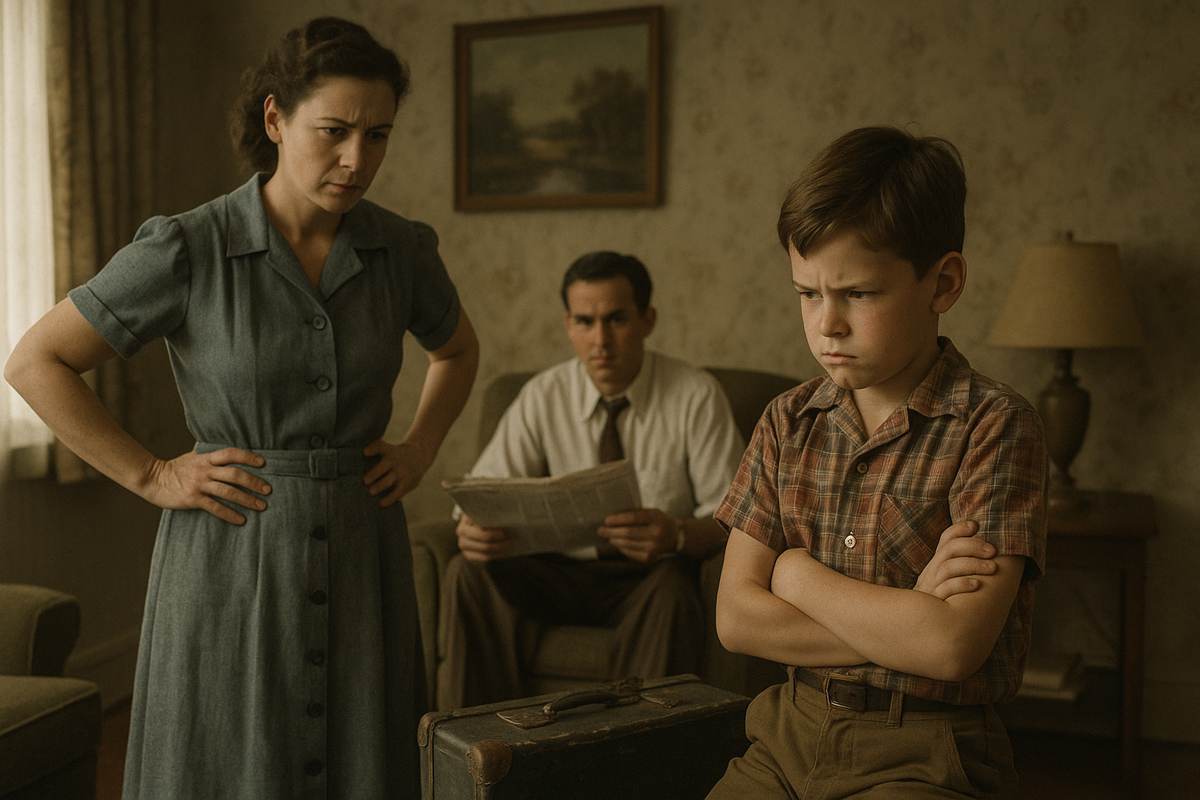
Gladys Taber's short story "Parents Can't Help It" reads like a time capsule sealed at the precise moment American domesticity still felt eternal. A mother named Andrea. A father named Phil. Their stubborn son Billy. The arguments over camp, over dinner, over obedience—the small battles that fill a household when the world outside hasn't yet demanded sacrifice.
By December, those same readers would be calculating rationing points and scanning casualty lists. But in January, they could still afford to find humor in a child who refused to eat his vegetables.
That tension—between the ordinary and the unimaginable—makes this issue one of the most culturally significant artifacts of prewar America.
Archive Metadata
Featured Story: "Parents Can't Help It" by Gladys Taber
Issue Date: January 27, 1940
Illustrator: Nicholas Riley
Historical Context: Published eight months after Nazi Germany invaded Poland, eleven months before Pearl Harbor
The Depression's Children, The War's Parents
The winter of 1940 wasn't peacetime. It was the pause between catastrophes.
The Great Depression had finally loosened its grip, but the muscle memory remained. Thrift wasn't a virtue—it was survival instinct. Parents like Andrea and Phil had lived through unemployment lines and foreclosure notices. They raised children with the hard-won knowledge that discipline, resourcefulness, and obedience weren't negotiable.
Billy represented something else entirely: the generation that would come of age during wartime, shaped less by scarcity than by the demands of a mobilized nation. His resistance to camp, his battles at the dinner table, his stubborn independence—these weren't character flaws. They were the friction between two Americas rubbing against each other in the same household.
Europe was already burning. Poland had fallen. Britain and France were at war. The United States maintained its neutrality, but the question wasn't if America would be drawn in—it was when. Against that backdrop, Taber's story carried unexpected weight. It reminded readers that even as the world order collapsed, the family remained the irreducible unit of American life.
This wasn't escapism. It was affirmation.
Why The Post Mattered
By 1940, The Saturday Evening Post had become the nation's living room. Circulation in the millions. Delivered weekly to farmhouses in Kansas and brownstones in Boston. It wasn't just read—it was shared, passed from kitchen table to armchair to neighbor.
The January 27th issue exemplified the magazine's peculiar alchemy. Fiction like Taber's sat alongside illustrations by Nicholas Riley, whose drawings captured Billy's sulking resistance and Andrea's exasperated love with the kind of visual specificity that made the story feel like it was happening next door. One image showed Billy with his suitcase packed for camp, radiating reluctance. Another caught Andrea mid-argument, every parent's frustration distilled into ink and paper.
These weren't decorative flourishes. They were translation devices—turning fiction into shared experience, private struggles into communal recognition.
Where Life Magazine used photojournalism to bring war into American homes, the Post used illustrated fiction to make those same homes legible to themselves. The effect was quietly powerful: it shaped how Americans understood their own lives, validating the small dramas of parenthood even as global drama mounted.
The Story That Refused to Age
What made "Parents Can't Help It" resonate in 1940—and what makes it valuable now—is Taber's refusal to sentimentalize. Andrea and Phil aren't idealized. They're exhausted, occasionally defeated, sometimes ridiculous. Billy isn't villainized. He's stubborn, yes, but his resistance is honest, even logical from his perspective.
The story's key moments landed because they were universal:
The Camp Resistance
Billy's elaborate excuses for avoiding Camp Happy Horizons mirrored the negotiations happening in thousands of households. Parents pushing independence. Children clinging to the familiar.
The Dinner Table Standoff
Food battles as proxy wars for control, patience, and authority. Taber captured the wearying repetition of parental persistence meeting childhood refusal.
Generational Collision
Depression-hardened parents versus a child who hadn't yet learned what scarcity meant. The clash wasn't personal—it was historical.
Humor as Survival
Beneath the frustration, Taber insisted on laughter. The story acknowledged that parenting is absurd, maddening, and ultimately an act of stubborn love.
What Taber understood—what made her one of America's most perceptive chroniclers of domestic life—was that these small moments mattered because they were small. They were the connective tissue of ordinary life, the daily work of building a family that would endure whatever came next.
Why It Endures
Photojournalism preserved war. Fiction preserved what war interrupted.
Stories like "Parents Can't Help It" matter because they document the domestic truths that don't make headlines but define lives. The exasperation. The laughter. The negotiations. The love that persists through the dailiness of raising children.
Today, when parenting advice arrives in algorithmically optimized fragments, these vintage stories offer something rarer: honest reflection without prescription. Taber didn't tell parents what to do. She showed them who they already were.
That honesty is why these magazines endure as more than collectibles. They're cultural testimony—proof that the struggles we think of as modern have always been human.
The Artifact in Your Hands
The January 27, 1940 issue commands collector attention for reasons beyond nostalgia.
Historical Positioning
It captures American culture at an inflection point. Families still oriented toward domestic concerns, unaware how thoroughly the coming war would reshape everything. It's the last full breath before the plunge.
Gladys Taber's Trajectory
This story represents Taber before she became a household name, before the Stillmeadow books that would define her career. It's early work from a writer finding her voice.
Visual Record
Nicholas Riley's illustrations document 1940s domestic life with the kind of specificity that photography sometimes misses—the emotional truth of family friction rendered visible.
Complete Cultural Portrait
The fiction is only part of the value. The advertisements, the editorials, the design—every page testifies to how Americans lived, what they bought, what they aspired to in early 1940.
For collectors, this issue isn't simply reading material. It's evidence—of values, anxieties, humor, and resilience—from a nation about to be transformed.
The Collection Awaits
The January 27, 1940 issue is one entry in a decades-long chronicle. From the 1920s through the 1960s, The Saturday Evening Post documented American life as it was lived—in Norman Rockwell covers, in fiction that captured the national mood, in advertisements that reveal what mattered to ordinary people.
Browse The Saturday Evening Post Magazine CollectionThe January 27, 1940 issue remains what it was in 1940—a window into domestic life at a moment when that life still felt permanent. Gladys Taber's "Parents Can't Help It" gave voice to the comedy and chaos of parenthood, reminding readers that even as Europe burned, the American family endured.
To hold this issue today is to hold proof: that before the world changed, people lived, laughed, argued, and loved in ways that feel startlingly familiar. It's not just a magazine. It's memory made tangible.