
When Rudolf Bing Remade the Met
Inside Time's Portrait of Opera at a Crossroads
January 15, 1951. Korea blazed on the front pages. McCarthy's hearings loomed. And tucked inside that week's Time Magazine, between the war dispatches and the Cold War anxieties, was a different kind of revolution: the remaking of American opera.
The cover story wasn't subtle. "Music: Under New Management" announced the arrival of Rudolf Bing at the Metropolitan Opera—and with him, the end of an era. What Time's editors understood, and what makes this issue indispensable seven decades later, was that they weren't just covering an administrative shuffle. They were documenting the moment when America's grandest cultural institution opened its velvet ropes to the subway crowd.
This wasn't a puff piece. It was a reckoning.
Archive Details
Historical Figure: Rudolf Bing, General Manager of the Metropolitan Opera
Issue Date: January 15, 1951
Archive Source: Time Magazine
Feature Title: "Music: Under New Management"
The Met in 1951: Prestige Under Pressure
By midcentury, the Metropolitan Opera had become more than New York's premier opera house—it was a symbol of American cultural ambition. Founded in 1883, the Met stood as proof that the New World could rival Europe's finest theaters. But prestige came at a cost.
Enter Rudolf Bing. The Austrian-born impresario had built his reputation at Britain's Glyndebourne and Edinburgh Festivals before crossing the Atlantic in 1950. His mandate was clear: modernize the repertoire, tighten the finances, and keep the Met from collapsing under its own grandeur.
Time captured him in mid-stride—pragmatic, unsentimental, and brutally honest about the odds. "I am not a magician; there is just so much time and money," Bing told the magazine. That quote, stark and unadorned, became the thesis of the piece: even the world's greatest opera house couldn't survive on reputation alone.
What made the article extraordinary was its refusal to romanticize. Yes, the Met boasted a golden roster—Leonard Warren, Robert Merrill, Zinka Milanov, Risë Stevens—but sold-out houses didn't balance the books. The institution depended on benefactors, and Bing's job was to juggle artistic excellence with financial survival.
Time made opera management legible to Middle America. That was no small feat.
The Democratization of the Opera House
The real story wasn't just Bing. It was the audience.
Time reported what the society pages wouldn't admit: the Met's patrons were changing. Working-class New Yorkers, out-of-towners, subway commuters—they were filling seats once reserved for Manhattan's elite. Opera was shedding its exclusivity, and the magazine framed this shift as both opportunity and challenge.
This was postwar America asserting itself. If culture defined a nation as much as industry or military might, then opera—once the preserve of old money—had to belong to everyone. The Met's democratization mirrored broader social currents: the GI Bill, suburban expansion, the rise of mass media. High art was going public.
Time understood the stakes. The magazine's reporting positioned the Met not as a relic but as a living institution adapting to a changing nation. That framing—culture as dynamic, not static—gives this issue its enduring relevance.
Time's Visual Theater: Photography as Storytelling
The January 15, 1951 issue doesn't just describe opera—it shows it.
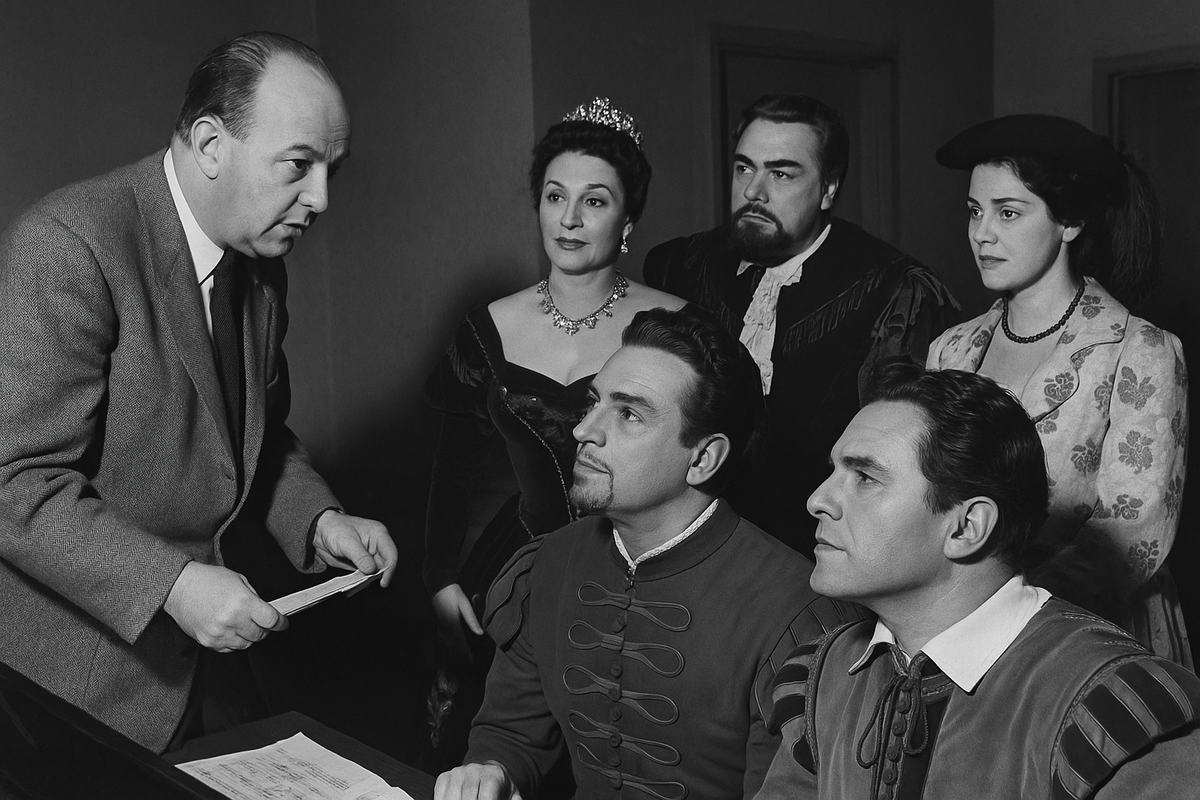
The portraits are arresting: Risë Stevens in Fledermaus, Leonard Warren in A Masked Ball, Regina Resnik in Der Rosenkavalier, Robert Merrill in Don Carlo. These weren't publicity stills. They were character studies, shot with the same gravity Time brought to world leaders and battlefield commanders.
One image stands out: Bing in rehearsal with his conductors, shirtsleeves rolled, score in hand. It's unglamorous and essential—a reminder that what audiences saw onstage was built on invisible labor. Time gave that labor dignity.
The magazine's mid-century design—clean typography, sharp black-and-white photography—amplified the authority of the reporting. Where other publications might have treated opera as niche entertainment, Time gave it the same visual weight as politics or war. The message was unmistakable: this matters.
For collectors, these images are gold. They capture not just singers in costume but the aesthetic sensibility of an era when photography still carried the weight of event.
Why This Issue Endures
Cultural Milestone
Marks the beginning of Bing's two-decade tenure that would redefine American opera and establish new standards for institutional management.
Golden Age Documentation
Captures the Met's vocal roster at its peak—Warren, Merrill, Milanov, Stevens—preserved in vivid portraiture and sharp reporting.
Historical Convergence
Documents the tension between tradition and modernization, elitism and democracy, at a pivotal moment in postwar American culture.
Primary Source Value
Offers unfiltered access to how the Met's transformation was understood in real time, before history softened the edges.
Cultural journalism is ephemeral. Most of it disappears with the next news cycle. But certain pieces transcend their moment—not because they predict the future, but because they capture a turning point with clarity and conviction.
The January 15, 1951 Time does exactly that. For music historians, this issue is primary-source material. For magazine collectors, it's a cultural artifact from Time's imperial phase, when the Luce empire set the terms for how Americans understood the world. For opera enthusiasts, it's a window into a vanished era when newspapers still ran opera reviews on the front page and Time devoted cover stories to general managers.
That convergence—history, journalism, art—is what makes this issue irreplaceable.
The Collector's Case
Institutional Turning Point
Documents Rudolf Bing's arrival at the Metropolitan Opera—a tenure that would last until 1972 and fundamentally reshape American opera.
Visual Preservation
Features costume portraits of opera's golden age stars and behind-the-scenes imagery that humanized the institution's invisible labor.
Cultural Democratization
Captures the moment when high culture opened to working-class audiences—a shift that defined postwar American cultural identity.
Journalistic Authority
Exemplifies Time's mid-century editorial power—when the magazine's cultural coverage shaped national conversation and perception.
Vintage issues of Time from the early 1950s are increasingly scarce. Cultural features like this one—substantive, richly illustrated, capturing a specific institutional moment—are especially prized.
This isn't nostalgia. It's documentation. The magazine reports on the Met as it was, not as memory has softened it. The financial pressures, the audience shifts, the personalities—all preserved in the house style that made Time indispensable.
It's history before it knew it was history.
Explore the Archives
Original copies of mid-century Time are more than reading material—they're artifacts of a media landscape that no longer exists. Every issue is a time capsule, capturing not just events but the texture of how Americans understood their world.
Browse Time Magazine CollectionFinal Take
The January 15, 1951 Time remains essential because it captured the Metropolitan Opera at an inflection point—when Rudolf Bing arrived to modernize an institution, when audiences were shifting, and when America was learning to measure its stature not just by economic or military power but by cultural achievement.
Time's reporting was sharp, unsentimental, and visually arresting. It treated opera management as news, not lifestyle filler. And it preserved a moment when high culture was opening its doors wider, navigating the tension between tradition and democracy.
For collectors, historians, and opera lovers, this issue is more than paper. It's a stage where ambition, artistry, and American identity converge—still speaking clearly across seventy years.