
Eleanor Roosevelt, Postwar Families, and the Questions That Shaped 1948 America
When the world's most influential woman told housewives not to panic about Soviet attacks—and why sex needed honest conversation
January 1948. Across America, women opened their mailboxes to find the latest issue of Ladies' Home Journal—and inside, between the recipes and fashion plates, they discovered something unexpected: Eleanor Roosevelt telling them not to panic about a Soviet sneak attack.
Her monthly column, "If You Ask Me," had become the nation's clearinghouse for anxieties no one else would name aloud. Readers wrote to her about teenage daughters who suddenly stopped bringing friends home. About whether distillers should be allowed to use grain for whiskey when Europe was starving. About sex—a subject polite society still wrapped in euphemism—and Roosevelt's answer was blunt: "The more we talk, the better."
This wasn't your grandmother's advice column. This was Eleanor Roosevelt conducting a master class in postwar citizenship, one question at a time.
Issue Profile
Historical Figure: Eleanor Roosevelt
Publication: Ladies' Home Journal
Issue Date: January 1948
Column Featured: "If You Ask Me"
Archive Source: Original magazine collection
When Sacrifice Was Still the National Language
By 1948, Americans had earned their relief. The war was over. Men were home. Factories were churning out refrigerators instead of bombers. Yet President Truman was asking housewives to accept cheaper cuts of meat—not for their own budgets, but to free resources for European relief.
Roosevelt backed him without hesitation. In her column, she reminded readers that food shortages weren't merely inconvenient—they were the moral architecture of recovery. The Atlantic wasn't a barrier. It was a shared responsibility.
This was sacrifice as civic duty, articulated by a woman who had spent the war years visiting troops, inspecting defense plants, and redefining what a First Lady could be. By 1948, she had left the White House but not the national conversation. Her readers trusted her because she had already asked as much of herself as she was now asking of them.
Cold War Hysteria Meets Roosevelt's Realism
The Soviet Union loomed. By midyear, Stalin would blockade Berlin, and the Cold War would crystallize into a test of Western resolve. But even in January, the rumors were already circulating—whispered warnings of a Soviet sneak attack, amplified by columnists like Walter Winchell who traded in alarm.
Roosevelt cut through it. When a reader asked if Winchell's warnings held merit, she dismissed the fearmongering outright. Diplomacy, not paranoia, was the path forward. Her logic was unsparing: nations don't telegraph their attacks through gossip columns.
This wasn't naïveté. Roosevelt had spent years negotiating with Soviet delegates at the United Nations. She knew the regime's brutality. But she also knew the Russians themselves—individual human beings trapped inside an ideological machine—and she refused to collapse that distinction. In her column, she praised specific Soviet representatives for their intelligence and dedication, insisting that Americans needed to see people, not just propaganda.
It was a radical act of nuance in an era rapidly losing patience for it.
Teenagers, Taboos, and the Unspoken Questions of 1948
For the first time, American culture was grappling with a new demographic: teenagers. Not children, not quite adults—an in-between stage that bewildered parents who had never experienced adolescence as a distinct life phase.
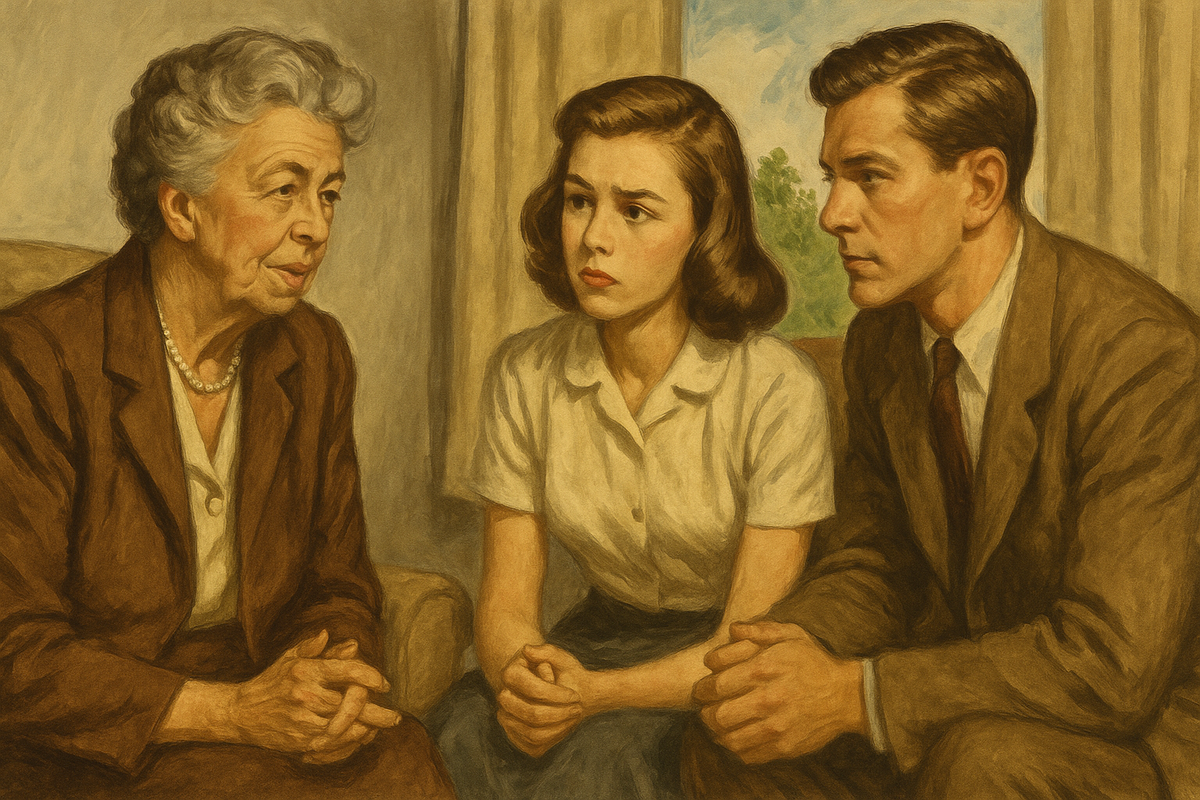
A worried mother wrote to Roosevelt: her 17-year-old daughter had stopped inviting friends over, preferring to meet them elsewhere. Was this normal? Was something wrong?
Roosevelt's response was matter-of-fact. This was adolescence—a natural withdrawal as children began forming identities separate from their families. The reassurance carried the weight of someone who had raised five children through their own turbulent youth. She normalized what parents feared, offering perspective instead of alarm.
But the most daring exchange came when a reader asked about discussing sex openly. In 1948, this was treacherous terrain. Polite society still cloaked reproduction in metaphor. School curricula avoided the subject. Parents fumbled through vague warnings.
Roosevelt didn't flinch: "The more we talk, the better."
Four words. A manifesto disguised as common sense. She was arguing for transparency in an age that preferred silence—and doing so in a magazine whose primary business was selling domesticity to Middle America.
The Magazine That Mirrored a Nation
Ladies' Home Journal was more than a publication. With circulation in the millions, it was a national forum—part advice dispensary, part cultural barometer, part political salon. Its pages blended serialized fiction with essays on democracy, meal planning with international affairs.
The January 1948 issue embodied this range. Readers could learn how to stretch their meat rations and then turn the page to Roosevelt's analysis of Soviet diplomacy. They could read short stories and then encounter her thoughts on whether the old proverb—"a son is a son until he gets a wife, but a daughter is a daughter all her life"—held any truth. (Roosevelt's verdict: individual relationships defied such tidy formulas.)
This was the magazine's genius: it never condescended to its audience. It assumed women could handle complexity—that they wanted to understand the world, not just navigate their kitchens. Roosevelt's column epitomized that respect.
The Seven Conversations That Defined January 1948
Why Collectors Prize This Issue
One of the 20th century's most influential figures, addressing both global politics and domestic life in a single column.
The issue captures America at a pivot point: prosperity dawning, Cold War tensions rising, traditional roles bending under new pressures.
From recipes to Roosevelt's progressive stance on discussing sex, the magazine reveals how American women understood their place in a shifting society.
The bright, optimistic cover art and layout reflect postwar aesthetics—visual time capsules as much as editorial ones.
Families preserve these magazines as tangible links to how their grandmothers and great-grandmothers lived, thought, and engaged with the world.
Like LIFE during the war years, Ladies' Home Journal issues endure because they froze their moment in time. They're physical objects—pages to turn, covers to admire, artifacts to hold.
Explore the Archive
If this issue resonates, there's more to discover. From the 19th century through the 20th, Ladies' Home Journal chronicled the evolution of women's lives, family ideals, and cultural values.
Browse Ladies' Home Journal Magazine CollectionWhether you're a collector, historian, or someone preserving family heritage, these magazines offer more than nostalgia—they're direct transmission from the past.
A Conversation That Still Speaks
The January 1948 issue of Ladies' Home Journal is a testament to what popular media could be: practical yet profound, domestic yet global, reassuring yet unflinching.
Eleanor Roosevelt's column anchored it all. She connected the immediate—cheaper meat, teenage friendships, family sayings—to the enduring: peace, diplomacy, honesty, shared responsibility. Her answers carried the authority of experience and the clarity of someone who believed democracy required reasoned conversation, even about uncomfortable subjects.
Holding this issue today is like eavesdropping on a moment when America was deciding what kind of nation it would become. Roosevelt's voice, pragmatic and compassionate, still cuts through the noise. For collectors and readers alike, it's not just a magazine. It's a piece of the American conversation—one we're still having.