
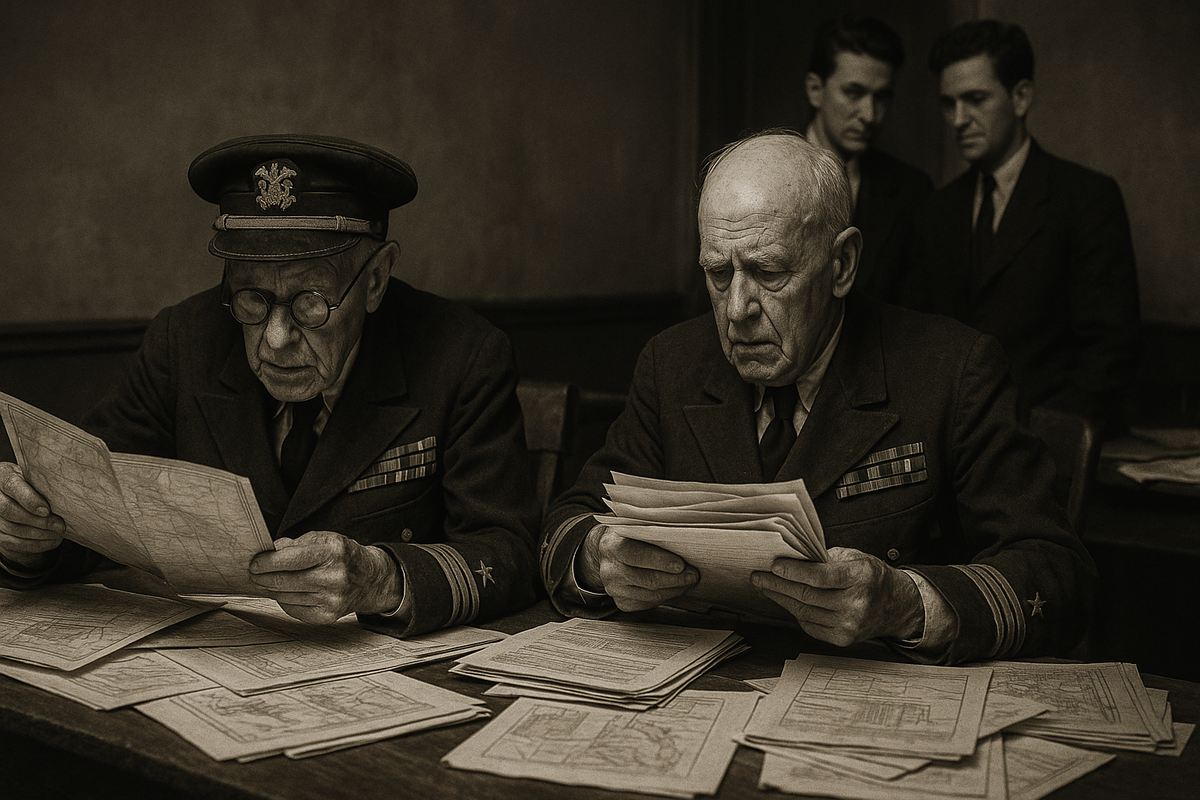
When America's Admirals Burned
The New Yorker's Perfect Depression-Era Satire
February 7, 1931. While breadlines stretched around city blocks and banks shuttered their doors by the hundreds, Manhattan's literati opened their New Yorkers to find something unexpected: a naval disaster played for laughs.
"The Burning Deck" wasn't reporting news—it was diagnosing a national crisis through comedy. In its fictional inquiry into the burning of the yacht Mayflower, readers found aging admirals drowning in charts and testimonies, fumbling through bureaucratic rituals while the ship—metaphorically, the country—went up in flames. The satire landed because it named what every American suspected: the old guard was failing, and no amount of ceremony could hide it.
This wasn't escapism. It was survival through wit.
Archive Details
Publication: The New Yorker
Issue Date: February 7, 1931
Featured Satire: "The Burning Deck"
Historical Context: Height of the Great Depression
Cultural Significance: Depression-era institutional satire
The Weight of 1931
By the winter of 1931, unemployment had blown past 8 million. The financial system was hemorrhaging confidence. Americans looked to their institutions—government, military, corporate—for steadiness and found only paralysis dressed in procedure.
The New Yorker understood the assignment. Where newspapers delivered grim tallies, the magazine offered something more subversive: permission to laugh at power when power had proven hollow. "The Burning Deck" centered on figures like Rear Admiral Luke Bidwell, satirically portrayed as ancient beyond functionality—a deliberate exaggeration that cut deep. These weren't just comic characters. They were allegories for a leadership class that had outlived its competence.
The inquiry itself became the joke: endless reports, testimonies, blueprints piling up while the core question—what actually happened?—remained unanswered. Readers recognized this absurdity immediately. They'd seen it in congressional hearings, bank collapses, relief programs strangled by red tape. The satire worked because it was documentary.
The New Yorker's Dangerous Sophistication
By 1931, Harold Ross's magazine had already carved out dangerous territory: urban, ironic, literate, and unimpressed by authority. This wasn't Midwestern earnestness or populist outrage. This was Manhattan watching the empire crumble and taking notes in elegant handwriting.
The magazine's genius lay in its refusal to moralize. "The Burning Deck" didn't editorialize about governmental failure—it showed it, through mock-serious naval proceedings that mirrored real-world bureaucratic theater. The dialogue itself became ammunition: "Please don't ask me for any memory—I only have this," one admiral protests, a line that distilled institutional senility into six words.
This was satire for readers who valued intelligence over sentiment, who wanted their criticism wrapped in style rather than shouted from soapboxes. The New Yorker cultivated an audience that could recognize the structures of power precisely because they lived adjacent to them.
The Visual Conspiracy
The February 7, 1931 cover delivered its own commentary: a towering figure in a checkered cloak looms over a smaller, hunched man walking a toy dog. The hierarchy is absurd, the vanity unmistakable. It's the visual equivalent of the naval satire inside—authority revealed as costume.
Inside pages reinforced the theme through cartoons of elderly officials buried under paperwork, procedures replacing action. This wasn't decoration. It was The New Yorker deploying its full arsenal: prose, illustration, and design working as unified cultural criticism.
While mass-market magazines aimed for broad entertainment, The New Yorker aimed for something riskier—a readership that prized wit over comfort, that wanted to laugh knowingly rather than be reassured falsely. The magazine wasn't just publishing satire. It was building a community of people sophisticated enough to get the joke and brave enough to find it funny.
Why "The Burning Deck" Mattered
The piece worked on multiple frequencies simultaneously:
The Generational Indictment
Admirals clinging to authority while lacking capacity became shorthand for an entire governing class.
Bureaucracy as Paralysis
The inquiry's mountain of documentation mocked how institutions had replaced decision-making with process.
Dialogue as Diagnosis
Sharp exchanges exposed incompetence through comedy rather than accusation.
Anxiety Displacement
Laughing at bumbling admirals allowed readers to process deeper fears about national leadership without confronting them directly.
This layered approach transformed entertainment into cultural work. Readers weren't just amused—they were validated. Their private doubts about American institutions found public expression, wrapped in humor sophisticated enough to feel safe.
The Collector's Case
Historical Precision
Published at the Depression's brutal peak, it captures how intellectual culture processed national crisis in real time.
Editorial Evolution
"The Burning Deck" exemplifies The New Yorker's mature satirical voice, establishing patterns that would define American humor writing for decades.
Visual Heritage
The cover art embodies the magazine's signature blend of whimsy and sophistication, making early issues instantly recognizable.
Scholarly Value
Researchers studying Depression-era media, the development of American satire, or the intersection of literature and political commentary consider early 1930s New Yorkers essential primary sources.
This isn't nostalgia collecting. This is acquiring documentary evidence of how America's cultural elite responded when the social contract appeared to be dissolving.
The Artifact
What makes the February 7, 1931 issue endure isn't its humor—comedy dates quickly—but its diagnosis. "The Burning Deck" identified the precise failure mode of institutions under stress: they retreat into ritual while abandoning function. The admirals fumbling through their inquiry weren't fictional absurdities. They were anthropological observations.
Holding this issue today means holding the moment when American confidence cracked but American wit didn't. When laughter became a form of resistance, and satire became a method of survival. It's a reminder that in every crisis, some people panic, some people freeze—and some people sharpen their pencils and draw blood with comedy.
That's the artifact. Not the magazine itself, but the proof that intelligence and humor can coexist with uncertainty. That sophistication doesn't require optimism. That you can look directly at failure and describe it beautifully.
The admirals are still burning. The deck is still on fire. But someone, somewhere, is taking notes—and they're wickedly funny.
Explore the Archive
Discover rare issues from The New Yorker, Life, Esquire, and more. Each magazine is a portal to 20th-century America—wit, culture, and history preserved in print.
Browse The New Yorker Magazine Collection