
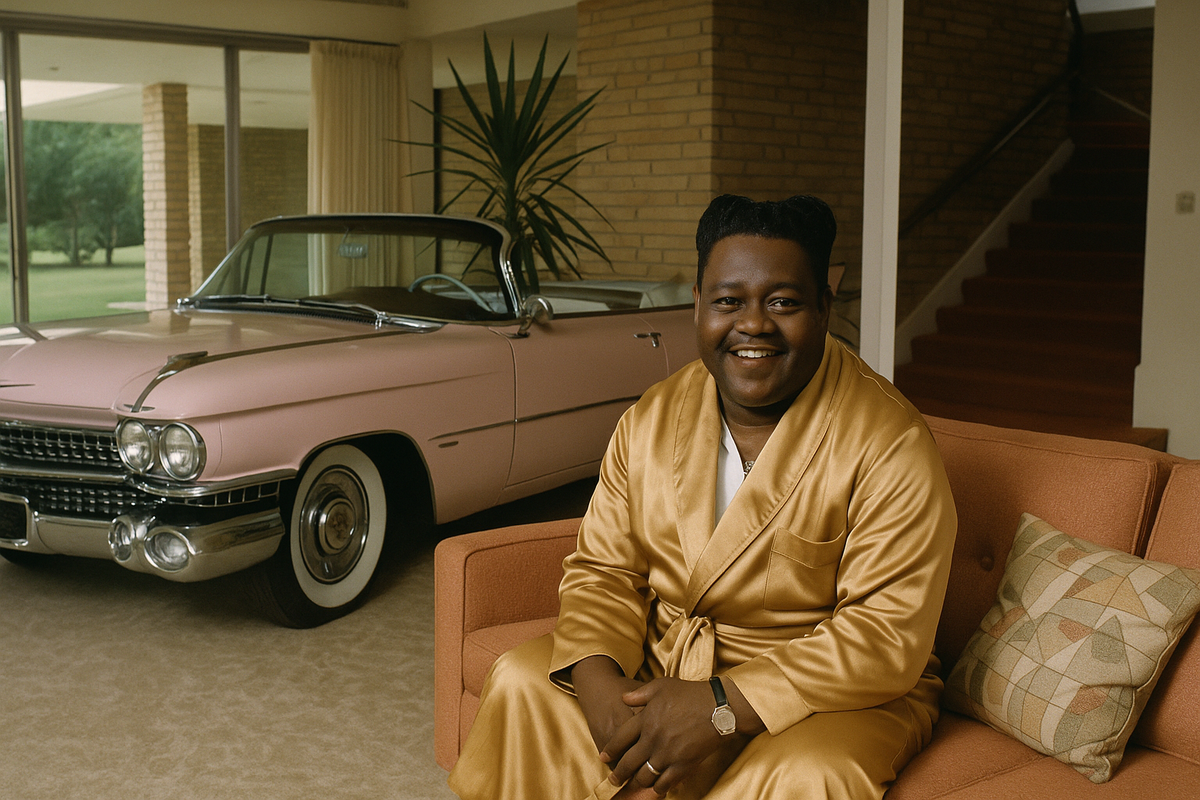
The Pink Cadillac in the Driveway
When Fats Domino Built a $200,000 Palace and Rewrote the Rules of Black Wealth in America
In July 1960, while college students were being dragged from lunch counters across the South, Ebony Magazine published something that shouldn't have been possible.
A Black man in New Orleans—a city still operating under Jim Crow—had just built a mansion that cost more than most white families would earn in ten lifetimes. The house had 40,000 Roman bricks, a $35,000 porcelain tile roof, and a custom terrazzo entryway inlaid with domino symbols and the initials F.D. Tour buses rerouted their schedules so teenagers could press their faces against the windows. Fans arrived at a rate of 150 visitors per day, some just to confirm it was real.
Fats Domino's $200,000 dream home wasn't just architecture. It was a declaration of war against every housing covenant, every redlined neighborhood, every bank loan denied on the basis of skin color. And Ebony made sure the world saw it in full color.
Archive Details
Historical Figure: Fats Domino (Antoine Domino Jr.)
Issue Date: July 1960
Archive Source: Ebony Magazine
Cultural Context: Published four months after the Greensboro sit-ins, during the height of the early civil rights movement
The Collision of Two Americas
The timing was no accident. February 1960: four students sat down at a Greensboro lunch counter and refused to move. By summer, sit-ins had spread to 100 cities. Martin Luther King Jr. was becoming the voice of moral resistance. Ella Baker and Diane Nash were organizing the Student Nonviolent Coordinating Committee. Television cameras were broadcasting arrests, fire hoses, and police dogs into American living rooms for the first time.
This was the crucible moment of the civil rights movement—a season of confrontation and violence.
And yet, in the same historical breath, Fats Domino was posing in a silk robe in his master bedroom, leaning against a pink-and-blue 1959 Cadillac convertible, showing reporters his walk-in closet designed to hold more than 100 tailored suits.
The contradiction was the point.
While one part of Black America was fighting for the right to sit at a lunch counter, another part was building mansions. Domino's home proved that even segregation couldn't contain Black excellence. His hits—"Blueberry Hill," "I'm Walkin'," "Ain't That a Shame"—had sold millions worldwide, making him one of the architects of rock 'n' roll. His wealth was undeniable. His home was a monument to what the American Dream looked like when a Black man claimed it on his own terms.
Ebony understood the assignment. The magazine didn't just cover the house. It weaponized it.
Why Ebony Was the Only Magazine That Could Tell This Story
Founded in 1945 by John H. Johnson, Ebony operated in a media landscape that either ignored Black life or reduced it to caricature. Mainstream magazines covered Black Americans primarily as problems to be solved—crime statistics, poverty, protest. When they appeared in lifestyle features, it was as servants, athletes, or entertainers captured mid-performance, never at home.
Ebony flipped the script. The magazine covered civil rights marches and Supreme Court battles, yes—but it also documented weddings, fashion, home design, and success. It showed African Americans living full lives: raising families, building careers, designing futures. In doing so, Ebony created a visual counter-narrative to white supremacy, one glossy page at a time.
The Domino feature was peak Ebony. The magazine deployed full-color photography that rivaled Life or Look, capturing every detail of the mansion: silk-simulated wall coverings, hand-crafted Belgian mirrors, redwood staircases, raw silk draperies imported from Hong Kong, modern furniture in ebony and white. The shots were intimate and aspirational—Domino playing piano with his children in their custom-acoustics music room, greeting fans at the driveway, lounging in luxury.
The visual message was unmistakable: This, too, is Black America.
Inside the $200,000 Dream: A House That Became a Movement
The details were staggering, even by today's standards.
From $40,000 to $200,000 in Three Years
Just three years before the mansion was completed, Domino had dreamed of building a "nice little home" for $40,000. His career exploded. By 1960, he was constructing one of the most expensive private residences in New Orleans—a sum equivalent to over $2 million today.
Seven Children, Seven Color-Coded Bedrooms
Domino and his wife, Rosemary, raised seven children in the house. Each child had a bedroom designed in a different color theme. Each room had its own television—a luxury so rare in 1960 that it bordered on science fiction for most American families, Black or white.
A Music Room as a Family Studio
The home featured a dedicated music room with custom acoustics, where Domino rehearsed and his children learned their craft. His son Antoine III was photographed playing guitar for visitors, embodying the generational transfer of artistry and ambition.
Architectural Defiance
The terrazzo entry floor wasn't just decorative—it was personalized with domino symbols and Domino's initials, F.D., embedded into the design. The house itself was a signature, a permanent mark on a city that had tried to define where Black families could and couldn't live.
The Walk-In Closet of Legends
Domino's stage persona was built on sharp suits and effortless style. His custom walk-in closet was designed to house more than 100 suits, a sartorial arsenal that reflected his status as one of the best-dressed men in American music.
An Instant Tourist Attraction
The mansion became a spectacle. Tour companies rerouted buses through Domino's neighborhood. Fans—150 a day at the peak—stopped by unannounced, hoping for a glimpse of the rock 'n' roll king at home. The house wasn't just a residence. It was a pilgrimage site.
The Dual Mission of Black Media
What made Ebony indispensable wasn't just that it covered Black life—it was that the magazine refused to choose between struggle and celebration.
In the same issues that profiled Domino's mansion, Ebony ran investigations into segregated schools, voter suppression, and police brutality. The magazine understood that African American life contained multitudes: protest and prosperity, rage and joy, resistance and achievement. To cover only one side was to flatten the truth.
This editorial balance was radical. It rejected the premise that Black people had to be either victims or icons, either suffering or succeeding. Ebony said: you can be both. You can march in Selma and build a mansion in New Orleans. You can demand justice and celebrate excellence.
The magazine's photography reinforced this. By using the same high-quality, full-color techniques that white-owned publications reserved for white subjects, Ebony insisted that Black lives deserved the same visual dignity, the same archival care, the same cultural permanence.
The Domino feature was a masterclass in this philosophy. It didn't downplay the barriers Domino had overcome. It celebrated the fact that he had overcome them—and built something magnificent in the process.
The Permanence of Print in a Disposable Age
Like Life Magazine's wartime editions, mid-century Ebony issues function as time capsules. They capture the urgency, aspirations, and triumphs of their moment with a specificity that digital media rarely achieves.
In an era when content vanishes into algorithmic feeds, these physical magazines endure. They sit in archives, attics, and collections, waiting to be rediscovered. They remind us that history was once experienced slowly—pages turned by hand, photographs studied in quiet rooms, stories absorbed without distraction.
That permanence gives vintage Ebony magazines unique power as tools for understanding the 20th century. They don't just report history. They are history.
Why the July 1960 Issue Endures as a Collector's Prize
Historical Timing
Published just months after the Greensboro sit-ins ignited a nationwide movement, this issue captures the dual nature of Black progress in 1960: protest in the streets, pride in the home. It's a snapshot of a community refusing to be defined solely by oppression.
Celebrity and Cultural Legacy
Fats Domino remains a titan of American music. This feature is one of the most intimate portraits of his life ever published, showing him not as a performer but as a father, a husband, a homeowner, and a symbol.
Visual Craftsmanship
The photo spreads are some of the finest examples of Ebony's lifestyle journalism—richly lit, carefully composed, and designed to rival any publication in America. These images are works of art in their own right.
Cultural Artifact
This isn't just a magazine. It's a primary source document. It's evidence of what was possible, what was achieved, and what was documented when African Americans controlled their own media narrative.
Preserving the Archive
For those drawn to Fats Domino's story or the broader narrative of African American cultural achievement, vintage Ebony magazines offer something irreplaceable. They document not only the civil rights struggle but also the quieter victories: family, fashion, music, architecture, and the relentless pursuit of dignity.
The July 1960 issue isn't just a profile of a rock 'n' roll legend. It's a meditation on what it meant to be Black, successful, and visible in a country that wanted you to be none of those things.
The images still resonate: Domino in his silk robe. Children's bedrooms with personal televisions. Terrazzo floors marked with domino symbols. A pink Cadillac in the driveway. These weren't just lifestyle choices. They were acts of defiance.
Explore the Original Archive
Whether you're a historian, a collector, or someone honoring family heritage, these magazines offer a rare opportunity: the chance to see history exactly as it was lived, reported, and preserved.
Browse Ebony Magazine CollectionThe Last Word
Holding the July 1960 issue of Ebony is holding a moment when African American achievement could no longer be ignored—and when Ebony made sure it would be remembered.
Fats Domino built a $200,000 palace in a segregated city. Ebony built an archive that ensured no one could erase it.
Both remain standing.