
The Dog, The Dictator, and The Magazine That Saw It Coming
How The New Yorker's 1936 Profile of Adolf Hitler Warned America Three Years Before the War
On February 29, 1936, a woman browsing a Manhattan newsstand plucked the latest issue of The New Yorker from the rack. The cover charmed her instantly: a whimsical illustration of a dog straining at its leash in Central Park, yanking its owner toward a man hiding—badly—behind a tree. She smiled, paid her fifteen cents, and tucked it under her arm.
She had no idea she was carrying a warning.
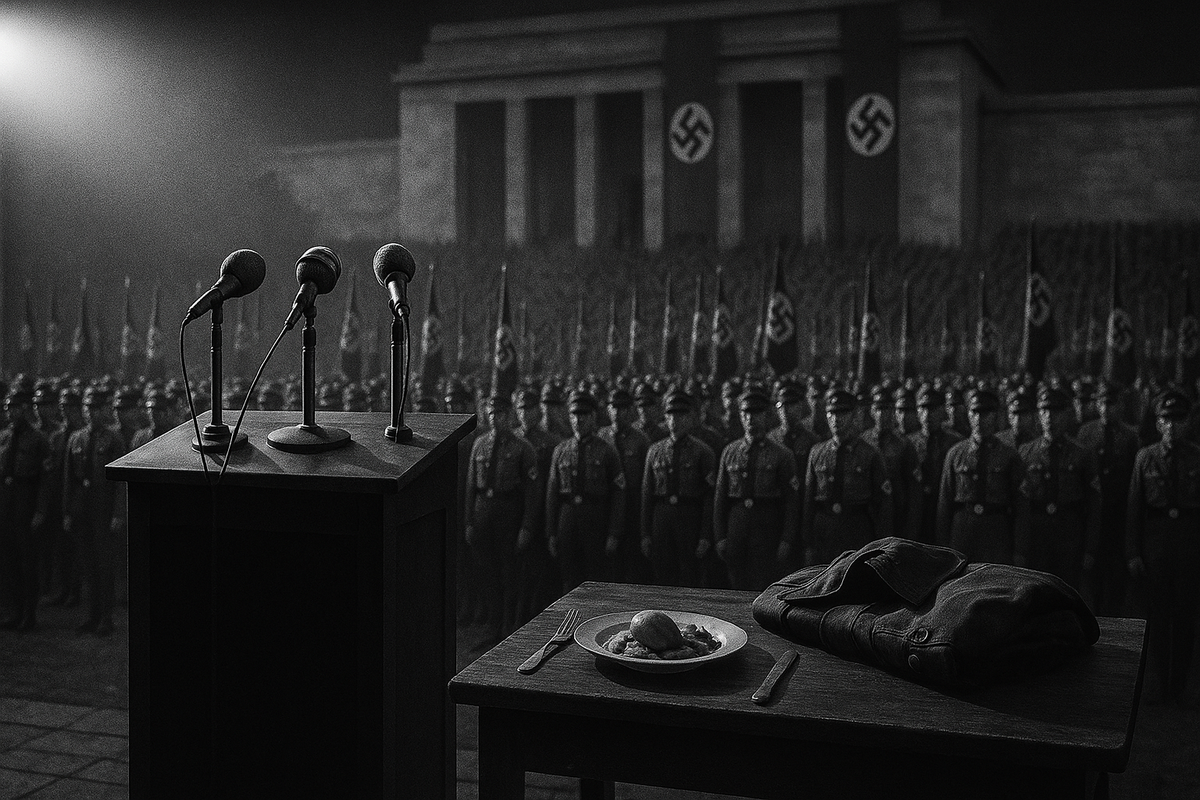
Wedged between Ogden Nash verses and razor-sharp cartoons was something American popular media had never attempted: an intimate, unflinching portrait of Adolf Hitler. Not the ranting demagogue of newsreels. Not the distant European problem dismissed at dinner parties. This was Hitler at breakfast. Hitler choosing his wardrobe. Hitler avoiding friends because he didn't know how to have them.
Janet Flanner's "Führer–I" didn't scream its alarm. It didn't need to. In her signature style—clinical, literary, devastating—she had dissected the daily rituals and emotional architecture of a man who had already transformed Germany into a dictatorship. Three years before the invasion of Poland. Three years before the world would be forced to pay attention.
The New Yorker had done what governments and newspapers failed to do: it looked closely.
Archive Details
Historical Figure: Adolf Hitler, Chancellor and Führer of Nazi Germany
Issue Date: February 29, 1936
Archive Source: The New Yorker Magazine
Author: Janet Flanner (Paris Correspondent)
Profile Series: "Führer–I" (Part One)
A Profile on the Edge of War
By February 1936, Adolf Hitler was no longer a fringe radical shouting in Munich beer halls. He was Chancellor, then Führer, having incinerated the Weimar Republic's democratic institutions with surgical precision. The Reichstag Fire. The Enabling Act. The Night of the Long Knives. By the time Flanner's profile appeared, Hitler had rearmed Germany in defiance of Versailles, stripped Jews of citizenship through the Nuremberg Laws, and was preparing to host the world at the Berlin Olympics—a propaganda coronation disguised as athletic competition.
Yet for most Americans, Hitler remained abstract. Distant. Vaguely concerning but not urgent. The United States was still clawing its way out of the Great Depression, inward-looking and isolationist. Europe's problems were Europe's problems.
The New Yorker disagreed.
Flanner, the magazine's Paris correspondent and one of its sharpest observers, had been watching Hitler's rise with the attention a naturalist gives a predator. Her Profile wasn't breaking news—it was something rarer and more dangerous: context. She understood that to comprehend what Hitler might do, Americans needed to understand who he was. Not the myth. Not the propaganda. The man.
Her subject was a vegetarian who obsessed over his diet. A teetotaler who banned alcohol and tobacco from his presence. A leader who kept no close friends and had, as she put it, "no gift for intimacy." He was rigid, compulsive, theatrically austere. He was also, she made clear, capable of extraordinary cruelty cloaked in bureaucratic efficiency.
The genius of Flanner's approach was its restraint. She never shrieked "monster." She didn't need to. The profile's power lay in what it revealed through accumulation: this was a man of dangerous banality, a mediocrity whose discipline and fanaticism had elevated him to terrifying heights. The emptiness at his core wasn't a weakness. It was the engine.
The Magazine That Mastered Juxtaposition
The New Yorker in 1936 was a peculiar animal in American publishing. Founded in 1925 by Harold Ross, it had carved out territory no other magazine occupied: sophisticated without being pompous, literary without being precious, deeply reported without sacrificing style. It spoke to educated, urban readers who wanted more than headlines but less than academic treatises.
The magazine's signature move was tonal whiplash—and it deployed it masterfully in the February 29 issue.
That playful cover—the eager dog, the awkward flirtation—set a tone of urbane amusement. Flip inside and you'd find the usual delights: witty cartoons skewering high society, caustic book reviews, Nash's light verse. The magazine's architecture suggested leisure, refinement, a civilized pause in a chaotic decade.
Then came Flanner's Hitler.
The contrast wasn't accidental. It was editorial philosophy. The New Yorker insisted that serious cultural and political analysis could coexist with satire and art, that sophistication meant holding multiple tones simultaneously. The magazine refused to choose between entertainment and alarm. It offered both, trusting its readers to navigate the dissonance.
This approach gave Flanner's Profile unusual power. Surrounded by cartoons and casual observations, her meticulous documentation of Hitler's eccentricities—his vegetarianism, his emotional void, his compulsive routines—felt more disturbing, not less. The magazine's lightness elsewhere made the darkness visible.
Where newspapers delivered headlines, The New Yorker delivered something closer to literature: character studies that revealed psychology, habit, motive. Flanner didn't just report what Hitler did. She showed how he lived, and in doing so, made visible the machinery of dictatorship at a human scale.
For readers willing to look, the warning was there. Specific. Detailed. Impossible to ignore.
What Flanner Saw
The Profile's power lay in its precision. Flanner catalogued Hitler's peculiarities not as gossip but as data points in a larger diagnosis:
The Austere Dictator
Hitler's vegetarianism, his refusal of alcohol and tobacco, his obsessive routines—these weren't quirks. They were performances of control, discipline made visible. Every personal restriction was a propaganda tool, evidence of superhuman willpower.
The Emotional Void
Flanner emphasized what wasn't there. Hitler had no close friends. He surrounded himself with loyal subordinates—Rudolf Hess, Joseph Goebbels—but kept even them at a distance. She described him as "a small-boned man" who built walls instead of relationships.
The Propaganda Machine
The Profile detailed how Hitler stage-managed his public image with theatrical precision. Every appearance was choreographed. The press was curated, censored, weaponized. The myth of the Führer was constructed with the same obsessive attention he gave his diet.
The Dangerous Ordinary
Perhaps most unsettling was Flanner's refusal to make Hitler extraordinary. He wasn't a genius. He wasn't superhuman. He was a mediocrity who compensated with fanaticism and organizational ruthlessness. The horror wasn't that a monster seized power. The horror was that someone so ordinary could.
Each detail accumulated into a portrait of authoritarian psychology before Americans had a vocabulary for it. Flanner was mapping dictatorship's architecture while most of the world still debated appeasement.
Why This Issue Matters Now
Temporal Significance
Published three years before Germany invaded Poland, this issue captures American consciousness at a hinge point—aware of Hitler, not yet aware of what Hitler would mean. It's a snapshot of the before.
Journalistic Landmark
Flanner's Profiles remain touchstones of 20th-century journalism, models of how to blend biography, cultural analysis, and political warning without sacrificing literary craft. This is reporting as art.
Material Culture
The whimsical cover paired with the sobering interior reflects The New Yorker's unique editorial identity—a blend of sophistication and seriousness that defined interwar intellectual culture. Owning this issue is owning a piece of that sensibility.
Primary Source Value
For scholars studying the American understanding of European fascism in the 1930s, this issue is a primary document. It shows what was knowable, what was published, what readers could have understood if they chose to look.
Unlike newspapers—discarded, ephemeral—The New Yorker was designed to endure. Its mix of literature, satire, and reportage gave it lasting value even when new. Today, these issues function as time capsules, preserving not just events but the texture of thought, the shape of cultural conversation at specific moments.
The February 29, 1936 issue is especially potent because it represents journalism's highest function: not just recording what happened, but preparing readers for what might come next.
Explore the Archive
If you're drawn to this intersection of history, journalism, and material culture, our collection offers thousands of original New Yorker magazines spanning the 1920s through the 1970s. Follow the evolution of American literary journalism, satire, and political commentary in real time, issue by issue.
Browse The New Yorker Magazine CollectionWhether you're a serious collector building a research archive, a historian seeking primary sources, or simply someone fascinated by how America understood the world as it transformed—these magazines offer something increasingly rare: unmediated access to the past, preserved in ink and paper.
The Warning We Held in Our Hands
The February 29, 1936 New Yorker remains one of the most haunting artifacts of the interwar period. Through Janet Flanner's Profile, American readers were given something precious: clarity. Not prophecy, but observation sharp enough to illuminate what was already happening.
Hitler wasn't hiding. His habits, his psychology, his methods—they were visible to anyone willing to look closely. Flanner looked. She documented. She warned.
Holding this issue today is holding that moment of possibility—when knowledge was available, when understanding was offered, before the full catastrophe made it all retrospectively obvious. It's a reminder that the most important journalism often arrives quietly, wedged between cartoons, waiting for readers who know how to pay attention.