
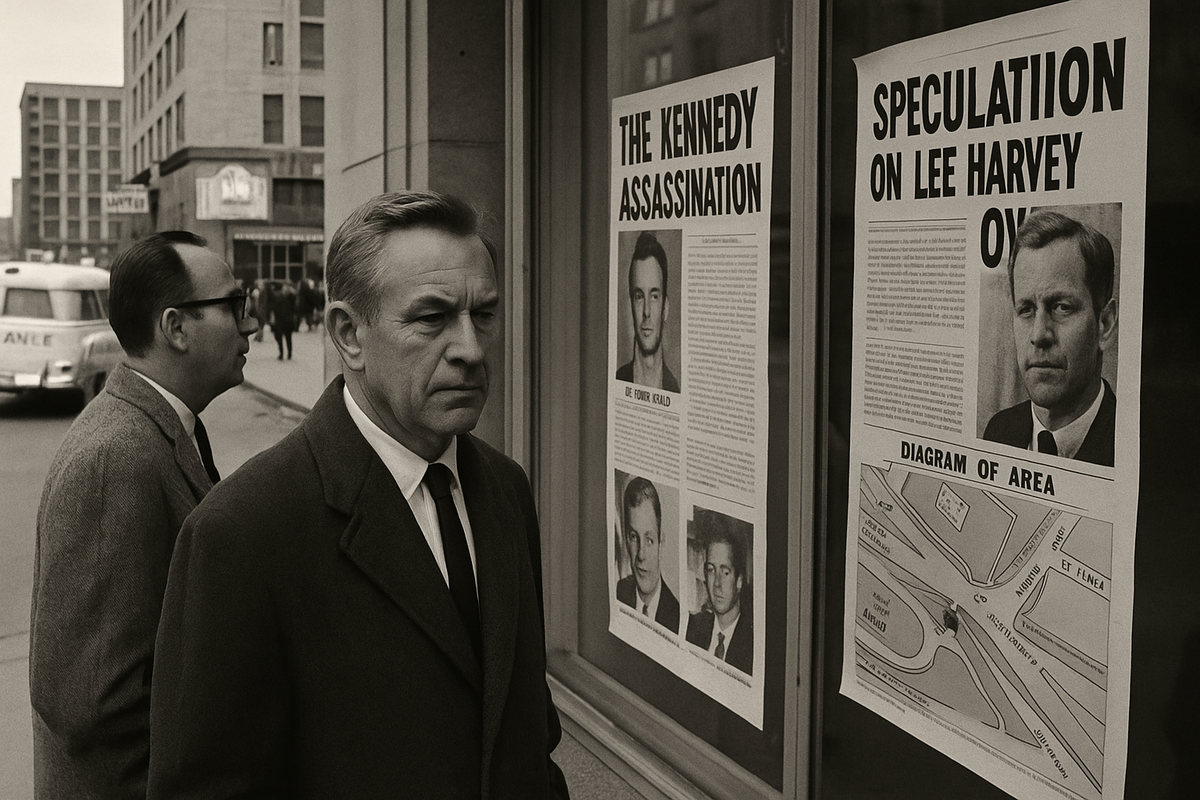
When Esquire Turned the Warren Report Inside Out
How a 1966 investigation became the blueprint for questioning official narratives
December 1966. A man walks into a newsstand, reaches past the holiday gift guides and year-end roundups, and pulls down the latest Esquire. Between the tailored suits and the Scotch ads, he finds something that makes his pulse quicken: a sober, methodical dismantling of everything the government told him about Dallas.
Three years after the shots in Dealey Plaza, one of America's most sophisticated magazines had done the unthinkable. It handed its pages over to a researcher named Sylvia Meagher and let her ask the questions Washington wouldn't answer.
The result was "Notes for a New Investigation"—and it changed how Americans talked about political murder.
Archive Details
Featured Researcher: Sylvia Meagher
Publication: Esquire Magazine, December 1966
Article Title: "Notes for a New Investigation"
Editor: Harold Hayes
Historical Context: First major mainstream reassessment of the Warren Commission findings
The Wound That Wouldn't Close
By late 1966, the Warren Commission's conclusion felt increasingly hollow. Lee Harvey Oswald, lone gunman. Case closed. But the nation wasn't buying it.
Vietnam body counts climbed weekly. Cities burned after civil rights marches. Authority itself was on trial, and the official story of Kennedy's death—delivered in an 888-page report that few had read but many distrusted—became a stand-in for every lie Americans suspected their government was telling.
Esquire saw the opening. This wasn't a fringe conspiracy rag or an underground pamphlet. This was Harold Hayes's magazine—the same publication that ran Norman Mailer and dressed American men in Italian suits. When Esquire questioned the Warren Report, it gave permission for the educated middle class to do the same.
Meagher's essay didn't traffic in hysteria. It built its case like a prosecutor who knows the jury is watching. And what it revealed was damning: not proof of conspiracy, but proof of institutional failure so profound that conspiracy seemed almost inevitable.
The Catalogue of Doubt
Meagher refused to champion a single theory. Instead, she mapped the terrain of speculation that had erupted since November 1963, treating each hypothesis with clinical detachment:
The power of Meagher's approach was its restraint. She didn't claim to solve the case. She demonstrated that the case had never been properly investigated.
The Witnesses Who Weren't There
The most devastating section of the essay was a simple accounting: the witnesses the Warren Commission never called.
Meagher ticked through the names. Dallas residents who saw suspicious activity. Jack Ruby's nightclub employees who might explain his mob connections. People whose testimony could have corroborated—or shattered—the official timeline.
Their absence wasn't accidental. It was architectural. The Commission had built its conclusion first, then gathered only the evidence that fit. Everything else was filed away, ignored, or dismissed as irrelevant.
For Meagher, this wasn't just sloppy work. It was a betrayal of the democratic contract. In a nation built on the rule of law, the murder of a president demands the most rigorous investigation imaginable. America got something less than that. Much less.
Her final paragraph was a gauntlet thrown: reopen the investigation, call the missing witnesses, test the physical evidence with fresh eyes. In 1966, that demand was radical. Today, it reads as obvious.
Esquire at the Height of Its Powers
To understand the impact of this article, you have to understand what Esquire was in the mid-1960s.
Under Harold Hayes, the magazine became a laboratory for New Journalism—that swaggering hybrid of literary ambition and shoe-leather reporting. Tom Wolfe dissected California car culture. Gay Talese followed Frank Sinatra through his bad mood. John Sack embedded with infantry in Vietnam.
But Esquire never abandoned its original mission: telling American men what to wear, what to drink, how to live. The brilliance was in the collision. You could read about the cut of a proper blazer, then turn the page and confront America's moral crisis in Southeast Asia.
The layout of the December 1966 issue embodied this tension. Meagher's essay wasn't buried in the back. It was presented with the same typographic swagger and visual weight as a fashion spread. Dense blocks of text. Legalistic subheadings. Charts of evidence. The design announced: This matters. Pay attention.
Other magazines might have sensationalized the JFK material. Esquire treated it as history-in-progress, a story still being written, and invited its readers to join the investigation.
The Questions That Won't Die
Meagher's questions from 1966 never found satisfying answers. In 1979, the House Select Committee on Assassinations concluded that Kennedy "was probably assassinated as a result of a conspiracy"—but couldn't say who conspired or how. The case remains officially unsolved.
What Esquire gave its readers wasn't closure. It was permission—permission to doubt, to question, to demand better from the institutions that claimed to serve them. That permission echoes through every scandal, every cover-up, every official story that doesn't quite add up.
The December 1966 issue remains relevant not because it solved the mystery, but because it modeled how citizens should respond when their government's explanations insult their intelligence.
Why Collectors Covet This Issue
Published three years after Dallas, it captured the first major wave of establishment skepticism toward the Warren Report. This was doubt going mainstream.
Sylvia Meagher would become one of the most respected independent researchers on the assassination, her 1967 book Accessories After the Fact cited for decades. This essay was her breakthrough.
The issue freezes a moment when American confidence cracked. You can see it in the ads, the fashion spreads, the tone of the prose. Vietnam was escalating. Cities were burning. Trust was collapsing. This magazine documented the vertigo.
Magazines are fragile. They tear, fade, and end up in recycling bins. Well-preserved copies—intact covers, bright pages, no water damage—grow rarer by the year.
For collectors, owning this issue means owning a turning point. It's the moment when questioning your government stopped being fringe and started being sophisticated.
Add This to Your Collection
If you collect vintage magazines, mid-century journalism, or cultural history, the December 1966 Esquire belongs on your shelf. It represents Esquire at its most fearless—equal parts style manual and civic alarm bell.
Browse Esquire Magazine CollectionFrom the magazine's 1930s origins through the upheavals of the 1970s, each issue captures its moment with precision. The fashion that defined an era. The fiction that won Pulitzers. The journalism that changed minds.
These aren't just magazines. They're arguments in physical form—about what America was, what it could be, and what it was willing to ignore.