
Allies Squeeze the German Bulge
When Life Magazine Brought America's Bloodiest Battle Home
On January 15, 1945, millions of Americans opened their mailboxes to find something more consequential than news. The latest issue of Life Magazine didn't just report the Battle of the Bulge—it made readers witnesses to the largest and most desperate fight the U.S. Army had ever waged. For families with sons freezing in Belgian foxholes, these pages weren't journalism. They were proof of survival.
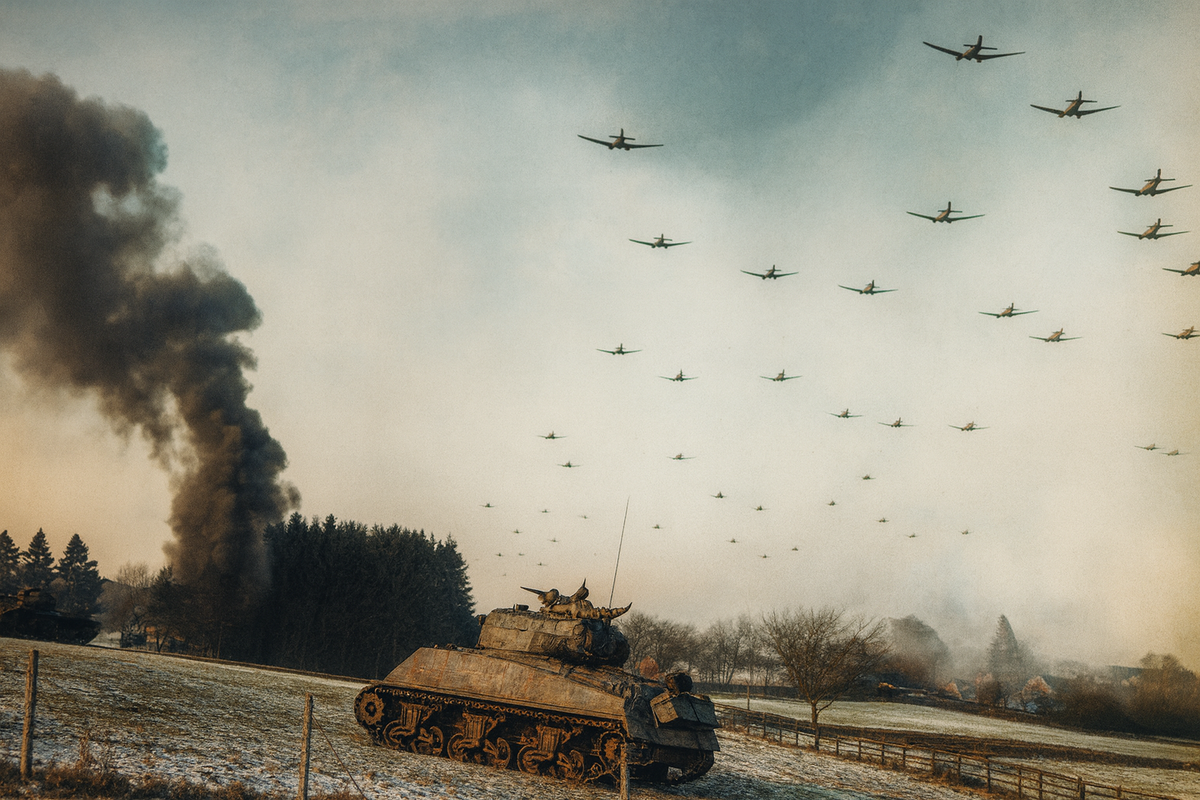
The cover alone told the story: Sherman tanks plowing through snow-choked fields while transport planes darkened the sky above. No illustration. No artistic license. Just the raw machinery of modern war, captured in unforgiving black and white. Inside, Robert Capa's frontline photographs—shot over six days embedded with American armor—brought the Ardennes forest into American living rooms with a visceral immediacy no other medium could match.
This wasn't just another war dispatch. It was Life doing what it did better than anyone: turning catastrophe into visual narrative, panic into understanding, and chaos into a story Americans could grasp while their coffee went cold.
Archive Details
Publication: Life Magazine
Issue Date: January 15, 1945
Featured Photographer: Robert Capa
Historical Context: Battle of the Bulge (December 16, 1944 – January 25, 1945)
Archive Classification: World War II Combat Photography
The Battle That Nearly Broke the Allies
By December 1944, victory in Europe seemed inevitable. Then Adolf Hitler gambled everything on one last offensive. German panzers smashed through Belgium's Ardennes forests in a surprise attack designed to split the Allied armies, capture the port of Antwerp, and force a negotiated peace. The shock was total. In subzero temperatures, elite German units drove deep into American positions, encircling entire towns and turning quiet sectors into killing grounds.
The stand at Bastogne became instant legend—the 101st Airborne Division and supporting units surrounded, outnumbered, holding against wave after wave of German armor. But Bastogne was just one node in a fifty-mile crisis. The "bulge" in Allied lines threatened to rupture the entire front.
Then the counterattack came. General George S. Patton wheeled the Third Army north in a maneuver still studied in war colleges today. British and American forces closed from the opposite flanks. By early January, the bulge was being squeezed shut. Hitler's last offensive was collapsing.
Life's January 15 issue hit newsstands at precisely this inflection point—the moment Americans at home needed to see that their army had not only survived the worst but was now driving the Wehrmacht back toward the Rhine. What the magazine delivered wasn't reassurance. It was evidence.
Photojournalism as Historical Record
By 1945, Life Magazine had become the definitive visual chronicler of World War II. While newspapers relied on wire service copy and grainy transmitted photos, Life dispatched photographers into combat with one directive: make people see the war as it actually is.
The January 15, 1945 issue exemplifies this philosophy with brutal clarity. The photo-essay unfolds not as propaganda but as documentation:
Advancing Infantry
Infantrymen moving toward Bastogne, their silhouettes stark against fields of unbroken snow—no heroic poses, just men moving forward because orders demanded it.
Engineers Under Fire
Clearing mines and felled trees under fire—the unglamorous, lethal work that kept tanks moving and supply lines open.
Sherman Formations
Tanks massing for assault, their tracks carving the frozen Belgian landscape into geometric patterns of war.
Captured Paratroopers
German elite troops, no longer Hitler's shock forces but exhausted men huddled against the cold, marched past American armor.
The Human Cost
An American officer's body recovered after a bombing—the photograph unflinching in its reminder that victory carried a price measured in individual lives.
La Gleize Wreckage
Destroyed German Tiger II tanks and skeletal Belgian villages—physical proof that the Wehrmacht's technological edge meant nothing against Allied logistics.
Moments of Humanity
Exhausted GIs eating after days of combat—a quiet moment that made the scale of suffering comprehensible.
Editorial Restraint
Concise captions explaining not just what readers were seeing but why it mattered. You didn't need military training to understand the Ardennes.
Each image carried the unmistakable stamp of authenticity. Life put you there.
The Capa Difference
Robert Capa, already one of the war's most celebrated photographers, embedded himself with American tank crews for six days during the counteroffensive. His images weren't composed from safe positions behind the lines—they were shot in motion, often while under fire, carrying the unmistakable stamp of someone who was enduring the battle alongside the men he photographed.
This wasn't observation. It was participation. And readers could feel the difference.
Capa's work, combined with Life's trademark narrative captions, created something unique in 1940s media: visual evidence married to narrative clarity. No other publication offered such direct, visceral access to the front. When Americans wanted to understand what their sons and brothers were facing in Belgium, they didn't turn to radio bulletins or newspaper columns. They opened Life.
What the Issue Captured
The January 15, 1945 edition documented the battle through specific, consequential moments:
- The relief of Bastogne — Armored columns breaking through to the surrounded garrison, a tactical victory that became American mythology within weeks.
- Engineering under fire — The dangerous, essential work of clearing obstacles so the advance could continue, often at catastrophic personal cost.
- Tank warfare in winter — Mass formations of Shermans exploiting the rare frozen ground that allowed off-road maneuver, turning mud-season disadvantage into tactical opportunity.
- The collapse of German elite units — Captured paratroopers symbolizing the exhaustion of Hitler's best remaining forces.
- The human cost — That haunting image of an officer's body being recovered, a visual argument that every mile gained was purchased in blood.
- Destroyed German armor at La Gleize — Tiger II tanks reduced to burnt-out hulks, physical evidence that the offensive had failed.
- American resolve — From tank battalions to infantry at rest, the issue emphasized one truth: American forces had absorbed the worst Germany could deliver and were now dictating terms.
- Civilian devastation — Ruined Belgian farms and villages, reminding readers that the war's toll extended far beyond military casualties.
- Editorial restraint — Life let the photographs carry the narrative weight, trusting images over commentary. This wasn't editorializing. It was showing.
Why This Issue Matters to Collectors
For anyone building a collection of 20th-century media or World War II documentation, the January 15, 1945 issue of Life Magazine stands as essential acquisition. Here's why:
Collector Significance
Historical Timing
Published just weeks after the offensive began, it captured the turning point in real time. This isn't retrospective analysis—it's contemporary witness to one of the war's pivotal moments.
Iconic Photography
Featuring Robert Capa's frontline work, the issue contains some of the most powerful battlefield imagery published during the war. These aren't sanitized rear-echelon photos. They're the real thing.
Cultural Impact
Millions of Americans saw these images simultaneously, shaping public understanding of the battle as it happened. To hold this issue today is to hold the same pages that families in 1945 studied by lamplight.
Collector Demand
World War II issues of Life consistently rank among the most sought-after vintage magazines. Milestone issues—Pearl Harbor, D-Day, the Bulge, V-E Day—command premium prices.
Material Authenticity
These aren't reprints or digital archives. They're original artifacts from the war itself, printed while the outcome was still uncertain, carrying the texture and weight of objects that mattered when they were new.
Designed Permanence
Each page was meant to be studied, discussed, kept. Families would save these issues for years, some binding them into annual volumes that became household reference works.
In today's digital age, where news images flash and vanish in seconds, the physical durability of vintage Life magazines feels almost radical. The pages don't disappear. The images don't update. The moment they captured remains fixed, available for examination decades later with the same clarity it had when the ink was wet.
For the Serious Collector
If you're drawn to this period—whether through family connection, historical passion, or appreciation for photojournalism at its apex—the January 15, 1945 issue of Life Magazine belongs in your collection. It represents the magazine at the height of its cultural authority: powerful photography, minimal commentary, maximum impact.
Explore Our Complete Archive
Our collection spans from the 1930s through the 1970s, documenting entire decades as they unfolded. Whether you're a seasoned collector, a historian building primary source material, or honoring a family member who lived through these years, these magazines offer something digital archives can't replicate: tangible connection to the past.
Browse Life Magazine CollectionThe January 15, 1945 issue of Life Magazine, with its photo-essay "Allies Squeeze the German Bulge," remains one of the most significant wartime publications in American journalism. It told families not only that the German offensive had been stopped but how—through determination, sacrifice, and the kind of resolve that doesn't photograph well but shows up in every frame anyway.
The images—advancing infantry, wrecked Tigers, engineers working under fire—carry the same weight today they did eighty years ago. For collectors, this issue represents both historical value and emotional resonance, a physical link to the moment when the outcome of World War II, however briefly, hung in genuine doubt.
To hold this magazine is to hold what your grandparents held in 1945: proof that the worst had been faced, absorbed, and answered. That the line had held. That victory, however distant, remained possible.
The same pages. The same images. The same moment in history, preserved.