
America Takes to the Skies
The birth of U.S. airborne forces—captured by LIFE Magazine seven months before Pearl Harbor
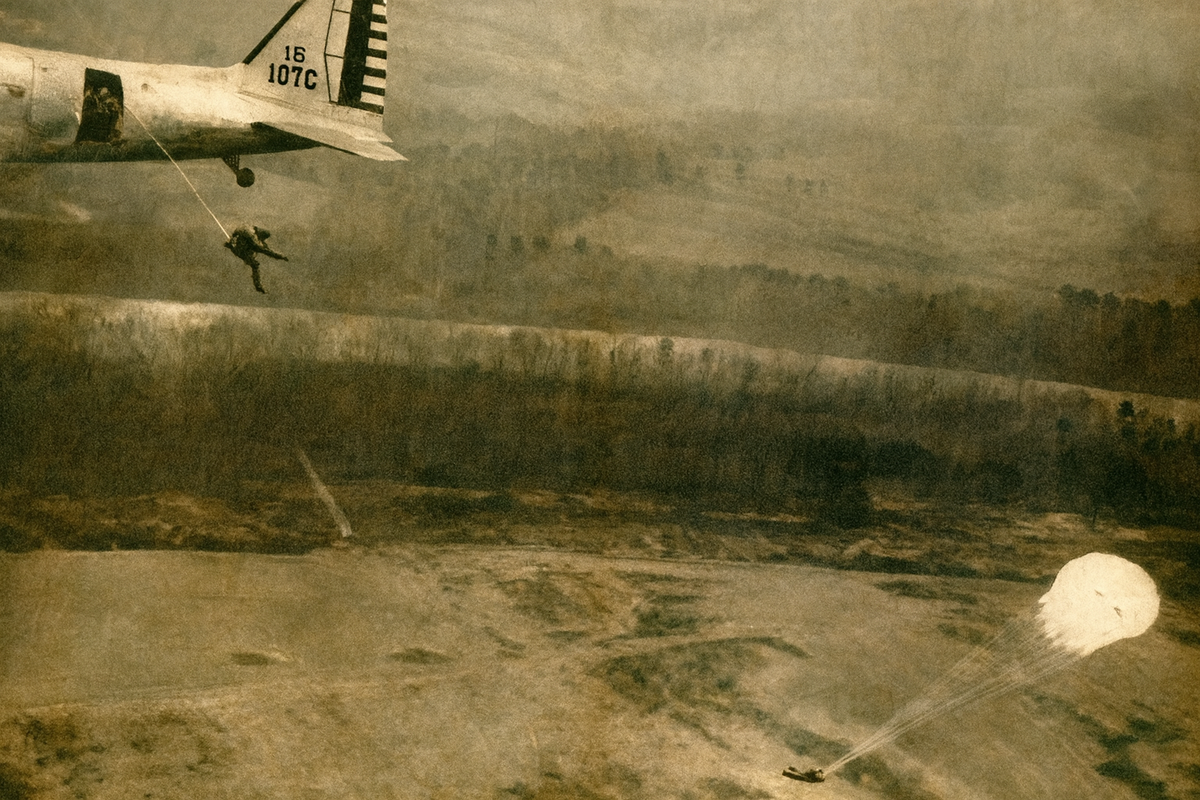
When Americans picked up the May 12, 1941 issue of LIFE Magazine, they witnessed something radically new: the United States Army's parachute troops. Across multiple pages, dramatic photographs showed young soldiers leaping from planes, tumbling to earth, and scrambling across Georgia fields to recover weapons and supplies.
This was more than military reporting. It was America at the edge of transformation. The country wasn't yet at war—Pearl Harbor remained seven months away—but preparations for conflict were already reshaping the armed forces. Germany had shocked the world with airborne assaults on Holland and Crete. Now, LIFE brought home the story of how America was racing to catch up.
For readers in 1941, the photo essay was a revelation. For collectors today, this issue stands as one of the most powerful artifacts from the months before the United States entered the war.
Archive Details
Issue Date: May 12, 1941
Archive Source: LIFE Magazine
Military Context: First major photographic feature on U.S. parachute troops
Training Location: Camp Benning, Georgia
Unit Featured: 501st Parachute Battalion
Historical Significance: Published seven months before Pearl Harbor
May 1941: The World on Fire
The spring of 1941 was tense, uncertain. Europe had been at war for nearly two years. Hitler's forces had swept across Poland, France, and the Low Countries. Britain stood alone, battered by the Blitz. In May 1941—the same month this issue of LIFE appeared—the Luftwaffe was still raiding London, and German paratroopers were preparing for their massive assault on Crete.
In Washington, President Franklin Roosevelt was steadily moving the United States closer to war. Congress had passed the Lend-Lease Act in March 1941, supplying Britain with ships, tanks, and planes. The U.S. Army, meanwhile, was undergoing rapid expansion.
One of the boldest innovations was the creation of parachute troops. Inspired by German success in using airborne units to sow confusion and capture key objectives, the U.S. Army began experimenting with paratrooper training at Camp Benning, Georgia.
When LIFE published its feature in May 1941, there were only a few hundred American paratroopers. Yet plans were already in motion to expand from 48 test soldiers to more than 4,000 men across eight battalions by year's end.
This wasn't just news. It was a glimpse of the future of warfare.
LIFE's Vision
By 1941, LIFE Magazine had established itself as the most important photojournalism publication in the country. Its pages blended words and images in a way that allowed ordinary Americans to see, not just read about, world events.
The parachute troops feature exemplified this power. Through photographs, readers witnessed the complete story:
Close-up details of equipment: Green coveralls, reinforced boots, helmets, .45 caliber pistols. Color-coded parachutes dropped machine guns, mortars, and ammunition alongside the men.
The physics of the jump: Soldiers leaping from 750 feet, with only eight and a half seconds before impact. Static lines automatically opened chutes, but every jump carried risk.
The brutality of training: A sequence of photos showed a man landing hard—legs crumpling, head snapping back, ropes tangling around his body. The captions didn't hide the danger; they emphasized it.
Combat preparation: Images showed soldiers hitting the ground, scrambling to recover weapons, flattening themselves against the earth as if already under fire.
Scale and spectacle: One unforgettable shot depicted 82 men of the 501st Parachute Battalion pouring out of planes in less than ten seconds, "like peas pouring from a bottle."
This was photojournalism at its peak: vivid, immediate, unforgettable. For readers who had never seen paratroopers in action, LIFE offered a front-row seat.
How LIFE Told the Story
Unlike illustrated magazines such as The Saturday Evening Post, LIFE insisted on real photography—often tied directly to the lead feature. The paratrooper spread showcased why LIFE was so influential. It didn't simply report that the Army was building airborne units—it showed exactly how.
Key stylistic elements included:
Sequential storytelling: Photos arranged in step-by-step order (jump, chute opens, landing, regrouping) gave readers a cinematic sense of action.
Human detail: Captions noted not just military facts but human realities—sprained ankles, tangled ropes, nervous recruits.
Balance of seriousness and humor: While most photos emphasized the danger and discipline of paratrooper training, LIFE also published cartoons by Parachute Captain Bill Yarborough, poking fun at common mishaps.
No other magazine of the era could match this combination of realism, immediacy, and accessibility.
The Details That Mattered
What LIFE Captured
- Rapid expansion: From 48 experimental paratroopers in 1940 to over 500 by spring 1941, with 4,084 projected by fall
- Camp Benning, Georgia: The birthplace of American airborne forces, where all training and jumps were centered
- Jump physics: From 750 feet, a paratrooper had 8.5 seconds to live if his chute failed—static lines gave about 3.5 seconds of leeway
- Dangerous training: Sprains, dislocations, and serious injuries were common; LIFE showed this in stark photographic detail
- Equipment drops: Weapons and ammunition dropped in separate parachutes, often color-coded for quick identification
- Landing tactics: Soldiers practiced hitting the ground flat, ready to fire, or rolling to their feet and running toward supply bundles
- 82-man drop: One of the most dramatic sequences showed three transport planes releasing 82 men in less than 10 seconds
- German inspiration: The article emphasized that America was following Germany's example, learning from airborne assaults in Europe
- Bill Yarborough's cartoons: A humorous look at paratrooper culture, providing comic relief in an otherwise intense essay
- The bigger picture: Readers understood this wasn't just training—it was preparation for America's inevitable entry into global war
Each detail contributed to the larger story: America was building a new kind of army, and LIFE was documenting it in real time.
Why It Endures
LIFE's wartime magazines remain powerful because they combine immediacy with permanence. Unlike radio broadcasts, which faded into the air, or newsreels that passed quickly through theaters, these magazines were held in people's hands, read at kitchen tables, and saved in family collections.
The parachute troop feature preserves not just facts but atmosphere. Readers in 1941 could feel the tension of America preparing for war, the bravery of young men volunteering for a dangerous new branch, and the sense that history itself was accelerating.
Today, collectors and history enthusiasts value these magazines precisely because they freeze that moment in time.
Collector Significance
For anyone building a collection of vintage LIFE magazines, the May 12, 1941 issue is more than journalism—it's a time capsule:
Historical Timing
Published just months before Pearl Harbor, it documents America preparing for war while still officially neutral.
Military Significance
The first in-depth national coverage of U.S. parachute troops, who would play critical roles in WWII battles like Normandy and Market Garden.
Iconic Photography
Dramatic images of men leaping from planes remain among the most striking pre-war military photos ever printed in the U.S.
Cultural Insight
Captures both the seriousness of training and the human side—fear, humor, and resilience.
Rarity
Wartime LIFE issues are among the most sought-after by collectors, with military-themed features ranking especially high.
Original Artifact
Owning this issue means holding the moment when America stood on the cusp of entering the Second World War.
Explore the Archive
If you're fascinated by the birth of U.S. airborne forces—or if you simply want to own a tangible piece of America's journey into World War II—the May 12, 1941 issue of LIFE Magazine is essential.
Browse Original LIFE MagazinesThousands of other original LIFE magazines are available, covering decades of history, culture, politics, and art. From the 1930s through the 1970s, LIFE documented the world with unmatched photography and narrative. Whether you're a seasoned collector, a history buff, or someone honoring the memory of a family member who lived through the war, vintage LIFE magazines offer something unique: the ability to see history as it was first reported.
The May 12, 1941 issue of LIFE Magazine stands as one of the most significant pre-war publications in American history. Its feature on U.S. parachute troops captured the moment when America was preparing for a new kind of warfare, even before it had officially entered World War II.
Through dramatic photographs, clear narrative reporting, and even a touch of soldierly humor, LIFE showed readers exactly what it meant to leap into the unknown. Today, this issue remains not only historically important but highly collectible.
Holding a copy means holding the moment when America's airborne dream first took flight—seven months before Pearl Harbor would change everything.