
Family Interference, Financial Strain, and the Struggle for Love in 1950s America
When Ladies' Home Journal exposed the hidden cracks in postwar marriage
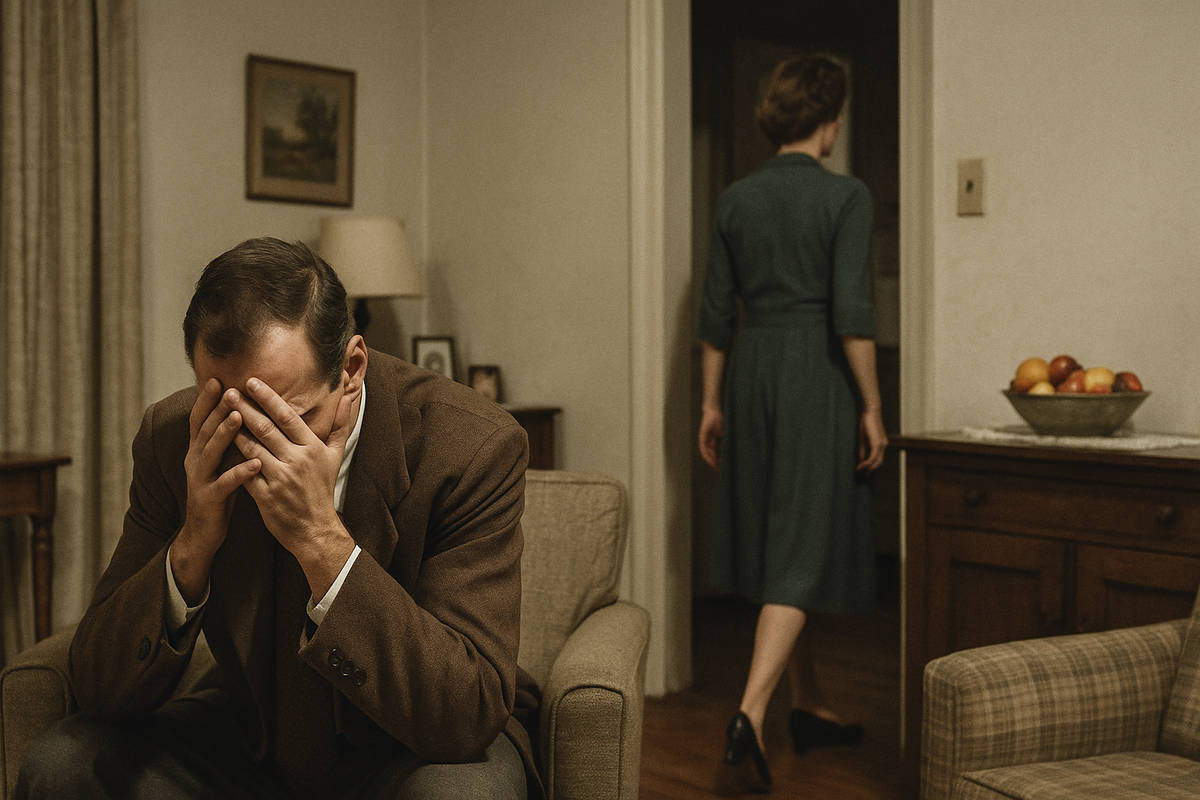
Bob slumped forward, head in his hands. Jill turned away.
The staged photograph in the March 1953 Ladies' Home Journal captured something millions of American couples recognized but rarely admitted: behind the white picket fences and Formica countertops, marriages were collapsing under pressures nobody discussed at cocktail parties.
Jill was twenty-five years old. Her mother had already hired the divorce lawyer—the same one who had handled her own divorce years earlier. Bob wanted his wife and children "back where they belong," but Jill was crying through sleepless nights, losing weight, and wondering if love had ever existed at all.
This was the third installment of "Can This Marriage Be Saved?"—a column that would run for decades and become one of the most influential features in American magazine history. For subscribers opening their March 1953 issue, this wasn't voyeurism. It was recognition.
Archive Details
Publication: Ladies' Home Journal, March 1953
Feature: "Can This Marriage Be Saved?" (Third Installment)
Subjects: Jill (25) and Bob, married couple facing divorce
Expert Counselor: Dr. Paul Popenoe, Director of the American Institute of Family Relations
Cover Subject: Spring fashion feature
The Polished Surface and the Hidden Cracks
The early 1950s sold America a specific vision: gleaming appliances, spotless kitchens, children playing in suburban cul-de-sacs, fathers commuting to steady jobs, mothers presiding over orderly homes. Life magazine photographed it. Television commercials promised it. Politicians celebrated it.
The reality was considerably messier.
Divorce rates had climbed after World War II as couples who had married hastily during wartime discovered incompatibility in peacetime. Young wives found themselves isolated in new subdivisions, cut off from extended family networks, expected to find fulfillment in domesticity alone. Veterans struggled with trauma nobody had vocabulary to discuss. And parents—particularly mothers-in-law—wielded enormous influence over adult children's marriages, often with devastating consequences.
Jill and Bob's story exposed all of it.
Two Testimonies, One Failing Marriage
The Journal's format gave both spouses space to present their cases directly to readers, unfiltered by editorial summary.
Jill's Account
At twenty-five, she had already initiated divorce proceedings using her mother's attorney. The symbolism was unmistakable—she was following a family pattern, repeating her mother's escape from an unhappy marriage.
Physical symptoms marked her distress: chronic headaches, insomnia, unexplained weight loss, constant crying. In 1953, doctors might have diagnosed "nervous exhaustion" or prescribed sedatives. The magazine recognized it as marital collapse.
Her nearly five-year-old son, Bobby Jr., was caught in the middle—confused, frightened, asking questions she couldn't answer. The prospect of damaging her children terrified her, yet staying felt impossible.
Jill's family actively opposed the marriage. Her sisters disliked Bob. Her mother not only disapproved but bankrolled the divorce, making escape financially viable for a young woman with limited options.
Bob's Rebuttal
He framed himself as a man under siege. Jill's family had "poisoned her mind," he insisted, undermining his authority and turning his wife against him. The villains weren't personal failings or incompatibility—they were meddling in-laws.
Bob fixated on Jill's spending habits, criticizing her installment plan purchases and trips to "nickel and dime stores." His complaints revealed 1950s anxieties about consumer credit and women's financial autonomy.
His proposed solution was simple: Jill should defer to his judgment. He knew what was best for the family. She should listen to him instead of her "bossy mother." The language was telling—Bob wanted obedience, not partnership.
He resented the divorce proceedings, the lawyer, the entire apparatus that gave Jill agency to leave. His closing sentiment—captured in the photo caption—was revealing: "All I need is to get her and my children back where they belong."
The Expert Weighs In
Dr. Paul Popenoe, director of the American Institute of Family Relations, delivered the institutional verdict. His diagnosis treated both spouses as patients requiring correction.
Jill was "emotionally fragile," too dependent on her mother, incapable of independent decision-making. The prescription: develop backbone, establish boundaries with family, stop being so sensitive.
Bob was domineering and withholding, demanding authority while refusing tenderness. The prescription: soften his approach, show affection, recognize that marriage required emotional investment beyond financial provision.
The underlying assumption was clear: with proper counseling and attitude adjustment, the marriage could be salvaged. Both parties just needed to try harder.
Why Ladies' Home Journal Mattered
By 1953, the Journal reached millions of American homes monthly. Publisher Curtis Publishing Company understood that women's magazines served multiple functions: aspiration, education, entertainment, and—increasingly—truth-telling.
The magazine's genius was its range. A single issue might contain spring fashion spreads promising elegance and renewal, recipes emphasizing convenience and modern appliances, fiction serialized across multiple issues, advice columns addressing real problems in real marriages, and advertisements selling the consumer goods that financed suburban life.
"Can This Marriage Be Saved?" exemplified the Journal's willingness to address uncomfortable realities. The column format—competing testimonies analyzed by an expert—gave readers permission to acknowledge their own struggles without feeling abnormal or defective.
The visual storytelling reinforced the message. That staged photograph of Bob's despair and Jill's departure communicated what decades of happy homemaker imagery had obscured: marriages could fail. Love could die. Women could leave.
Then readers turned the page to a cheerful Dole Pineapple advertisement—bright Hawaiian colors, promises of tropical sweetness, reminders that consumer culture offered escape from domestic unhappiness, at least temporarily.
The juxtaposition wasn't accidental. It reflected the contradictions women navigated daily.
What This Issue Reveals About 1950s America
Family Enmeshment: Jill's mother didn't just disapprove of Bob—she actively financed the divorce and had previously used the same attorney for her own marriage dissolution. This wasn't support; it was control extending across generations.
Financial Anxiety: Bob's obsession with Jill's spending reflected genuine postwar tensions. Installment buying was exploding, credit was becoming normalized, and husbands who had grown up during the Depression viewed debt as moral failure.
Gender Role Rigidity: Bob's language revealed expectations: wives belonged at home, under husbands' direction, grateful for provision. Jill's suffering didn't register as legitimate grievance—only as emotional weakness requiring correction.
The Seeds of Change: Within a decade, Betty Friedan would publish The Feminine Mystique, naming the dissatisfaction Jill experienced. Second-wave feminism would challenge the assumption that women's fulfillment came solely through marriage and motherhood. But in 1953, Jill had access only to her mother's solution: find a lawyer and repeat the pattern.
Professionalization of Marriage: Dr. Popenoe's involvement signaled a shift toward treating marriage as something requiring expert intervention. The American Institute of Family Relations represented a growing industry of counselors, psychologists, and advice-givers who would shape how couples understood their relationships.
The Magazine as Cultural Artifact
The March 1953 cover emphasized spring fashion—bright colors, optimistic styling, the promise of seasonal renewal. Inside, the contrast between aspiration and reality was stark.
This wasn't editorial schizophrenia. It was sophisticated understanding of audience needs. Women bought the Journal for multiple reasons: to dream, to learn practical skills, to see their struggles validated, to escape temporarily into fiction or fantasy.
The magazine succeeded because it offered all of these simultaneously, without apology or contradiction.
The advertising reinforced this duality. Dole promised Hawaiian paradise. Appliance manufacturers promised liberation through technology. Fashion spreads promised transformation through consumption. And nestled among these promises were stories of women crying themselves to sleep, contemplating divorce, wondering if they'd made terrible mistakes.
Collector Significance
For historians, researchers, and collectors of American cultural artifacts, the March 1953 Ladies' Home Journal represents several converging threads:
The Column's Evolution: This third installment of "Can This Marriage Be Saved?" marked the column's transition from experiment to institution. It would run until 2014, making it one of the longest-running features in magazine history.
Postwar Gender Dynamics: The issue captures the precise moment when the 1950s domestic ideal was being constructed and simultaneously questioned. Jill and Bob's story reveals the cracks in the foundation.
Consumer Culture Documentation: The advertisements alone justify acquisition—they show what companies were selling to women and what promises they made about modern life.
Women's Voice Preservation: Despite editorial framing that often reinforced conservative values, the magazine gave women like Jill space to articulate discontent. These testimonies are primary sources for understanding women's lived experiences.
Visual History: The staged photography, the layout choices, the typeface selections—all reflect 1950s aesthetic sensibilities and communication strategies.
Issues connected to iconic columns or cultural turning points command particular collector interest. The March 1953 Journal qualifies on both counts.
Why Vintage Women's Magazines Endure
Life magazine preserved wartime America, documenting battles and rationing and victory. Ladies' Home Journal preserved domestic America—the quieter battles fought in kitchens and bedrooms, the struggles over money and autonomy and identity.
Each issue contains layers of cultural information: fashion and beauty standards that shaped women's self-perception, recipes and homemaking advice that defined domestic labor, fiction that reflected and shaped social values, advice columns that brought private struggles into public discourse, and advertisements that reveal consumer desires and corporate manipulation.
Vintage Ladies' Home Journal magazines aren't just collectibles. They're primary sources for understanding how American women navigated the contradictions of mid-twentieth-century life.
They show what was promised and what was delivered, what was displayed and what was hidden, what was celebrated and what was endured.
Explore the Original Archives
From the origins of "Can This Marriage Be Saved?" to decades of fashion, fiction, recipes, and cultural commentary, these magazines preserve the hopes, anxieties, and resilience of American women across generations.
Browse Ladies' Home Journal CollectionThe story of Jill and Bob, published in March 1953, marked a cultural turning point: the moment when women's magazines began acknowledging that the domestic ideal often concealed domestic struggle. These magazines deliver heritage in its original form—unfiltered, unrevised, and unforgettable.