
When America Looked Backward on the Eve of War
How Life Magazine's June 1939 photographic essay captured a century of American history—three months before the world ignited
Three months before Hitler invaded Poland, Americans opened their mailboxes to find the Statue of Liberty staring back at them—floodlit, monumental, impossible to ignore. It was June 5, 1939. Inside that issue of Life Magazine, beneath Lady Liberty's torch, lay something unexpected: not warnings about Europe's collapsing peace, but a reckoning with America's own century of blood, ambition, and expansion.
"American Yesterdays" wasn't nostalgia. It was a mirror held up to a nation that had no idea what September would bring.
Published exactly one hundred years after Louis Daguerre's invention made it possible to freeze time on a silver plate, the six-page photographic essay did what no history textbook could: it showed readers their grandparents' wars, their great-grandparents' wagon trains, and the brutal machinery of nation-building through images that had never been widely seen. For families navigating the last bitter years of the Great Depression—uncertain whether their sons would fight in another European war—these weren't quaint relics. They were evidence that America had always been forged in struggle.
And the camera had been there to witness it all.
Archive Details
Publication: Life Magazine
Issue Date: June 5, 1939
Feature Essay: "American Yesterdays"
Historical Context: Published 100 years after photography's invention, three months before World War II began
Cover: The Statue of Liberty, illuminated for the first time
Collector Significance: One of the most sought-after pre-WWII issues
The Republic's First Witness
The Mexican-American War of 1846–48 gave Americans something unprecedented: proof that battles could be captured, not just described. Early daguerreotypes of soldiers in the field were crude, but their existence alone was revolutionary. For the first time, war had a face that wasn't drawn by an artist with an agenda.
By the Civil War, photography had matured into something more devastating. Matthew Brady and Alexander Gardner dragged their cumbersome equipment across battlefields and brought back images that stripped war of its romantic veneer. Life's essay reproduced those haunting frames: cannonballs stacked like cordwood in Washington, the unburied dead sprawled across Cold Harbor's killing ground, a Union observation balloon—the "Intrepid"—hovering above the battlefield in one of humanity's first experiments with aerial reconnaissance.
These weren't illustrations. They were arguments. Photography didn't just record history; it changed what history meant.
The Mule That Carried the West
Among Life's selections was a photograph that captured the absurd heroism of frontier documentation: William H. Jackson's mule, loaded with a portable darkroom, picking its way across the Rocky Mountains. Jackson didn't ride; he hauled chemistry through wilderness so he could develop glass plates before the emulsion dried.
That mule—anonymous, overburdened, essential—symbolized what it took to preserve the American frontier. Jackson's images of Yellowstone convinced Congress to create the first national park. His photographs didn't just document westward expansion; they justified it, giving Americans visual proof that the continent's beauty demanded protection and possession.
The Oregon Trail family photograph in the essay told a parallel story. A family posed beside their wagon, rifles visible, faces set with the grim determination of people who knew the journey ahead might kill them. Migration wasn't an abstraction in 1939. Readers' own parents or grandparents had made similar crossings. The photograph was a genealogical document as much as a historical one.
Custer's Ghost Regiment
One image carried particular weight: George Armstrong Custer's 7th Cavalry, photographed before their annihilation at Little Big Horn in 1876. In the frame, soldiers stand in neat formation, confident, whole. Within months, most would be dead on a Montana hillside, victims of Custer's catastrophic miscalculation.
The photograph transformed into something else after the massacre—evidence, eulogy, warning. Life understood this. The caption didn't need to explain the tragedy; readers in 1939 knew the story. The image simply asked them to look at men who didn't know they were doomed.
For an audience three months away from global war, the parallel was inescapable.
Gold Fever and the Architecture of Greed
The essay's Gold Rush images captured American ambition at its most raw. San Francisco's harbor in the 1850s, choked with abandoned ships as crews deserted for the goldfields. Prospectors on Alaska's Chilkoot Pass in 1898, bent double under impossible loads, climbing a 45-degree ice staircase toward probable failure.
These weren't success stories. They were photographs of desperation disguised as opportunity—the visual record of a national obsession that built cities and destroyed lives in equal measure.
Life also included the Pullman Palace Car interior, all polished wood and velvet luxury, a reminder that while some climbed frozen mountains, others rode in comfort. The tension between those two Americas—fortune-seekers and the already-fortunate—threaded through the entire century the magazine was documenting.
Law, Death, and the Frontier's Final Act
Perhaps the essay's most unsettling inclusion was a photographic sequence of a horse thief's execution in Wyoming, 1890. Multiple frames captured the progression: the gallows, the priest administering last rites, the moment before the trap dropped.
It was one of the earliest uses of sequential photography to tell a narrative—and the narrative was state-sanctioned killing on the frontier. Life didn't editorialize. The images did the work. They showed readers what "law and order" had looked like in a place where institutions were still being written in real time, often with a rope.
The Oklahoma Land Rush photograph of 1889 told a related story: settlers charging across prairie on horseback and in wagons, racing to claim parcels of land that had been guaranteed to Native nations by treaty. The photograph froze a moment of chaotic optimism, but beneath it lay displacement, broken promises, and the violent mechanics of American expansion.
Why 1939 Mattered
Life Magazine had been publishing for less than three years when it ran "American Yesterdays," but it had already revolutionized photojournalism. Co-founder Henry Luce believed photographs could do what words never could: collapse the distance between reader and subject, making history visceral instead of abstract.
In June 1939, that philosophy carried urgent subtext. Europe was weeks away from war. Americans were debating isolation versus intervention. And Life chose to publish a retrospective that reminded readers of their own nation's century of conflict, expansion, and sacrifice.
The message wasn't subtle: This is who you are. This is what it cost to build this country. What will you do now?
The Statue of Liberty on the cover—illuminated for the first time—wasn't just a symbol of immigration or hope. In that moment, she was a challenge. The floodlights asked whether the values she represented were worth defending, again, in someone else's war.
Key Images from "American Yesterdays"
The First Photographed War
Early daguerreotypes from the Mexican-American War (1846–48) introduced Americans to the concept that battles could be documented through images rather than just written accounts.
Civil War Devastation
Matthew Brady and Alexander Gardner's unflinching photographs of cannonballs, corpses at Cold Harbor, and the Union's "Intrepid" observation balloon revealed war's brutal reality.
Jackson's Documentary Heroism
William H. Jackson's mule, carrying a portable darkroom across the Rockies, symbolized the extraordinary effort required to document westward expansion.
Oregon Trail Determination
A family posed with their wagon and rifles embodied the grim resolve of pioneers whose migration reshaped the continent.
Custer's Doomed Regiment
The 7th Cavalry photographed before Little Big Horn became a haunting memorial to soldiers who didn't know their fate.
Gold Rush Desperation
From San Francisco's ship-choked harbor to Chilkoot Pass climbers, images captured ambition at its most desperate and destructive.
Frontier Justice
A sequential photograph of a Wyoming horse thief execution (1890) documented frontier "law and order" in its rawest form.
The Oklahoma Land Rush
Settlers racing across prairie to claim land previously guaranteed to Native nations captured both American optimism and its violent expansion.
Industrial Elegance
The Pullman Palace Car interior revealed the luxury enjoyed by America's fortunate few while others struggled on frozen mountain passes.
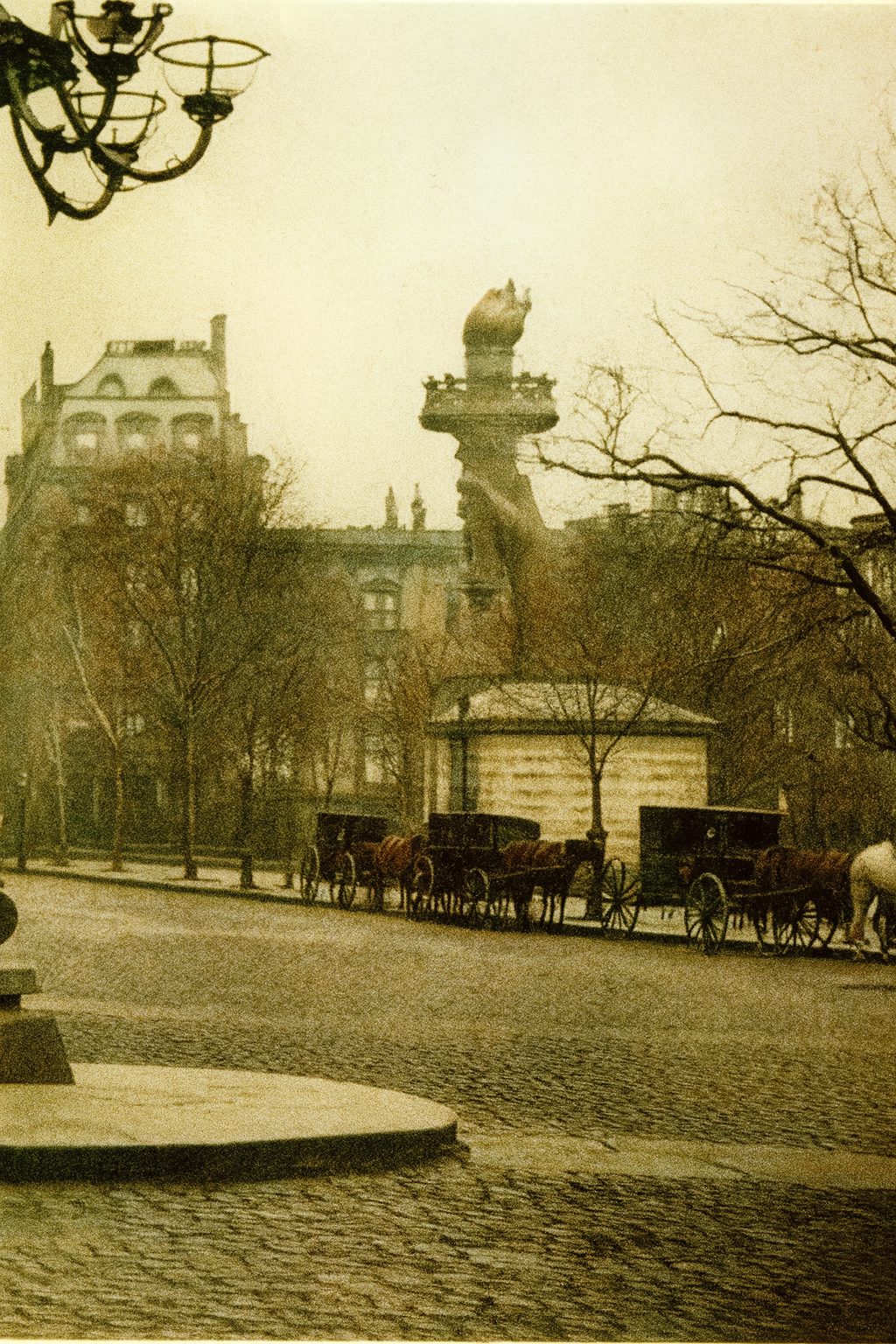
Liberty's Fundraising Torch
The Statue of Liberty's torch displayed at Madison Square to raise funds for the pedestal symbolized America's civic ambitions.
The Collector's Case
For those who pursue vintage Life magazines, the June 5, 1939 issue occupies rare territory. It appeared at a historical inflection point—the last summer before the world ignited. It marked photography's centennial with an essay that doubled as American myth-making. And it preserved images that most readers had never encountered, even as it shaped how they would remember their own history.
The issue's value isn't purely monetary, though scarcity and condition matter. It's the layered significance: a primary source about how 1939 Americans understood their past, published at the moment their future became unrecognizable.
Historical Timing
Published three months before World War II began, capturing America's last moment of peacetime reflection before global conflict.
Centennial Significance
Marked exactly 100 years since Daguerre's invention, making it a milestone document in photography's history.
Unique Photographic Essay
Few issues feature such a comprehensive sweep of American history told entirely through previously unseen historic images.
Iconic Cover
The Statue of Liberty, floodlit for the first time, became an enduring symbol of American values at a moment of crisis.
Family Heirloom Status
Families who lived through these moments kept these issues as keepsakes, making surviving copies tangible connections to ancestral experiences.
Physical Permanence
In an era of digital ephemerality, these magazines offer something irreplaceable: the weight, texture, and authenticity of original artifacts.
Families kept these issues. They passed them down. When you hold an original copy, you're not just handling archival material—you're touching the same pages someone turned while listening to radio reports from Europe, wondering if their son would be next.
That tangibility matters. In an era when images dissolve into infinite digital feeds, these magazines are anchored, physical, deliberate. They force you to slow down. They insist that history isn't a scroll; it's a weight you hold in your hands.
What Endures
"American Yesterdays" endures because it understood something fundamental: photographs aren't neutral. They're arguments about what deserves to be remembered and how. Life's editorial choices in 1939—which images to include, which captions to write, which stories to amplify—reveal as much about that moment as they do about the century being documented.
The magazine asked its readers to see themselves as inheritors of a tradition built on war, migration, innovation, and conquest. It asked them to reckon with that inheritance at precisely the moment when reckoning mattered most.
Collectors and historians return to this issue because it's a time capsule with two timestamps: the century it documents and the summer it was published, when Americans still believed they might stay out of Europe's war.
They couldn't. Three months later, the world changed. But for one June week in 1939, Life Magazine gave Americans a chance to look backward before history pulled them forward.
Explore the Archive
For those seeking original editions of Life and other landmark 20th-century publications, these aren't reproductions. They're the genuine articles—ink on paper, preserved across decades, waiting to connect you to the moments that shaped modern America.
Browse Life Magazine Collection