
The Day America's Most Feared Journalist Blessed the Shopping Mall
Dorothy Thompson's 1954 essay in Ladies' Home Journal marked the moment when suburban consumerism became respectable—and commerce put on its "new look"
June 1954. Dorothy Thompson—the woman who'd been expelled from Nazi Germany, who'd dined with presidents and dismantled dictators in print—opened the pages of Ladies' Home Journal and did something unthinkable.
She praised a parking lot.
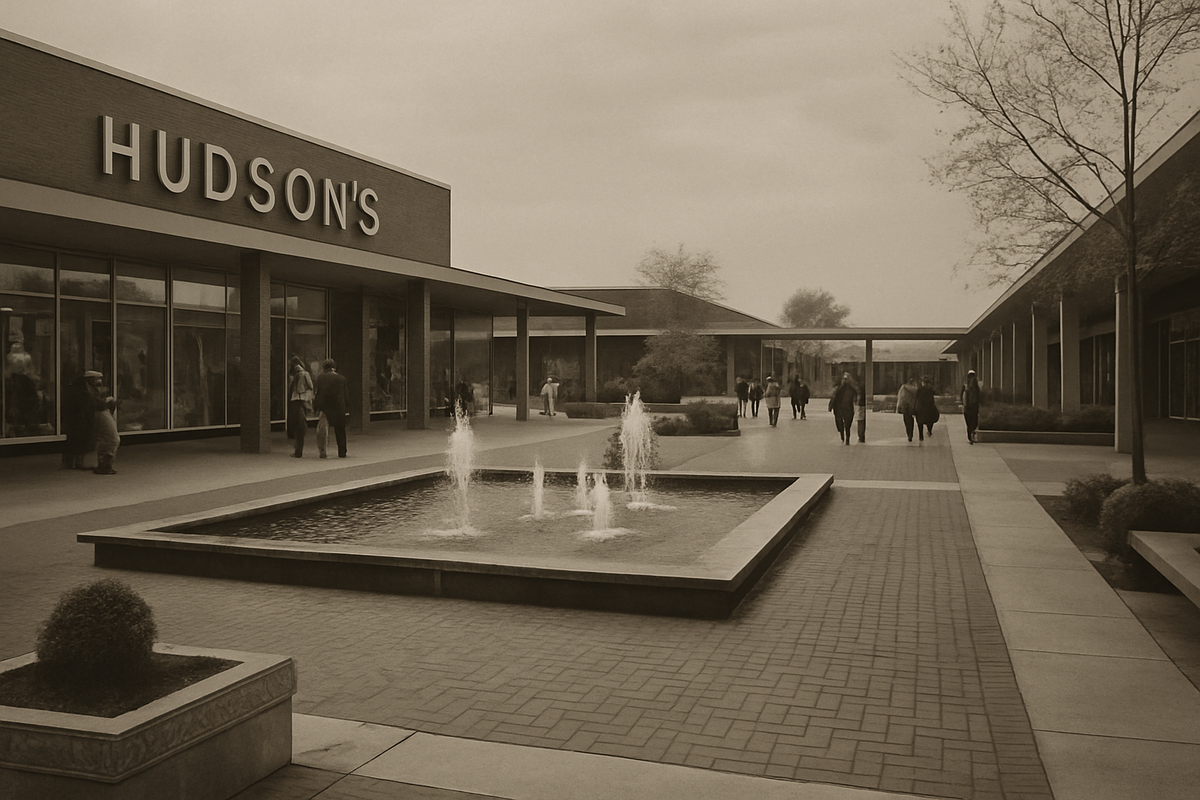
Not just any parking lot. Northland Center in Detroit: a sprawling temple of consumption designed by architect Victor Gruen, bankrolled by the J.L. Hudson Company, and destined to become the blueprint for every suburban mall in America. Thompson, whose pen had skewered commercialism as a "defacer of beautiful landscapes with screaming billboards," now called it beautiful. She compared it to the Greek agora. She invoked the Great Cloth Market of Leeds. She saw fountains, sculptures, pedestrian plazas—and declared that American commerce had put on a "new look."
This wasn't a puff piece. It was a capitulation. And it marked the exact moment when postwar America stopped apologizing for wanting things.
Archive Details
Historical Figure: Dorothy Thompson, journalist and political commentator
Issue Date: Ladies' Home Journal, June 1954
Essay Title: "Commercialism Takes—and Wears—a New Look"
Featured Development: Northland Center, Detroit (designed by Victor Gruen)
Archive Source: Original print edition from private collection
When Consumerism Became Respectable
For decades, intellectuals had treated commerce like a necessary evil—crass, garish, the enemy of high culture. Thompson herself had been no exception. But by 1954, millions of families were flooding into newly built suburbs, fleeing crowded cities for ranch houses and two-car garages. The GI Bill had democratized homeownership. Highways were carving up the countryside. And the old downtown department stores were suddenly too far away.
Someone had to build the infrastructure of desire.
Enter Victor Gruen, a Viennese émigré who envisioned shopping centers not as strip malls but as civic spaces—places where art, commerce, and community could coexist. Northland Center was his proof of concept: 110 acres of retail anchored by Hudson's flagship store, wrapped in landscaped gardens and punctuated by modernist sculpture. It opened in March 1954, three months before Thompson's essay appeared.
She was transfixed. "Commerce," she wrote, was no longer the villain. It was the builder.
Why This Article Mattered—Then and Now
Thompson's essay arrived at a pivot point in American domesticity. By the mid-1950s, women controlled an estimated 80% of household purchasing decisions. Advertisers knew it. Retailers knew it. And Ladies' Home Journal—circulation 4 million—knew it better than anyone.
The magazine had always walked a tightrope: homemaking tips alongside political commentary, cake recipes next to essays on public health. But this issue signaled something new. By reframing shopping centers as places of beauty and social connection, Thompson wasn't just describing suburbia—she was legitimizing it. She was telling her readers that their role as consumers wasn't frivolous. It was foundational.
The irony is almost too perfect. The opening page of "Commercialism Takes—and Wears—a New Look" featured a reproduction of Jean-Antoine Watteau's pastoral idyll: 18th-century French aristocrats lounging in a garden, untouched by commerce. Opposite it, Thompson's essay about parking lots and profit motives. Old world versus new. Tradition versus progress. Art versus asphalt.
She bridged the gap with a single argument: Commerce could be both.
Thompson's Argument: Profit with a Conscience?
What makes this essay remarkable isn't its optimism—it's its clear-eyed ambivalence. Thompson refused to treat commerce as either savior or demon. Instead, she dissected it like a specimen:
Commerce as Civilization
She traced a lineage from ancient marketplaces to modern malls, arguing that trade had always been inseparable from public life.
Public Beauty as Private Strategy
She acknowledged that Northland's fountains and sculptures weren't altruism—they were calculated. Beauty attracted shoppers. Shoppers generated profit.
The Dual Nature of American Capitalism
Thompson insisted that the shopping center's genius lay in its contradiction: civic utility powered by self-interest.
Family Life, Redesigned
By making shopping safe, convenient, and visually appealing, Gruen and his peers weren't just selling goods—they were engineering suburban culture.
Her final note was cautionary. Commerce's "ultimate loyalty," she reminded readers, would always be to profit. The fountains could dry up. The sculptures could disappear. The civic ideal could be sacrificed the moment it stopped generating revenue.
She was right. By the 1980s, Victor Gruen himself would disown the American shopping mall, horrified by what his vision had become: enclosed fortresses cut off from nature, engines of sprawl, monuments to consumption without community. But in 1954, the dream was still intact.
The Magazine as Artifact
Hold the June 1954 Ladies' Home Journal in your hands, and you're holding a contradiction. The cover likely featured a model in pearls or a mother gazing at her children—aspirational domesticity frozen in Kodachrome. Inside, advertisements for Cambridge crystal and freezer paper shared pages with Thompson's meditation on commerce and culture.
This juxtaposition was the message. The magazine didn't just report on American life—it curated it, shaped it, sold it back to its readers as something worth aspiring to. And Thompson's essay gave that aspiration intellectual heft. She told women that their shopping trips weren't shallow. They were historic.
For collectors, this issue is foundational. Dorothy Thompson was one of the most influential journalists of her era—the second woman ever to head a major European news bureau, a radio commentator who reached millions, a columnist whose work appeared in 170 newspapers. When she chose to write about shopping malls for Ladies' Home Journal, she wasn't slumming. She was documenting a seismic shift in American identity.
Why Collectors Want This Issue
A Cultural Turning Point
This essay captures the precise moment when suburban consumerism became respectable—when commerce stopped being something to apologize for and became something to design.
Thompson's Legacy
As one of the most prominent women in 20th-century journalism, her work remains essential to understanding media, gender, and public discourse in postwar America.
Visual Storytelling
The magazine itself is a study in contrasts: Watteau's pastoral fantasy opposite Gruen's parking lot utopia, high-minded essays sandwiched between appliance ads. It's a perfect encapsulation of 1950s middle-class aspiration.
Rarity and Preservation
Original issues from this era are increasingly scarce in archival condition. Each one is a tangible piece of women's history, cultural criticism, and the origins of modern consumer society.
When you own this issue, you own the moment when America decided that shopping could be beautiful.
The Irony Thompson Couldn't See
Dorothy Thompson died in 1961, seven years after her essay appeared. She never lived to see the enclosed mega-malls of the 1970s, the dead malls of the 1990s, or the Amazon warehouses that would eventually render Gruen's pedestrian plazas obsolete. She couldn't have predicted that the "new look" of commerce would one day become as dated as the billboards she once despised.
But she understood the essential bargain. Commerce would always promise community, beauty, convenience—whatever it took to keep people buying. And Americans, for better or worse, would always want to believe that their consumption meant something more than just consumption.
The shopping mall was never just a building. It was a story we told ourselves about who we were becoming.
And in June 1954, Dorothy Thompson was the one who wrote it down.
Explore More
If you're captivated by the intersection of commerce, culture, and women's history, discover our full collection of original Ladies' Home Journal magazines.
Every issue is a time capsule—wartime editorials, postwar reinventions, the debates and dreams of American women across decades. These aren't reproductions. They're the real thing.
Browse Ladies' Home Journal Magazine Collection