
When Andre the Giant Couldn't Find a Partner
Inside Wrestling's Lost Portrait of Vulnerability
October 1977. Andre the Giant stands in a wrestling ring somewhere in America, and for once, he looks uncertain.
Not because of an opponent. Not because of the crowd. But because of something far more elusive: finding someone willing to stand beside him.
That month, Inside Wrestling published what remains one of the most psychologically complex profiles of Andre Roussimoff ever committed to print. The feature wasn't about his dominance—fans already knew that story by heart. Instead, it documented his repeated failures in tag team wrestling, a frontier where sheer size meant nothing without synchronicity, trust, and timing. The magazine framed it as Andre's "unfinished business," and the phrase carried weight. Here was the eighth wonder of the world, and he couldn't solve a problem that journeymen wrestlers handled every night.
The solution, according to the article, was Chief Jay Strongbow—a veteran whose own doubts about the partnership became part of the narrative itself.
Archive Details
Historical Figure: Andre the Giant (Andre Roussimoff)
Issue Date: October 1977
Archive Source: Inside Wrestling Magazine
Featured Partnership: Chief Jay Strongbow
The Mechanics of Failure
By 1977, Andre had already transcended wrestling. At 7'4" and over 500 pounds, he was a touring spectacle, a man who filled arenas by existing. Singles matches were exhibitions of inevitability. But tag team wrestling exposed a crack in the mythology.
The article detailed why. Tag matches required rhythm—knowing when to extend a hand for the hot tag, when to absorb punishment to build sympathy, when to explode. Andre, accustomed to operating alone, struggled with the choreography of partnership. Most wrestlers feared becoming his partner not because of his size, but because of the weight of expectation. How do you complement a man who needs no complement?
Inside Wrestling reported that Andre studied over 50 wrestlers before selecting Strongbow. Fifty. The detail suggests desperation, or at least the kind of methodical problem-solving rarely associated with a man who won matches by stepping on opponents. Strongbow, for his part, carried his own reservations. The magazine portrayed him as weary, physically depleted, questioning whether tag team glory justified what it would cost him.
This wasn't kayfabe softened for modern audiences. This was 1970s wrestling journalism—dramatic, yes, but operating within the world's internal logic. The struggles were presented as real because, within the framework of the sport, they were real.
Photography as Evidence
What separated Inside Wrestling from television coverage was its ability to freeze moments that broadcast cameras rushed past. The October 1977 issue deployed photography as emotional architecture.
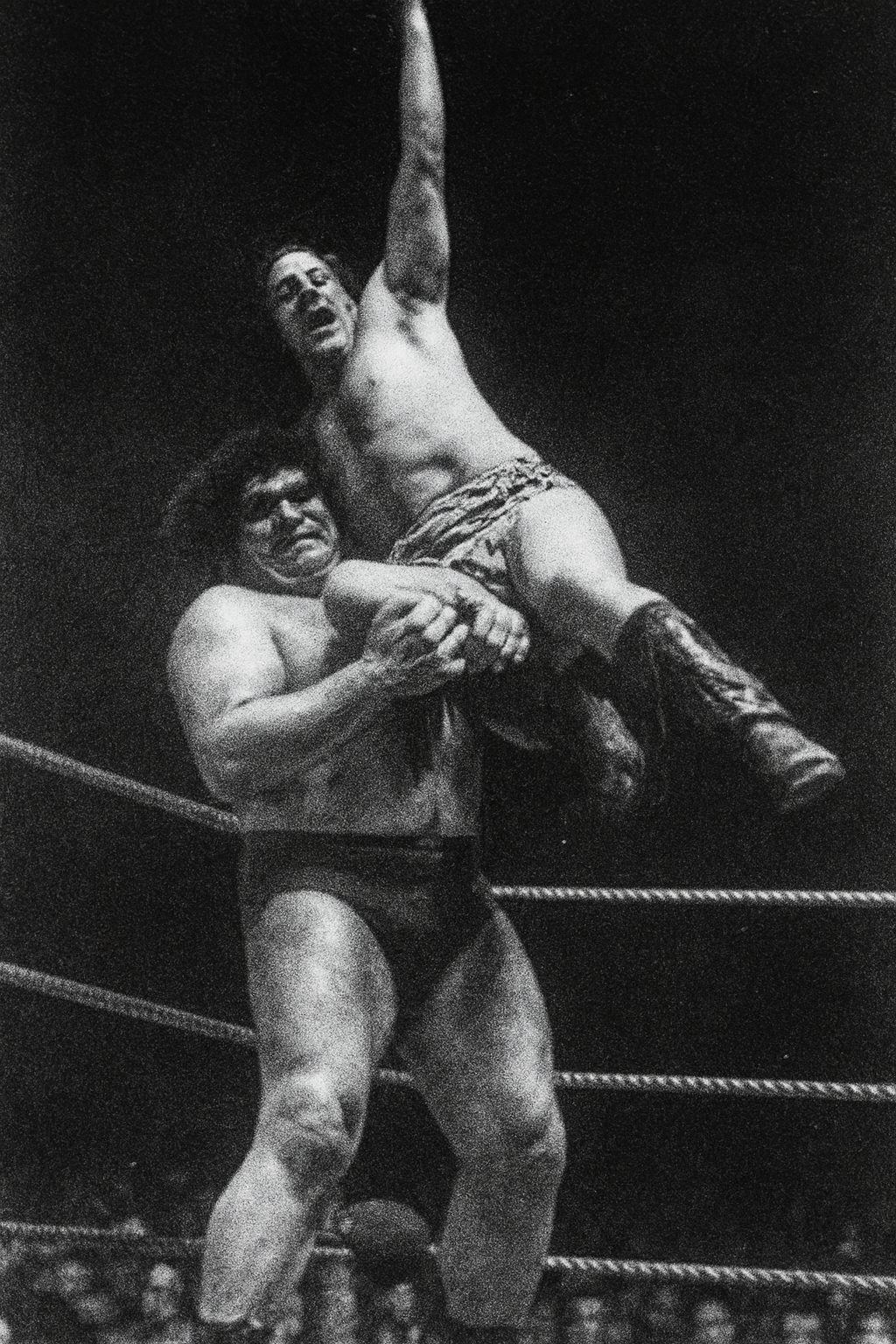
One image: Andre hoisting an opponent overhead, muscles taut, face concentrated. Pure dominance.
Another: Nikolai Volkoff overwhelmed by both Andre and Strongbow, the caption noting that "Volkoff never had a chance." The photo composition emphasized scale—two bodies working in concert to dismantle a third.
But the captions carried ambivalence. For every moment of power, the text questioned whether this partnership could endure. The magazine understood something fundamental: readers wanted to believe in Andre's invincibility, but they also wanted to see him work for something. Tag team wrestling provided that narrative tension.
The photos weren't candid—this was staged spectacle—but they documented an emotional truth about Andre's career. Here was a man who had conquered every physical challenge, now grappling with something intangible.
The Cultural Architecture of 1977
Wrestling in 1977 existed in a specific ecosystem. Territorial promotions still dominated, with regional heroes and villains cycling through towns on predictable schedules. National television exposure was limited. Magazines like Inside Wrestling weren't supplementary—they were primary texts, the way fans discovered storylines unfolding two states over.
The Andre-Strongbow story functioned as connective tissue between territories. Fans in Texas might have heard Andre was attempting tag team wrestling. Fans in New York might have seen Strongbow wrestling solo. The magazine stitched these fragments into a coherent narrative, creating the illusion of a unified wrestling universe years before that universe actually existed.
And the emotional stakes mattered. Readers in 1977 understood that athletes aged, that bodies broke down, that even giants had limits. Strongbow's exhaustion wasn't melodrama—it was the reality of working 300 nights a year in high school gymnasiums and civic centers. Andre's struggle to adapt wasn't weakness—it was the human cost of being treated as superhuman.
What the Issue Preserves
For collectors, the October 1977 Inside Wrestling functions as a time capsule. Not just of wrestling, but of how stories were told before instant replay, before the internet archived every match, before wrestlers broke kayfabe on podcasts.
The magazine captured Andre before his 1980s transformation into a mainstream pop culture figure. This was Andre as a working wrestler with an unsolved problem, not Andre as the cuddly giant in The Princess Bride. It preserved Strongbow in his final chapter, a man whose career would soon end but whose partnership with Andre created a narrative "what if" that still intrigues historians.
The issue also represents the peak of wrestling magazine culture—the moment when publications like Inside Wrestling had genuine influence over how fans understood the sport. Photographer Bill Apter's images from this era remain iconic not because they're technically revolutionary, but because they documented wrestling as mythology in progress.
The Unfinished Business
The October 1977 issue left the story open-ended. Andre and Strongbow had united, fans had cheered, but the magazine warned against premature celebration. Whether they succeeded or failed, whether the partnership endured or collapsed—these questions were left unanswered, giving the article a novelistic ambiguity unusual for wrestling journalism.
That ambiguity is part of the issue's enduring appeal. It captured a moment of genuine uncertainty in Andre's career, a rare instance where outcome wasn't predetermined by his physical superiority.
For anyone studying wrestling's territorial era, this magazine offers primary source material. For collectors of vintage sports media, it represents the craft of magazine storytelling at its most effective. For fans who grew up watching Andre, it provides a window into the version of him that existed before global fame calcified his image.
Collector Significance
The October 1977 Inside Wrestling is more than archival curiosity—it's a document of wrestling's creative peak, when magazines shaped narratives and photographers captured mythology as it formed. Owning this magazine means possessing a fragment of 1977 itself—the arena crowds, the uncertainty, the drama of watching Andre attempt something he might not achieve.
Explore the Archive
Whether you're building a comprehensive wrestling library, researching territorial-era storytelling, or honoring family members who watched Andre wrestle in person, this issue delivers something increasingly rare: a professionally documented moment when even giants seemed human.
Browse Inside Wrestling Magazine Collection