
The Kite, the Laundry Bag, and the Birth of the American Teenage Summer
How Seventeen Magazine's May 1958 Issue Codified Youth Identity Through Stripes, Whites, and Suburban Performance
May 1958. A beach. Two girls in striped tunics hold kites aloft, their turbans catching the wind. The photograph is selling something, but it isn't swimwear.
When Seventeen magazine published "The Big Idea" that spring, editors weren't simply showing readers what to wear—they were codifying what it meant to be young in postwar America. The spread's central revelation? The humble laundry bag had been elevated to summer essential. This wasn't fashion advice. It was a manifesto disguised as beachwear.
For collectors and cultural historians, the May 1958 issue represents more than vintage editorial content. It captures the precise moment when American teenagers became a demographic force, when youth culture calcified into consumer identity, and when a magazine could teach girls to balance suburban propriety with the promise of independence—all through the language of stripes, whites, and carefully chosen accessories.
Archive Details
Publication: Seventeen Magazine
Issue Date: May 1958
Feature: "The Big Idea" — Summer Fashion Spread
Historical Context: Peak of postwar teen consumer culture
Archive Source: Original Magazines Collection
The Teenager as Economic Power
By 1958, the American teenager had purchasing power their Depression-era parents never imagined. Postwar prosperity created suburban enclaves where adolescence could expand into its own territory—complete with dedicated music, slang, and spending habits. Seventeen understood this better than most publications. Founded in 1944, it had spent over a decade refining its approach: speak to the teen girl not as a child, but as an emerging consumer with taste, agency, and a bedroom of her own.
The magazine's genius lay in its duality. It encouraged self-expression while reinforcing social expectations. It celebrated independence while preparing readers for futures as wives and hostesses. "The Big Idea" embodied this tension perfectly—playful beach fashion made from washable, practical fabrics. Freedom with guardrails. Individuality within acceptable bounds.
This wasn't accidental. The 1950s teen girl occupied contradictory cultural space. She had more autonomy than her mother's generation—summer jobs, increased mobility, rock and roll—yet faced rigid expectations about femininity, marriage, and domesticity. Seventeen didn't resolve this contradiction. It merchandised it.
Decoding "The Big Idea"
The beach sequence opened the feature with deliberate visual impact. Models wore tunic-style swimsuits in pink, yellow, and orange stripes, their matching turbans adding polish to what might otherwise read as pure play. The kites they held weren't random props—they functioned as semaphore, signaling carefree youth, summer leisure, the lightness of being sixteen.
Then came the pivot: the laundry bag, repositioned as beach essential. In featuring this household workhorse, Seventeen performed a subtle act of domestication. The message was clear—style emerges from resourcefulness, glamour from everyday life. This was aspirational fashion grounded in practicality, teaching readers that transformation didn't require wealth, just imagination applied to what you already owned.
The move was strategic. While Vogue spoke to women with disposable income, Seventeen addressed girls whose allowances and summer earnings funded their wardrobes. By elevating the laundry bag, editors validated their readers' economic reality while teaching them to see potential in the mundane. It was fashion education and life lesson compressed into a single spread.
The Patio as Social Laboratory
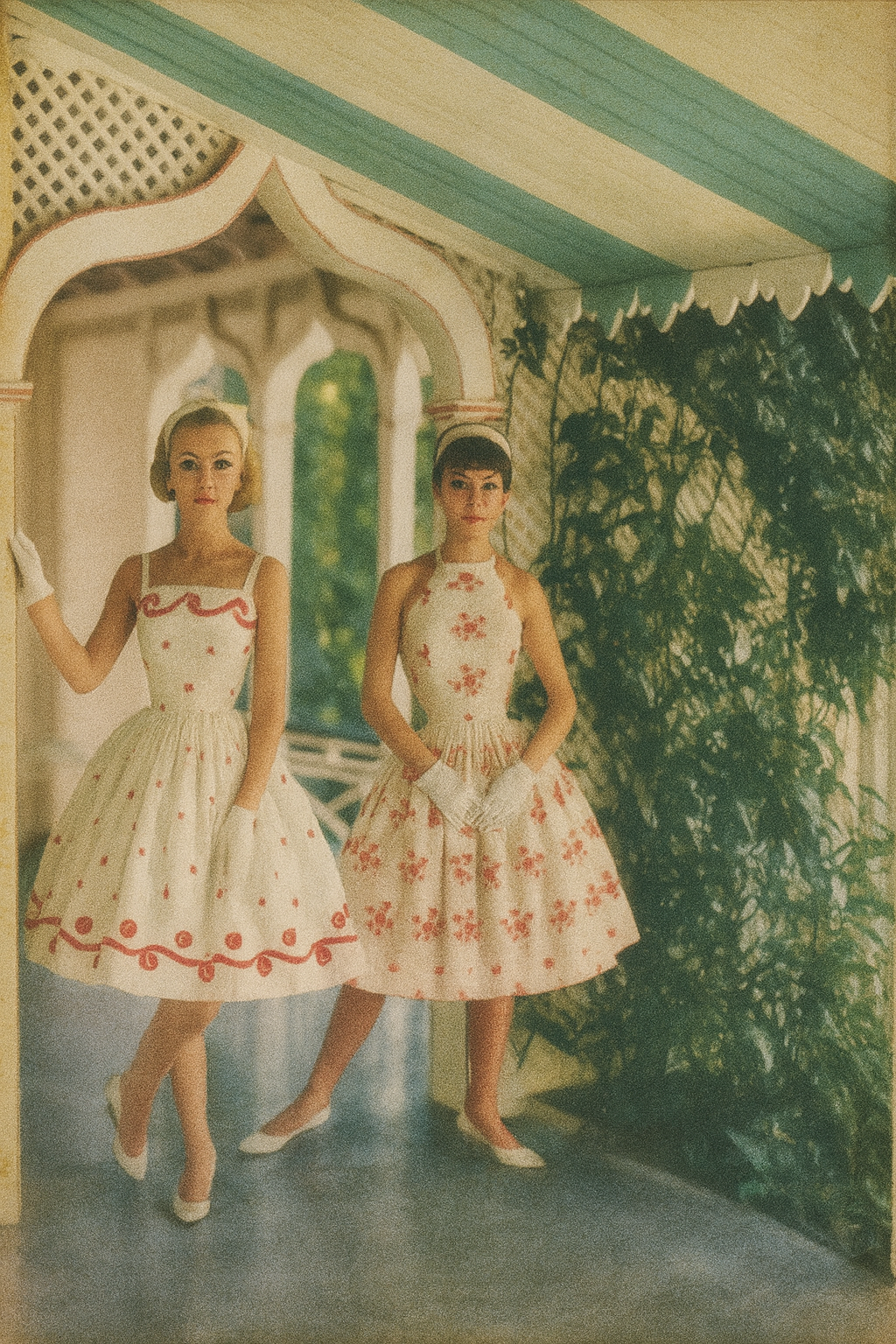
The feature's second act moved from beach to backyard. Models appeared in white dresses accented with red belts, bows, and ribbons—photographed in black and white to emphasize the formality of contrast. These weren't beach clothes. They were uniforms for suburban social performance.
The postwar patio represented more than outdoor space. It was theater for the rehearsal of adult roles. Here, teenage girls learned to host, to circulate, to navigate the choreography of family gatherings and church socials. Seventeen understood that fashion served this apprenticeship. The crisp white dress with its sharp red accent wasn't simply pretty—it was appropriate, signaling that its wearer understood occasion, context, and the unwritten rules of mid-century entertaining.
This emphasis on "patio party" style reveals what differentiated Seventeen from other fashion publications. The magazine consistently framed clothing within social scenarios, teaching readers that fashion choices were never merely aesthetic. They communicated breeding, values, readiness for the responsibilities of womanhood. A belt wasn't an accessory. It was proof you understood the stakes.
Carefree Whites and Controlled Rebellion
The spread concluded with its boldest statement: "Care-free whites sharpened with color." Models wore white dresses transformed by polka dots and geometric prints—innocence made modern through pattern alone.
White carried tremendous symbolic weight in 1950s culture. It signified purity, virtue, the unmarked slate of girlhood. But solid white could read as bland, unsophisticated, childish. By introducing prints and dots, Seventeen showed readers how to remain symbolically innocent while asserting personality. This was rebellion within bounds—enough individuality to feel authentic, not so much as to alarm.
The polka dot, in particular, operated as safe subversion. Playful but not provocative, it let girls signal youthful energy without crossing into the territory of "fast." Seventeen excelled at this calibration, offering readers just enough self-expression to feel seen while keeping them firmly within acceptable feminine norms.
Editorial Architecture and the Magazine as Mirror
What made Seventeen culturally significant wasn't its fashion alone, but how it integrated editorial voice, photography, and lifestyle advice into a coherent worldview. The magazine spoke directly to readers—never condescending, always encouraging, as if from an older sister who'd successfully navigated the same terrain.
The imagery in "The Big Idea" constructed a visual grammar of teen life: kites against sky, arches framing backyard spaces, models who looked accessible rather than impossibly glamorous. This wasn't the haute couture remoteness of Harper's Bazaar. These were girls readers could imagine themselves becoming.
The genius was making aspiration feel achievable. A tunic and turban. A white dress and red belt. A polka-dot pattern on washable cotton. Nothing required wealth, only attention—attention to detail, to occasion, to the signals clothing sent. Seventeen trained readers to read these signals, then taught them to send the right ones.
Key Themes: What "The Big Idea" Teaches Us
The Kite as Symbol
Bright kites weren't random props—they embodied the lightness and playfulness of summer youth while remaining tethered, like teenage freedom itself.
The Laundry Bag Twist
By elevating a humble household item, Seventeen blended practicality with style, teaching resourcefulness alongside aspiration.
The Patio Party Look
Crisp white and red ensembles showcased the importance of social events in suburban teen life and the rehearsal of adult roles.
Whites with Personality
Polka dots and prints showed that innocence and individuality could coexist—rebellion calibrated to remain acceptable.
The Everyday Girl
Models were relatable, the "everyteen" readers could see themselves becoming—aspiration made accessible.
Consumer Identity
The spread taught teenagers to see themselves as consumers with agency, taste, and the power to construct identity through purchases.
Why Collectors Prize This Issue
Cultural Timing
Published at the apex of postwar teen culture, the issue documents both prosperity and the gender expectations that would soon face challenges from second-wave feminism.
Fashion Authentication
Designers, costume departments, and vintage reproduction specialists use these pages as primary sources for accurate 1950s silhouettes, fabrics, and color palettes.
Sociological Evidence
Beyond fashion, the magazine reveals the values, anxieties, and aspirations of mid-century girlhood—making it invaluable for understanding how mass media shaped feminine identity.
Visual Preservation
The photography—compositionally sophisticated, vibrantly colored—represents editorial design at a moment before television dominated visual culture.
Generational Connection
For families researching postwar life, these magazines provide intimate access to how youth was experienced, not just remembered.
Historical Juncture
The May 1958 issue captures teenage identity at a pivotal moment—after the establishment of youth culture but before the countercultural upheavals that would redefine it.
The Magazine as Artifact
Vintage Seventeen issues endure because they function as primary historical documents. They preserve language, visual style, and cultural assumptions that official histories often miss. Where textbooks summarize, magazines specify. They show exactly what "appropriate summer wear" meant in 1958, which colors signified modernity, how girls were expected to move through social space.
For their original readers, these magazines were guidebooks. For contemporary researchers, they're evidence—of what was sold, what was valued, what remained unspoken but understood. "The Big Idea" teaches us that even the laundry bag could be marketed as essential, that kites signified freedom within carefully photographed bounds, that white plus polka dots equaled acceptable rebellion.
This is why serious collectors pursue complete runs, why fashion historians cross-reference issues against runway archives, why cultural studies programs assign them as texts. These aren't simply magazines. They're the infrastructure of postwar youth identity, preserved in glossy pages.
Explore the Archive
The May 1958 Seventeen is one piece of a larger story—how American youth culture emerged, evolved, and eventually exploded into forms its 1950s architects never imagined. Each issue charts this evolution, from the polished conformity of the 1940s through the experimental energy of the 1960s and beyond.
Whether you're a collector seeking period-accurate fashion references, a historian documenting youth culture, or a reader drawn to the material culture of midcentury America, these archives offer irreplaceable access.
Browse Seventeen Magazine CollectionThe Beach, the Kite, the Archive
When those two models raised their kites on that May 1958 beach, they were performing more than a photo shoot. They were demonstrating how American girlhood could be packaged, marketed, and sold back to girls as aspiration. The striped tunics, the elevated laundry bag, the white dresses sharpened with red—each element taught readers that identity could be purchased, practiced, perfected.
Seventeen didn't invent the American teenager. But it gave that teenager a visual language, a set of social scripts, and a belief that the right outfit could unlock belonging. "The Big Idea" was never about beachwear. It was about selling girls a version of themselves—vibrant, acceptable, free within limits.
That's why this issue, nearly seventy years later, still matters. It's evidence of how thoroughly fashion and identity fused in postwar America, how magazines became culture-makers, how even something as simple as a kite could carry the weight of an entire generation's dreams.