
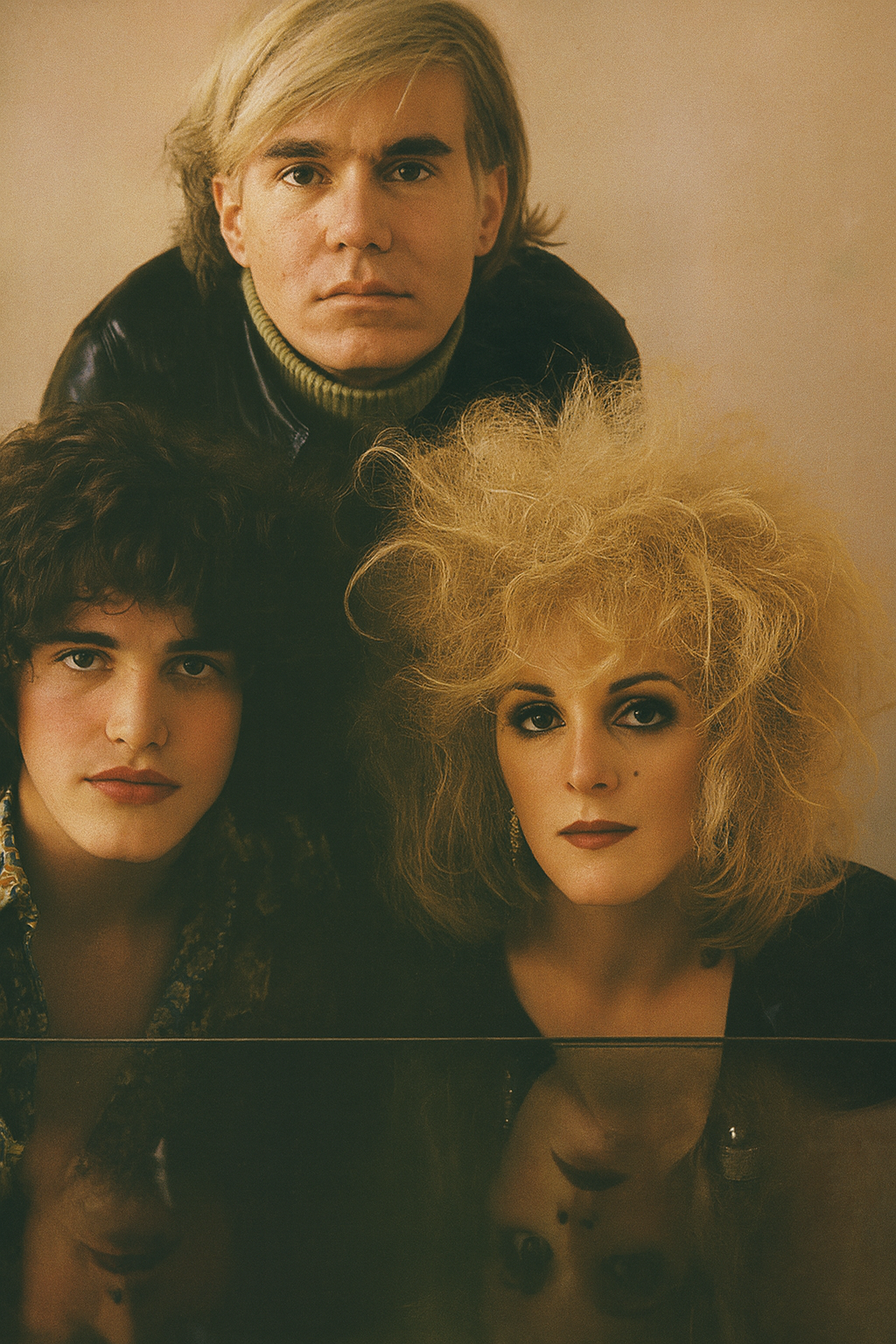
Andy Warhol, Celebrity, and the Blurred Lines of Art in 1970
How Vogue captured the artist at his most transformative moment
On March 1, 1970, Vogue readers expecting spring hemlines and makeup tutorials found something else entirely: Andy Warhol staring back at them from the magazine's interior pages—pale, silver-haired, unflinching. Not as an advertisement. Not as a fashion accessory. But as the subject of a full cultural dissection.
Two years after Valerie Solanas had shot him in his own Factory, leaving him physically and psychologically scarred, Warhol had become something more dangerous than an underground provocateur. He had become unavoidable. And Vogue—arbitrator of taste, gatekeeper of glamour—had decided it was time to explain him to the world.
What followed was one of the most revealing mainstream profiles of Warhol ever published: Leticia Kent's "Andy Warhol, Movieman: 'It's hard to be your own script'" paired with John Perreault's essay "Andy Warhol disguised here as Andy Warhol." Together, they captured Warhol at the precise moment he stopped being an artist who courted fame and became fame itself.
This wasn't just a magazine feature. It was documentation of a cultural threshold.
Archive Details
Historical Figure: Andy Warhol
Issue Date: March 1, 1970
Archive Source: Vogue Magazine
Featured Essays: "Andy Warhol, Movieman: 'It's hard to be your own script'" by Leticia Kent and "Andy Warhol disguised here as Andy Warhol" by John Perreault
The Cultural Climate: Why March 1970 Mattered
The late 1960s had detonated American certainties. Vietnam raged. The counterculture had moved from Haight-Ashbury into suburban living rooms. Civil rights, women's liberation, and youth rebellion were rewriting the social contract in real time.
Fashion magazines weren't immune to this upheaval—they were barometers of it. By 1970, Vogue had begun trafficking in something beyond clothes: it sold access to the emerging cultural elite. The March 1970 issue understood that art and celebrity were no longer separate categories. Warhol had collapsed the distinction.
His silk-screen Marilyns had already transformed movie-star tragedy into high art. His underground films like Chelsea Girls had dragged avant-garde cinema into commercial theaters. His Factory—part studio, part salon, part circus—had manufactured a new species of fame: the "superstar," celebrated not for talent but for sheer presence.
Edie Sedgwick. Candy Darling. Brigid Polk. These weren't actresses in any traditional sense. They were Warhol's living artworks, embodiments of his prophecy that "everybody will be famous for fifteen minutes."
The 1968 shooting had only amplified Warhol's mythology. Perreault would call him both "the Fool and the Magician"—a figure who survived his own near-death to become simultaneously vulnerable and untouchable, human and icon.
Vogue captured him in that liminal space: no longer underground, not yet fully domesticated.
Inside the Issue: Design as Cultural Statement
The March 1, 1970 cover featured the expected: a model's face, luminous and composed, selling beauty as aspiration. But flip inside to the Warhol feature and the visual grammar shifted entirely.
Stark black-and-white photographs showed Warhol himself alongside two Factory collaborators. His pale skin, silver wig, and dark clothing created an almost photographic negative effect—he appeared less like a man than a cultural X-ray, exposing the skeletal structure of fame beneath the flesh of celebrity.
The layout itself made an argument. Vogue was declaring it could move seamlessly between the commercial shine of fashion photography and the intellectual grit of avant-garde portraiture. The magazine's sophistication lay not in choosing one world over the other, but in making them speak to each other.
What Warhol Actually Said
Kent's interview revealed a Warhol who deflected, circled, and evaded—yet somehow told the truth through omission.
"Movies are really the new paintings," he told her. The shift from canvas to celluloid wasn't abandonment; it was evolution. Both mediums trafficked in repetition, surface, and the act of watching.
His films had barely any scripts. Eat showed Robert Indiana consuming a mushroom for an hour. Henry Geldzahler captured the Metropolitan Museum curator smoking a cigar for 45 minutes. These weren't narratives. They were durational portraits—capturing presence rather than performance, exactly as his silk-screens did.
"Life doesn't end," Warhol explained when asked why his films lacked resolution. The comment sounds flip until you realize it's a philosophical position: his work rejected artifice in favor of recording existence itself.
The Factory, as described by Kent, functioned as perpetual theater. Phone calls, visitors, hangers-on, creative chaos—it was all part of the art. Warhol had turned his studio into a stage where the performance never stopped and everyone was both audience and actor.
Perreault's essay pushed further. "Andy Warhol" was itself a disguise, he argued—a carefully constructed persona as deliberate as any silk-screen. The artist's greatest work might be the invention of "Andy Warhol": the shy observer who made himself central by pretending to disappear, the commercial illustrator who became a prophet of postmodernism.
Warhol even admitted that lies were sometimes the only path to truth. His repeated images—Campbell's soup cans, Marilyns, car crashes—transformed surface into depth, banality into iconography. The lie of mechanical reproduction somehow revealed more than originality ever could.
Key Themes from the Feature
Movies as the New Paintings
Warhol explicitly told Kent that "movies are really the new paintings." The shift from canvas to celluloid was natural: both were about repetition, surface, and observation.
Improvisation Over Script
Warhol admitted that many of his films had only a page of script or none at all. He let people talk, interact, and exist on camera—the unscripted quality was the truth of modern life.
Portraits in Film
In Eat, Robert Indiana ate a mushroom for an hour. In Henry Geldzahler, the curator smoked a cigar for 45 minutes. These films captured presence rather than performance.
The Factory as Stage
The article described Warhol's Factory as a labyrinth of phone calls, visitors, and creative chaos—a constant performance that was itself part of Warhol's art.
Superstars and Fame
Edie Sedgwick, Candy Darling, Brigid Polk were central to Warhol's creative world—embodiments of his idea that "everybody will be famous for fifteen minutes."
The Role of Lies and Truth
Warhol said lies were often the only way to get at truth. His screen prints and repeated images turned surface into depth, transforming banality into icon.
Warhol as Persona
Perreault argued that "Andy Warhol" was a disguise, a fiction. He was both Fool and Magician, someone who could make himself central by pretending to disappear.
Life Doesn't End
When asked why his films lacked resolution, Warhol's response was philosophical: "life doesn't end." His work rejected artifice in favor of recording existence itself.
Why Vintage Vogue Endures
Fashion magazines were never just about clothes. They were instruction manuals for aspiration, blueprints for identity, records of what mattered.
Vintage Vogue issues preserve shifting ideals of beauty, gender, and celebrity. They show how fashion, art, and lifestyle were synthesized for a mass audience. Most importantly, they contain primary sources: Warhol's actual words, the photographs that defined his public image, the layouts that communicated mid-century sophistication.
For historians, these magazines are evidence. For collectors, they're material culture. For anyone interested in how we became who we are, they're indispensable.
The March 1970 issue doesn't just tell us what people wore. It reveals how they thought about art, identity, and fame at a moment when all three were being reinvented.
Why Collectors Covet This Issue
The Warhol Factor
Any vintage Vogue featuring substantial Warhol content is collectible by default. As one of the most studied—and expensive—figures in 20th-century art, Warhol's presence elevates the entire issue.
Timing as Historical Document
Published just two years post-shooting, this feature captures Warhol at a pivot point—transitioning from downtown filmmaker to mainstream icon. Primary documents from transitional moments are always valuable.
Visual Distinction
The stark black-and-white photography of Warhol and his collaborators stands apart from typical fashion magazine aesthetics. Design historians and art collectors value the issue for its images alone.
Crossover Appeal
This isn't just for fashion collectors. Art historians, pop culture scholars, and Warhol specialists all seek this issue, expanding the collector base and driving demand.
Scarcity
Well-preserved copies grow rarer each year. Magazine paper degrades, casual readers discarded issues, and survivors become increasingly precious.
Cultural Artifact
Owning the March 1970 Vogue means possessing an artifact of absorption—the moment mainstream culture pulled avant-garde art into its pages and made it legible to millions.
For Collectors and Cultural Historians
Whether you're searching for "Vogue magazine March 1970," "collectible Vogue magazines," "1970s Vogue," or "original Vogue magazines," you already understand what these issues represent: not nostalgia, but evidence.
They aren't reprints or digital scans. They're objects that existed in 1970, were touched by 1970 readers, and carry 1970's ink and paper and intention.
Browse Vogue Magazine CollectionConclusion
The March 1, 1970 Vogue remains a landmark in fashion journalism—not because it abandoned fashion, but because it recognized that by 1970, art was fashion, celebrity was art, and Andy Warhol was the hinge on which both turned.
The interviews and photographs reveal Warhol as artist and invention, filmmaker and myth, Fool and Magician. Five decades later, the issue endures as both collectible artifact and intellectual document—proof that the best fashion magazines were never really about fashion at all.
They were about transformation. And in March 1970, Vogue documented the transformation that mattered most: the moment when pop culture ate avant-garde art and became indistinguishable from it.
For anyone who values cultural history, these aren't just old magazines. They're the original receipts.