
When a Wartime Alliance Became a Magazine Cover Story
John Steinbeck, Robert Capa, and the Most Audacious Cultural Diplomacy of the Early Cold War
In February 1948, American housewives opening their copies of Ladies' Home Journal discovered something unprecedented tucked between the recipes and fashion spreads: a two-month eyewitness account from inside Stalin's Soviet Union, written by John Steinbeck and photographed by Robert Capa.
Three years after V-E Day, with the Berlin Blockade months away and McCarthy's witch hunts gathering momentum, the Journal did something audacious. It asked four million households to see Russians not as the coming enemy, but as human beings.
This wasn't propaganda. It was cultural diplomacy disguised as a magazine feature—and it remains one of the most significant American publications of the early Cold War.
Archive Details
Historical Figures: John Steinbeck (author), Robert Capa (photographer)
Issue Date: February 1948
Publication: Ladies' Home Journal
Article Title: "In the U.S.S.R."
Archive Source: Original Magazines Collection
The Political Gamble
By 1948, the geopolitical ice was already forming. Europe lay in ruins. The wartime alliance had curdled into mutual suspicion. Fear of communist infiltration was metastasizing into paranoia, and newspapers trafficked in demonization rather than nuance.
Into this climate stepped Ladies' Home Journal—not The Atlantic, not Harper's, but a magazine read primarily by middle-class American women—with a sprawling photo-essay titled "In the U.S.S.R." The assignment: show how ordinary Russians actually lived.
The Journal chose its emissaries wisely. Steinbeck, fresh off his Pulitzer Prize for The Grapes of Wrath, brought literary credibility and a novelist's eye for human detail. Capa, who had photographed the D-Day landings and the liberation of Paris, understood how to make distant suffering feel immediate.
Together, they spent two months traveling through a country most Americans knew only through State Department briefings and newsreel footage of military parades.
What They Found Behind the Iron Curtain
The article opened with bold red letters spelling out U.S.S.R.—a visual declaration that readers were crossing into forbidden territory. What followed shattered expectations.
Steinbeck's Lens
Steinbeck wrote about Soviet women with a precision that bordered on anthropological. These weren't the babushkas of American imagination. They were unloading ships in Leningrad, laying bricks in Kiev, harvesting wheat in Ukraine, and running households in cities still choked with rubble. With the war having killed millions of Soviet men, women carried the nation's reconstruction on their shoulders.
He documented scarcity without condescension. Russians lacked soap, cosmetics, and refrigerators—goods Americans considered basic necessities. Yet they endured with what Steinbeck recognized as quiet resilience, not desperation.
He captured their curiosity. Ordinary Russians peppered the Americans with questions: What do you eat? How do your schools work? What do your homes look like? The interrogation ran both ways, exposing how little either side knew about the other.
Most striking was the hospitality. Despite devastation, Russians welcomed the foreign visitors into their homes and lives, hungry for connection across the ideological divide.
Capa's Eye
Where Steinbeck provided context, Capa delivered visceral proof. His camera found:
- Women rebuilding Stalingrad brick by brick, their faces marked by exhaustion and determination
- Children playing in bombed-out ruins, their innocence colliding with destruction
- Families gathered in cramped apartments, their poverty offset by dignity
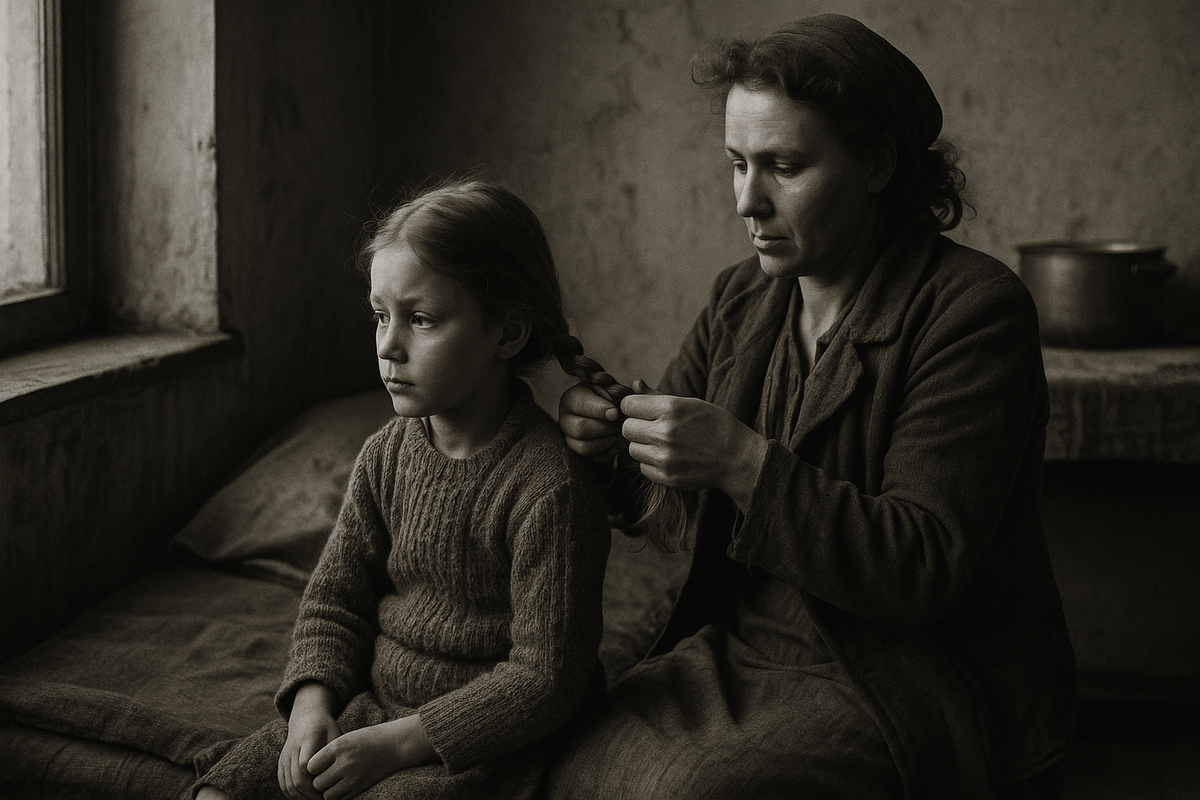
- Daily rituals—braiding hair, preparing food, tending gardens—that revealed normalcy persisting through catastrophe
Capa's photographs did what State Department reports could not: they made Soviet life legible to Americans who had never left their counties, let alone their country.
Ten Truths from the Rubble
The Steinbeck-Capa report crystallized several realities that challenged American assumptions:
The Permanence of Print
What distinguishes magazines like this from digital ephemera is their intended longevity. These publications were read slowly, discussed at kitchen tables, passed between neighbors, and archived in attics. They weren't designed to be consumed and discarded in seconds.
That physical permanence is what transforms them into historical documents. The February 1948 Ladies' Home Journal wasn't just news—it was a statement delivered on glossy paper, meant to be kept and reconsidered.
This is why serious collectors and cultural historians prize original issues rather than reprints or digital scans. Context collapses without the artifact itself: the advertisements selling soap and appliances alongside images of Soviet scarcity, the editorial choices about placement and typography, the physical weight of the magazine in readers' hands as they encountered Capa's photographs of a nation their government was learning to fear.
Why This Issue Commands Collector Attention
For historians and collectors of vintage magazines, the February 1948 Ladies' Home Journal occupies a singular position:
Owning this issue means possessing a moment when popular media chose complexity over propaganda.
A Bridge Still Standing
The February 1948 issue of Ladies' Home Journal endures as a monument to what journalism could achieve when it prioritized humanity over ideology. Through Steinbeck's reporting and Capa's photography, millions of Americans were asked to recognize that the Soviet Union contained not just a rival superpower, but mothers, children, and families trying to rebuild after unimaginable destruction.
It documented women bearing extraordinary burdens, children playing in ruins, and families extending hospitality despite scarcity. For readers in 1948, it was a radical act of empathy. For us, seventy-seven years later, it remains a reminder that understanding and connection matter most when they're most difficult to achieve.
To hold this issue is to hold proof that popular media once dared to build bridges during the dawn of the Cold War—and that some of those bridges are still standing.
Explore the Archive
Thousands of original Ladies' Home Journal magazines spanning from the Victorian era through the 20th century are available in our collection. These issues trace the evolution of American women's lives, family culture, and social change as they were first documented—before revision, before interpretation, in their original published form.
Whether you're building a research library, honoring a family member who lived through these decades, or preserving artifacts of media history, these magazines offer something irreplaceable: unmediated access to the past.
Browse Ladies' Home Journal Magazine Collection