
The Literary Accident That Changed American Reading
James Herriot's American debut in Ladies' Home Journal, May 1973
In May 1973, between advertisements for Clairol hair dryers and Nestlé fudge recipes, American women discovered a Yorkshire veterinarian who would alter the course of popular literature.
The magazine was Ladies' Home Journal. The story was an excerpt from All Creatures Great and Small. And for millions of readers accustomed to the Journal's blend of domesticity and aspiration, James Herriot's chronicles of dying dogs and emaciated cows arrived like a whisper from another world—one that felt, paradoxically, more authentic than their own.
This wasn't literature packaged as Literature. It was something stranger: profound storytelling disguised as light reading, slipped into households under the cover of pantyhose ads and coffee promotions. By the time readers realized what they'd encountered, Herriot had already entered the American consciousness—not through the front door of the literary establishment, but through the kitchen table.
Archive Details
Historical Figure: James Herriot (Alf Wight)
Issue Date: May 1973
Archive Source: Ladies' Home Journal
Featured Work: All Creatures Great and Small (excerpt)
The Magazine and the Moment
Ladies' Home Journal in 1973 was navigating a cultural minefield. Its tagline—"Never Underestimate the Power of a Woman"—had to stretch across two Americas: the one where women still clipped recipes and sewed curtains, and the one where they demanded workplace equality and bodily autonomy. Just four months earlier, Roe v. Wade had rewritten the rules of American womanhood. The women's movement was no longer theoretical. It was happening in real time, in living rooms and courtrooms and magazine pages.
The Journal's editors understood their readers lived in both worlds simultaneously. A woman could believe in ERA ratification and still want a reliable fudge recipe. She could join a consciousness-raising group and still care deeply about the dog sleeping at her feet.
Enter Herriot.
Three Stories, One Truth
The May 1973 excerpt presented three narratives from Herriot's recently published book, each a self-contained meditation on life's fundamental architecture:
"Old Dog III" opens with Mr. Dean, an elderly man whose fourteen-year-old collie, Connie, is dying. "She's my only friend now," Dean tells Herriot. The story refuses sentimentality while drowning in sentiment—a paradox Herriot mastered. Connie's death is inevitable, handled with clinical precision and devastating tenderness. American readers, many caring for aging parents or confronting their own mortality, recognized the story's real subject wasn't veterinary medicine. It was loss itself.
"Strawberry" offers the opposite trajectory. A cow so skeletal she appears "nothing more than a shoe-cover" defies every reasonable prognosis and survives. Herriot doesn't explain why some animals live and others don't—he simply documents the mystery. For readers exhausted by a culture demanding answers, explanations, and five-step solutions to everything, Strawberry's survival felt like permission to accept life's incomprehensibility.
"Topsy's Kittens" completes the cycle with new life. Miss Bramley's cat and her robust litter embody renewal without preaching about it. The kittens simply exist, vital and messy and real.
Together, the three stories formed an accidental liturgy: death, survival, birth. Repeat.
The Collision of Content
What makes the May 1973 issue extraordinary isn't just what it contained, but how it contained it.
On one page, Herriot describes cradling a dying dog with the reverence of a hospice nurse. Turn the page, and Stayfree Mini-Pads announces a revolution in menstrual products with unprecedented candor. Turn again, and L'eggs pantyhose promises that showing your legs equals showing your power. A Clairol "Beautiful Machines" spread sells modernity through chrome and convenience. Max-Pax Coffee offers "a superb cup every time"—domestic reassurance in an era of domestic upheaval.
The juxtaposition wasn't accidental. It was editorial genius.
The Journal's readers didn't compartmentalize their lives into "serious literature" and "daily concerns." They experienced both simultaneously, and the magazine mirrored that reality. Herriot's stories gained power from their context. Read between ads for beauty products and kitchen appliances, his Yorkshire farms felt both impossibly distant and intimately familiar. The Journal was saying: Your life—caring for sick pets, making dinner, managing a household, wanting better hair—is worthy of the same attention great literature gives to anything else.
This was radical in 1973. It remains radical now.
Cultural Context
Post-Roe v. Wade America, women's liberation movement, shifting domestic ideals converging in mass-market publishing.
Literary Innovation
Profound storytelling disguised as light reading—Herriot's veterinary tales as meditations on mortality and renewal.
Editorial Strategy
Juxtaposing international literature with consumer advertising to reflect the multifaceted reality of women's lives.
Archive Preservation
Complete issues documenting how Americans lived through advertising, fiction, recipes, and cultural commentary.
Why Herriot Worked
Herriot's prose doesn't announce its own importance. It's plainspoken, almost transparent—the literary equivalent of a clean window. You don't admire the glass; you look through it directly at what matters.
He writes: "She's my only friend now." Not "Connie had become, over the years, his sole companion in an increasingly isolating existence." Herriot trusted his readers to understand loneliness without having it explained.
This restraint made his stories accessible to Journal readers who might have been intimidated by "literature" as marketed by the literary establishment. Herriot wasn't The New Yorker's urbane sophistication or Harper's cerebral density. He was something American women in 1973 desperately needed: a writer who took their emotional lives seriously without condescension.
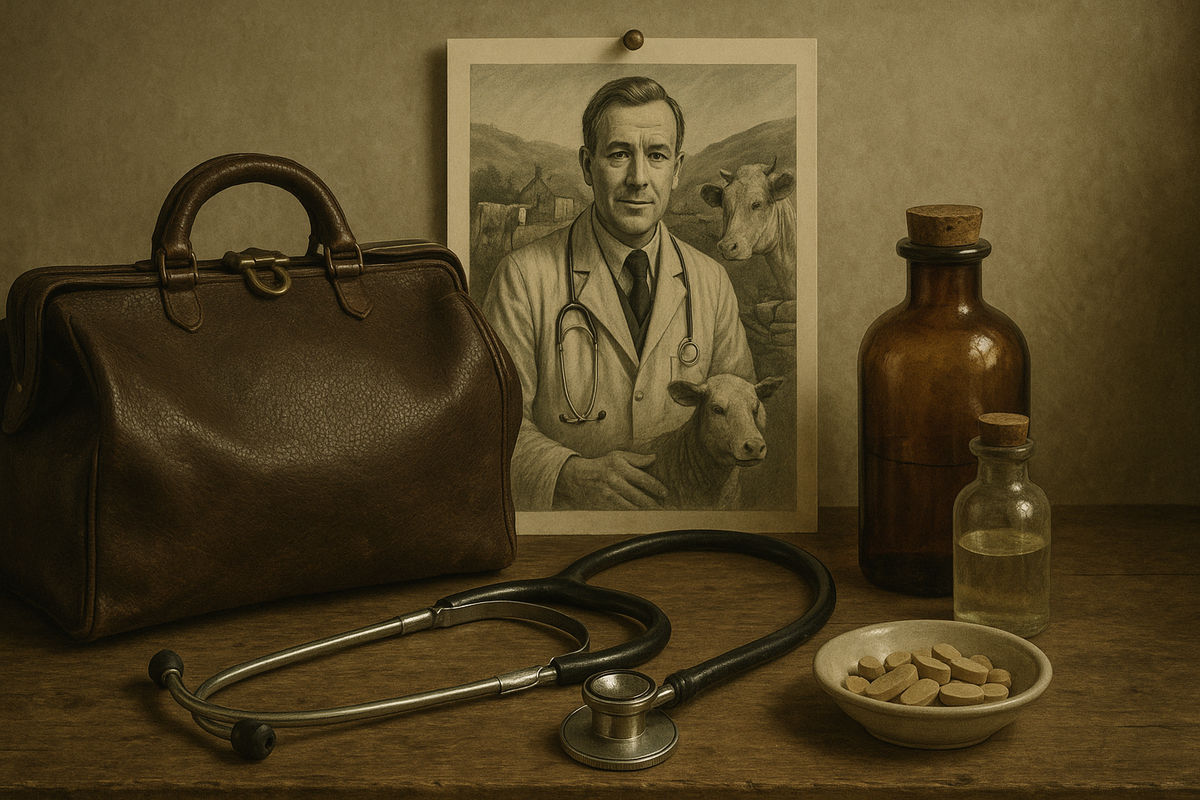
The painted portrait accompanying the article reinforced this accessibility. Herriot appears in veterinary garb, stethoscope visible, surrounded by farm animals with a Yorkshire village sketched behind him. He's heroic but not distant—a professional who still gets mud on his boots. For readers, the illustration promised that this writer understood work, mess, and the dignity of caring for living things.
The Cultural Aftershock
The Journal's excerpt introduced Herriot to millions of Americans who might never have discovered him otherwise. All Creatures Great and Small wasn't initially positioned as a blockbuster. It was a quiet British memoir about a rural veterinarian in the 1930s—not obvious bestseller material for 1970s America.
But the Journal created a bridge. Its readers became Herriot's American apostles, recommending the book to friends, giving it as gifts, making it a publishing phenomenon. By the decade's end, Herriot's books had sold millions of copies. The BBC television series followed. All Creatures Great and Small entered the permanent catalog of comfort literature—books people return to when the world feels too sharp.
None of this was guaranteed. It happened because the Journal's editors understood something profound about their audience: women wanted substance, not just service. They wanted to feel, not just function.
For Collectors: Why This Issue Matters
Literary History
This issue marks Herriot's American debut before mass audiences. Owning it means possessing a primary source document of how international literature entered U.S. popular culture.
Cultural Documentation
The advertisements alone justify acquisition. Stayfree's frank menstrual language, L'eggs' sensual confidence, Clairol's technological optimism—each ad captures a specific frequency of 1970s womanhood. Together, they form an accidental ethnography.
Historical Proximity
Published four months after Roe v. Wade, this issue exists in the immediate aftermath of seismic cultural change. The editorial content reflects a nation still processing what the decision meant for women's lives, autonomy, and futures.
Visual Storytelling
The Herriot portrait, the ad layouts, the typography—the issue's design embodies 1970s magazine aesthetics at their peak, before digital disruption flattened publishing into pixels.
Completeness
Issues with intact pages, original ads, recipes, and fiction are increasingly rare. Each surviving copy becomes more historically significant as others deteriorate or disappear.
Archive Preservation
This isn't nostalgia collecting. It's archive preservation. These magazines document how Americans actually lived—what they read, bought, worried about, and aspired to become. No digital surrogate captures the texture of original paper, the heft of physical pages, the experience of encountering Herriot's stories in their original context.
Explore the Archive
Our collection of original Ladies' Home Journal issues offers direct access to this history. Each magazine is a complete artifact, preserved from an era when publishing meant something different—more permanent, more considered, more tactile.
Browse Ladies' Home Journal Magazine CollectionDiscover not just Herriot's stories, but decades of fashion, fiction, cultural commentary, and the unfiltered voice of American women navigating century-defining change.
The Enduring Lesson
The May 1973 Ladies' Home Journal succeeded because it refused false hierarchies. It didn't separate "important literature" from "women's concerns." It presented Herriot's profound meditations on mortality alongside beauty product ads and fudge recipes because that's how life actually works—the profound and the mundane coexist, always.
For modern readers, this issue offers more than literary history. It's a reminder that great storytelling doesn't require institutional validation. Sometimes it just needs the right editor, the right magazine, and readers willing to find meaning wherever it appears—even between ads for pantyhose and coffee.
The Journal understood what many publishers still miss: underestimate readers at your peril. Give them substance, and they'll make room for it in their lives, no matter what else demands their attention.
That lesson, like Herriot's stories, never gets old.