
The Magazine That Brought Everest Home
How Life Magazine delivered humanity's highest triumph to American living rooms in 1953
On July 13, 1953, Americans opened their mailboxes to find something extraordinary: proof that the impossible had just become real.
Life Magazine had done it again—not climbed Everest, but something nearly as difficult. They had transported the summit itself into living rooms across the country. In an era before satellite television, before instant news, this single issue became the lens through which millions of Americans first witnessed humanity's conquest of the world's highest peak.
What they held in their hands wasn't just journalism. It was the first mass-media encounter with 29,029 feet of achievement, told through the voices of the two men who stood there first: Edmund Hillary and Tenzing Norgay.
When Empire Met Altitude
The spring of 1953 crackled with historical voltage. World War II's shadow still stretched across the globe, the Cold War had frozen into permanent tension, and Asia was throwing off colonial rule. India had claimed independence just six years earlier. Nepal had only recently opened its borders to outsiders.
Into this charged atmosphere came the British-led Everest expedition—a curious artifact of old imperial ambition colliding with new global realities.
The timing verged on theatrical. Word of Hillary and Tenzing's success reached London on the eve of Queen Elizabeth II's coronation—an accidental gift to a nation grasping for symbols of renewed greatness. But in Kathmandu and across the Indian subcontinent, it was Tenzing who emerged as the true victor. His success detonated debates about identity, recognition, and what partnership meant when the colonial world was still sorting out who got to claim glory.
For Americans, the story landed differently. Everest represented something purer: the confirmation that human limits remained negotiable, that the ceiling could always be pushed higher.
Life delivered this moment with the medium it had perfected—photojournalism that made distant triumph feel intimate and immediate.
Archive Details
Historical Figures: Edmund Hillary (New Zealand mountaineer) and Tenzing Norgay (Sherpa climber)
Issue Date: July 13, 1953
Archive Source: Life Magazine
Summit Date: May 29, 1953
Elevation: 29,029 feet (Mount Everest)
The Architecture of Awe
By 1953, Life had mastered a specific alchemy: the fusion of image and narrative into something greater than either component alone. The Everest issue stands as perhaps their finest example.
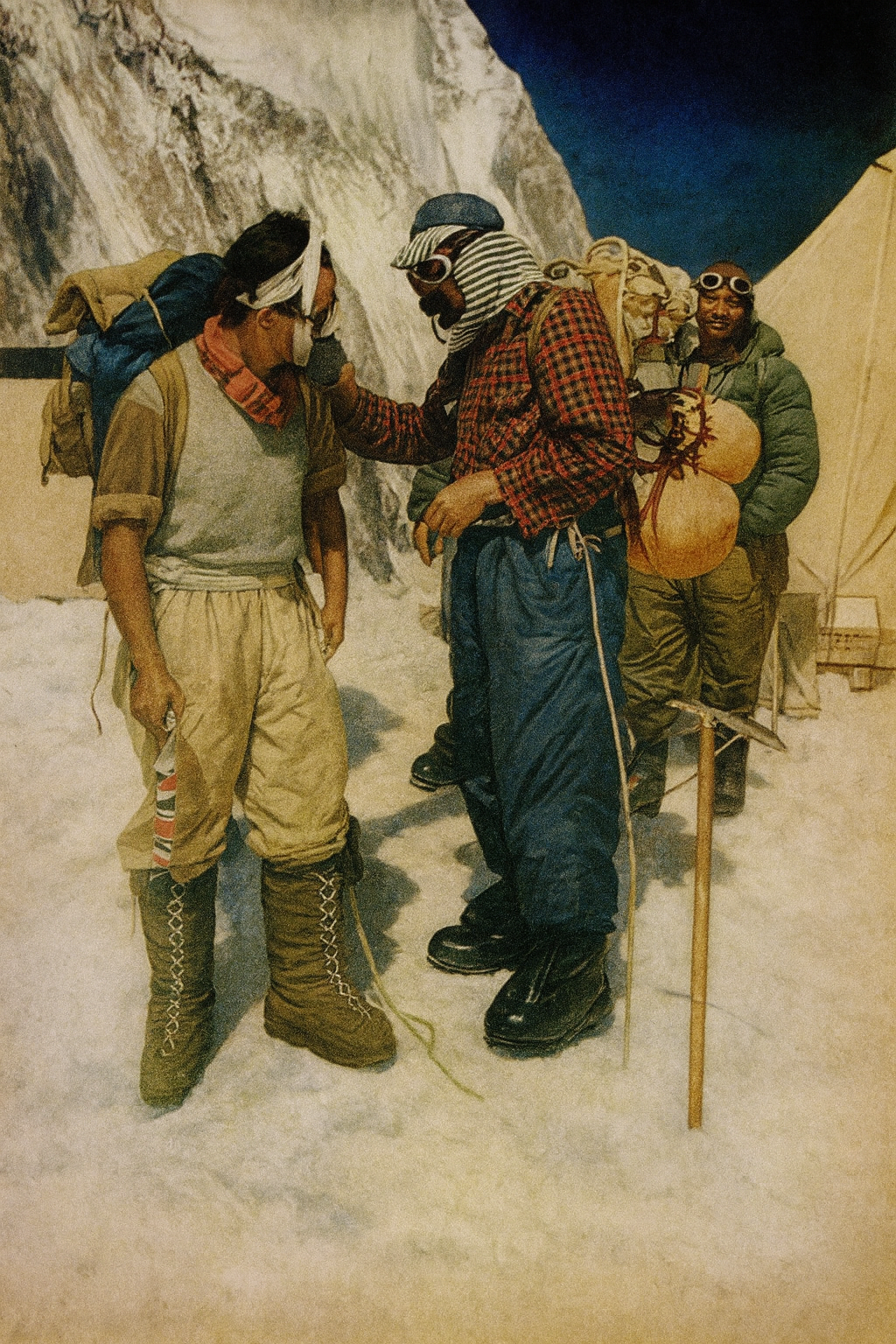
Readers encountered color photographs from altitudes where survival itself became a technical problem—climbers testing oxygen masks at 22,000 feet, bodies bent under massive loads, figures inching across snowbound ridges where a single misstep meant oblivion.
The summit shot stopped people cold: Tenzing Norgay braced against the wind, holding aloft flags from Nepal, Great Britain, and the United Nations. Hillary had snapped this image moments after they'd conquered the peak together. It would become one of the century's defining photographs.
Then came the panoramic revelation—Hillary's photographs from the top showing the Himalayas from an angle no human eye had ever registered. Makalu, Lhotse, Kanchenjunga: peaks that would themselves be mountaineering legends, now visible as subordinates in an endless procession of snow-covered summits dissolving into the horizon.
But Life understood that triumph has consequences. Their cameras captured the aftermath in Kathmandu—vast crowds mobbing Tenzing, banners proclaiming him Nepal's glory, traditional dances erupting in temple squares. They documented the political tension as rival groups pressured Tenzing to declare national loyalty, as British authorities worked to frame the conquest as their institutional victory.
The magazine didn't simply print pictures. It constructed meaning. Captions decoded altitude, conditions, the specific roles each climber played. Articles paired images with direct testimony: Hillary's technical precision and Tenzing's simple, powerful reflections in his own English.
For families studying these pages in 1953, this wasn't secondhand reporting. It was proof—visual, visceral proof—that history could still be made.
The Visual Grammar of Impossibility
Life's cover announced its contents with photographic boldness—no illustrated romanticism, just sharp, high-contrast reality. This was history unvarnished.
Inside, the Everest feature sprawled across multiple spreads, alternating between the sweeping and the claustrophobic:
Why This Issue Endures
For collectors of vintage Life magazines, the July 13, 1953 issue ranks among the publication's most significant achievements.
The Permanence of Print
The July 13, 1953 Everest issue transcends reportage. It functions as a time capsule preserving not just what happened, but how it felt when it happened—the determination, the stakes, the sense that two men had demonstrated something essential about human possibility.
In an era of infinite digital content and vanishing context, these magazines offer something increasingly rare: permanence. They are fixed witnesses to the 20th century, immune to edits, updates, or algorithmic burial.
History, held in your hands. Immutable. Present. Real.
Explore the Archive
If the Everest issue resonates—or if you want to trace other defining moments as they unfolded—thousands of original Life magazines await in our collection. From the 1930s through the 1970s, you can follow entire eras of culture, politics, war, exploration, and art as they happened, page by page.
Browse Life Magazine CollectionWhether you're a dedicated collector, a historian seeking primary sources, or someone preserving the memory of family who lived through these decades, these magazines transcend nostalgia. They are living artifacts—the actual objects that shaped how generations understood their world.
The Summit, Preserved
The July 13, 1953 issue of Life Magazine remains one of the most significant publications in the magazine's seven-decade history. Its coverage of Hillary and Tenzing's Everest triumph delivered not just information but sensation—the feeling of standing atop the world, transmitted through photography, testimony, and editorial craft.
Its images, words, and cultural context continue to resonate. For anyone who values history preserved in its original form, this issue represents something beyond collectibility. It is the moment humanity reached its highest summit, frozen forever in print, waiting to be held again.