
When Britain's Unemployed Hijacked Chamberlain's Favorite Word
The January 23, 1939 Life Magazine protest that turned political rhetoric into weapon
On January 23, 1939, Life Magazine went to press with an issue that would become one of the most haunting artifacts of the pre-war era. Bette Davis gazed from the cover with Hollywood's signature glamour—but inside, a different kind of drama was unfolding. British protesters had carried a coffin through London's streets, mockingly demanding that Prime Minister Neville Chamberlain "appease" them instead of Hitler and Mussolini.
It was political theater at its most desperate and brilliant. And Life's photographers captured every frame.
Archive Details
Issue Date: January 23, 1939
Publication: Life Magazine
Historical Figure: Prime Minister Neville Chamberlain
Cover Feature: Bette Davis
Archive Source: Original Life Magazine Collection
The Collision of Two Crises
By early 1939, Britain stood at a crossroads between two catastrophes. Abroad, Neville Chamberlain's policy of appeasement had reached its zenith—and was beginning its collapse. His Munich Agreement of September 1938 had surrendered Czechoslovakia's Sudetenland to Nazi Germany in exchange for what he famously called "peace for our time." The phrase would haunt him.
At home, the economic wreckage of the previous decade lingered. Unemployment ravaged Britain's industrial regions. While Chamberlain negotiated with dictators in European capitals, working-class families faced hunger, cold, and vanishing prospects. The disconnect was stark: diplomatic niceties abroad, grinding poverty at home.
Then, on New Year's Eve 1938, the unemployed decided to speak Chamberlain's language back to him.
A Coffin, A Slogan, A Challenge
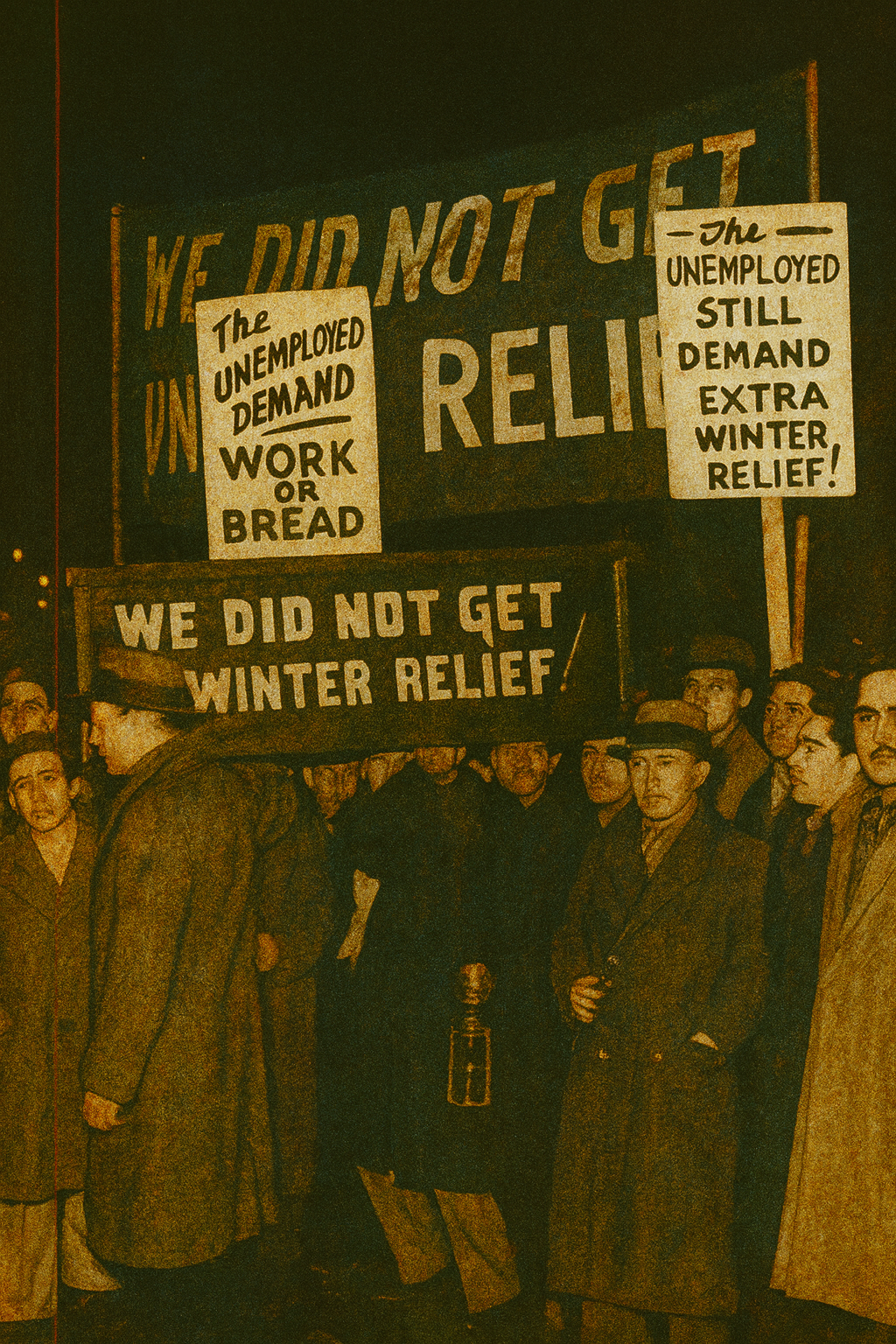
The protest began with symbol-making. Unemployed men and women in London constructed a coffin and painted it with stark declarations: "We did not get winter relief" and "The unemployed—no appeasement." They carried it through the streets, an improvised funeral for broken promises.
Days later, they attempted to deliver it to 10 Downing Street. Police confiscated it—Life captured the image of officers loading the coffin onto a truck—but the protesters were undeterred. When Chamberlain departed Victoria Station for diplomatic talks in Rome, they returned with fresh banners: "Appease the unemployed—not Mussolini."
The wordplay was surgical. By appropriating "appeasement"—the Prime Minister's signature policy—protesters transformed it from diplomatic doctrine into biting satire. The unemployed weren't just demanding relief. They were exposing the absurdity of a government that negotiated endlessly with foreign strongmen while ignoring its own citizens.
Life's Eye: Photography as Historical Testimony
Life Magazine had perfected a form of journalism that newspapers couldn't match. Where text-heavy columns reported events, Life made you witness them.
The January 23 issue delivered that witness with precision. One photograph showed unemployed men clutching signs reading "Work or Bread" and "We Did Not Get Winter Relief." Another captured the coffin itself—painted with the word "Appeasement"—being hauled away by authorities. A third showed protesters marching in formation, faces set with cold determination.
These weren't staged portraits. They were raw moments of confrontation, preserved in the grain of black-and-white film. For American readers thousands of miles away, the images collapsed distance. The struggle wasn't abstract or foreign—it was immediate, visible, human.
This was Life's genius: transforming distant crises into tangible stories through the marriage of photography and narrative. In 1939, as Europe slid toward catastrophe, that combination gave readers both the global picture and the granular detail—the policies of appeasement and the faces of those demanding to be heard.
Glamour and Grit: The Contradictions Inside One Issue
Bette Davis owned the cover—elegant, composed, the embodiment of Hollywood's golden age. Inside, unemployed Britons marched with a coffin. The juxtaposition wasn't accidental.
Life understood that its readers wanted both cultural escape and political reality. The magazine delivered Bette Davis's sophistication and the grim determination of London's jobless in the same package. That range—from cinema to protest, from art to survival—defined Life's editorial ambition.
The protest photographs carried a weight that no studio portrait could match. Readers saw people in motion: marching, chanting, clashing with police, refusing to be silenced. Each image was anchored with captions precise enough to ground the moment without drowning its symbolic power.
Life didn't just report history. It crystallized it—showing readers that the world contained both glamour and desperation, often on the same day, sometimes on adjacent pages.
The Visual Record: Key Moments Preserved
The Coffin Symbolism
A literal coffin carried through the streets represented the "death" of promises to the unemployed—painted with slogans that turned government rhetoric into accusation.
Protest Slogans
Chants of "Appease the unemployed—not Mussolini" mocked the Prime Minister's diplomacy while demanding domestic attention.
Police Intervention
Authorities confiscated the coffin and loaded it onto a truck—an image Life captured that revealed the state's discomfort with political theater.
Persistence
Protesters brought the coffin back days later, timed to Chamberlain's departure for Rome—determined not to be silenced.
Crowd Imagery
Photos showed weary but resolute unemployed men standing in the cold, their signs demanding "Work or Bread" with stark simplicity.
Language Play
By reusing "appeasement," protesters cleverly turned political rhetoric into satire—a weapon borrowed from their own government.
Why This Issue Endures
Historical Timing
Published just months before World War II erupted, it captures Britain at the moment when appeasement's failure was becoming undeniable. The protesters' words would prove prophetic by September.
Singular Visual Record
The coffin protest, with its theatrical symbolism and sharp political critique, was documented by few publications with Life's photographic rigor. These images exist nowhere else with this clarity.
Cultural Duality
The pairing of Bette Davis on the cover with political unrest inside exemplifies Life's range—a magazine that could honor Hollywood artistry and chronicle social upheaval without diminishing either.
Tangible Connection
Holding this issue is an act of time travel. The paper, the typography, the advertisements for products long vanished—they reconstruct January 1939 in material form.
The Permanence of Print
Unlike digital journalism, which dissolves into the infinite scroll, Life magazines persist as time capsules. Every page—from Bette Davis's portrait to the photographs of unemployed Britons with their coffin—preserves not just events but atmosphere.
Revisiting this issue today carries a reminder: history wasn't inevitable. It was lived in uncertainty, day by day, with ordinary people making their voices heard while leaders charted controversial paths. The unemployed protesters of 1939 couldn't know war was months away. They knew only that their government had abandoned them while courting dictators.
For historians, collectors, and anyone curious about how the 20th century unfolded, vintage Life magazines offer something irreplaceable—the chance to see history as it was first witnessed and reported.
A Voice That Still Speaks
The January 23, 1939 issue of Life Magazine stands as a masterwork of photojournalism and a document of political courage. Its coverage of unemployed Britons demanding to be "appeased" captured both the failure of Chamberlain's diplomacy and the desperation of those left behind.
Through unforgettable images and precise narrative, Life gave American readers a front-row view of a world in crisis. More than eight decades later, that same issue remains essential—not just for its historical weight but for what it preserves: the voices of ordinary people who refused to be silent.
Hold it in your hands, and you're standing in those London streets in January 1939, hearing the chants echo against the walls of power. Thanks to Life's unmatched photojournalism, those voices still speak.
Explore the Archive
If this issue resonates, thousands more original Life magazines from the 1930s through the 1970s await discovery. Each preserves its moment—war fronts, cultural revolutions, technological breakthroughs, the struggles of everyday people trying to survive extraordinary times.
Browse Life Magazine CollectionWhether you're a seasoned collector, a historian tracking the pre-war period, or simply curious about the world your grandparents inhabited, these magazines offer something invaluable: history as it was first told.