
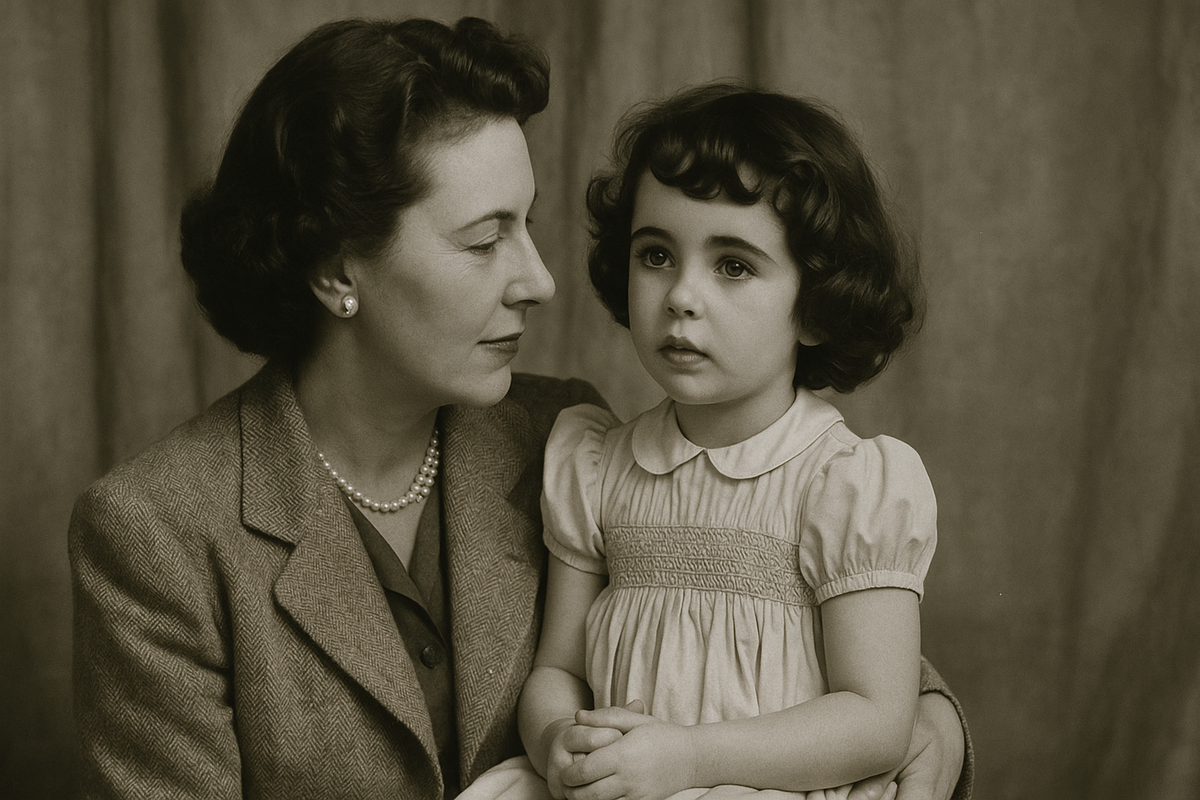
The Violet-Eyed Child
When Elizabeth Taylor's Mother Told Her Story
In February 1954, a Hollywood star's mother did something almost unthinkable: she told the truth.
Sara Sothern Taylor had watched her daughter become one of the most photographed faces in America. She'd seen Elizabeth transform from the plucky girl in National Velvet into a woman whose beauty seemed to justify every superlative the studios invented. But when Ladies' Home Journal asked Sara to write about her daughter, she didn't deliver press-agent copy. She wrote about praying over a newborn's features. About hospital nurses who stopped mid-shift to stare at a baby's eyes. About the quiet terror of wondering if beauty would arrive in harmony—or in awkwardness.
"Elizabeth, My Daughter" wasn't celebrity journalism. It was a mother's confession, printed between dishwasher advertisements and casserole recipes.
Archive Details
Historical Figure: Sara Sothern Taylor (Elizabeth Taylor's mother)
Publication: Ladies' Home Journal
Issue Date: February 1954
Article Title: "Elizabeth, My Daughter"
Archive Source: Original mid-century women's magazine collection
When Motherhood Met Stardom
By 1954, postwar America had built an entire architecture around domestic contentment. Suburban homes rose like cathedrals to family life. Ladies' Home Journal served as the hymnal, teaching women how to bake, decorate, and navigate the unspoken pressures of being both nurturing and modern. The magazine didn't traffic in scandal—it offered trusted guidance, wrapped in aspirational storytelling.
So when the Journal featured Elizabeth Taylor, it didn't put her on the cover in diamonds and décolletage. It gave readers Sara Taylor's voice: vulnerable, specific, unmistakably maternal. She described cradling her newborn in a London hospital, silently bargaining with God. She remembered seaside trips in caravans, the hunt for their first real home in Hampstead, the ordinary textures of family life before Hollywood swallowed them whole.
The nurses had marveled at Elizabeth's "deep pools of violet blue eyes"—a detail Sara recalled with the precision of someone who understood she'd witnessed something rare. Not just beauty, but a kind of destiny encoded in color.
Readers learned that Elizabeth's rise wasn't accidental. Sara admitted feeling as though "the whole world seemed bent on making Elizabeth beautiful." It was half-prayer, half-prophecy, and it landed in American kitchens alongside recipes and household tips as if glamour and domesticity occupied the same moral universe.
They did, in 1954. The Journal made certain of it.
The Architecture of Influence
Ladies' Home Journal didn't just report on American womanhood—it constructed it. The magazine blended fiction, homemaking advice, cultural commentary, and celebrity profiles into a single editorial vision. When Sara Taylor's essay appeared, it wasn't sensationalism. It was framed as maternal wisdom, the kind the Journal's readers trusted because it came from one of their own: a mother who worried, hoped, and watched her child grow.
This was the magazine's genius. It reframed celebrity not as escapism but as extension—proof that even the extraordinary began in ordinary moments. Elizabeth Taylor had once played in English sand, eaten family dinners, lived in caravans. Her mother had prayed the same prayers every mother knows.
The Journal understood that its readers didn't want distance from Hollywood. They wanted intimacy with it. Sara's essay delivered both.
What Sara Told Them
The essay's power lay in its specificity. Sara didn't generalize about motherhood or beauty. She named moments:
The Silent Prayer
Sara's candid recollection of asking God to let her child's beauty arrive in harmony, not awkwardness—a vulnerability every mother understands.
The Violet Eyes
Hospital staff stopped their rounds to marvel at the infant's "deep pools of violet blue eyes"—a feature that would become cinema's most famous trademark.
English Domesticity
Caravan trips, seaside visits, the search for a home in Hampstead—the ordinary texture of life before Hollywood fame.
A Sense of Destiny
Sara's eerie awareness that "the whole world seemed bent on making Elizabeth beautiful"—prophecy disguised as maternal observation.
These weren't publicity flourishes. They were the granular details of memory, offered without apology or spin. Sara wrote like someone who understood her daughter's life had already passed into mythology, but who insisted on preserving the human scale of it.
Placed against advertisements for KitchenAid dishwashers and modern conveniences, the essay performed a cultural trick: it suggested that motherhood, whether it produced a Hollywood star or a teacher or a homemaker, carried the same emotional weight. Every child was a prayer. Every mother, a witness to potential.
The Artifact We Inherit
Reading Sara Taylor's essay now is like opening a capsule from a moment when celebrity still required justification through domesticity, when even stars needed to prove they'd been children once. The Journal gave Sara a platform to humanize her daughter—but also to claim her, to insist that Elizabeth belonged to a family before she belonged to the public.
That tension, between the intimate and the iconic, is what makes this issue matter beyond nostalgia. It shows how motherhood was narrativized in postwar America, how fame was domesticated, how women's magazines taught readers to see themselves in extraordinary lives.
Sara's voice—honest, specific, tender—cuts through the decades. She wasn't selling a fantasy. She was describing what it felt like to raise a daughter whose beauty seemed like a force outside maternal control, whose destiny announced itself in a hospital ward, whose life would become public property.
Every mother knows that feeling, in some measure. Sara just lived the extreme version.
For the Collector
Unique Perspective
Few primary sources capture Elizabeth Taylor's childhood from her mother's point of view—making this a rare biographical document.
Historical Timing
Published during Elizabeth's transition from child actress to adult star, freezing a pivotal moment in Hollywood history.
Cultural Significance
Demonstrates how mid-century women's magazines mediated between private motherhood and public celebrity.
Advertising History
The accompanying KitchenAid and household product advertisements reveal postwar domestic ideals and consumer culture.
Original Documentation
Sara Taylor's own words, unfiltered by studio publicity—a maternal confession printed in America's most trusted women's magazine.
Archive Quality
Mid-century Ladies' Home Journal issues are treasured for their blend of literature, lifestyle, and social history.
Own a Piece of Hollywood History
The February 1954 Ladies' Home Journal isn't a reprint or digital scan—it's an original issue, preserved from the era when Sara Taylor told the world about her violet-eyed child.
Browse Ladies' Home Journal Magazine Collection